









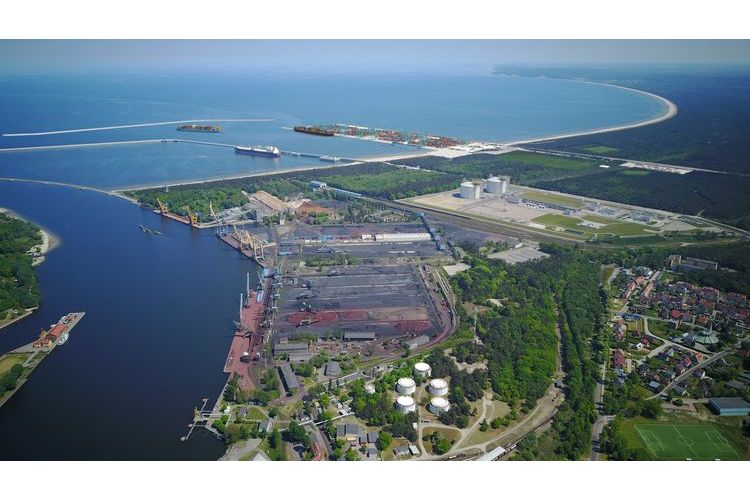
Combining water, rail, and road transport provides a synergy effect and enables meeting customer expectations while maintaining high care for the natural environment. In the case of the container terminal in Świnoujście, intermodal transport will be the type of transport that primarily connects the terminal with its hinterland.
– Intermodality of transport in the concept of the deep-water container terminal in Świnoujście is something obvious – admits Krzysztof Urbaś, President of the Szczecin and Świnoujście Seaports Authority. – We are closely observing the transport market, legislative changes, dynamics, and analyzing market trends. We are aware that intermodal transport is the future and a necessity. We are also aware of how important ecological aspects are. That is why we are focusing on infrastructure investments today, so that when the terminal is launched, we can use the full chain of the most ecological intermodal transport. Therefore, we are adapting the infrastructure of the ferry terminal in Świnoujście to handle intermodal transport. The ferry terminal is located in the immediate vicinity of the future container terminal and will offer such functions as early as next year.
Intermodal trends and ecology
In global maritime transport, changes are dynamic; there has been, among other things, a significant increase in the size of ships, meaning larger one-time batches of containers handled in ports, and we are also observing the growing importance of intermodal transport chains. Containers reach ports via oceanic routes, are then loaded onto rail trains, and then onto trucks – to reach the final recipients.
The use of intermodal transport is an excellent solution used in the sea-land supply chain: environmentally friendly, cost-effective, and helping to reduce road traffic. Road regulations regarding cargo transported in the intermodal system allow for a greater total vehicle weight on the “last mile” section, which allows for intermodal deliveries of cargo units with greater weight than is possible on the entire route in road transport. The container terminal in Świnoujście also offers the possibility of using inland waterway transport, which is the cheapest and most eco-friendly method of transport. The planned revitalization of the Oder Waterway is an opportunity for the rebirth of this branch of transport in deliveries between the seaport and destinations in its hinterland. The terminal in Świnoujście, with convenient access to the Oder Waterway, an international railway line, and an efficient road connection, offers a chance to effectively combine all available branches of transport.
Rail chain
As part of the mentioned investments, which are part of the intermodal transport project, PKP Polskie Linie Kolejowe is improving and modernizing port infrastructure in Szczecin and Świnoujście for PLN 1.5 billion. They will modernize nearly 100 kilometers of tracks and almost 84 kilometers of the overhead contact line. They will replace as many as 285 turnouts, install modern railway traffic control devices, and rebuild 22 road crossings. In Szczecin, they will also rebuild the bridge over the Parnica River and 3 railway viaducts. The completion of the work is scheduled for mid-2022.
Another investment by PKP Polskie Linie Kolejowe will be the modernization of the CE 59 railway line (the so-called Nadodrzanka), connecting Świnoujście with Lower Silesia and the Czech Republic, which constitutes a connection between ports and Central and Southern Europe. The investor will adapt the tracks for longer and heavier trains and speeds of up to 120 km/h.
Road chain
The Szczecin-Świnoujście ports are connected to the European motorway system via the A11 and A20, while the S3 expressway (E65) will connect Świnoujście with the Czech border as early as 2024.
Inland waterway chain
Next year, the Maritime Office in Szczecin will finish deepening the Świnoujście-Szczecin fairway to 12.5 m. The modernization will cost PLN 1.4 billion. The investment is very important in the context of the water transport chain. In accordance with the government’s strategy for restoring the navigability of Polish rivers, the Oder Waterway (E30), included in the AGN Convention as a waterway of international importance, will be gradually modernized in the long term.
Source: Szczecin and Świnoujście Seaports Authority