









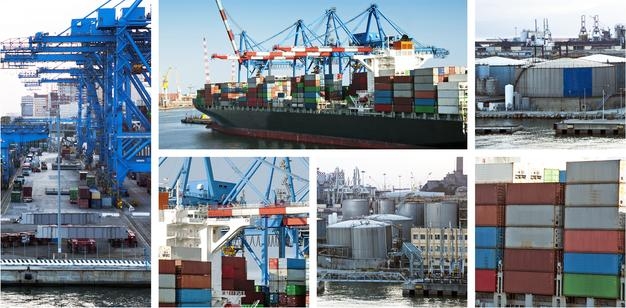
Abstract: The importance of inland waterway transport in container shipping in Western European countries is discussed. The share of this transport is significant, especially in the Rhine transport corridor. This is a result of the significant share of container transport in total transport performance. Against this background, container transport in Poland differs significantly from the situation in the countries of the old EU. In Poland, inland waterway transport does not participate in container transport. However, it has been shown that it can be competitive with rail transport in the Oder transport corridor, despite the existing limitations on this waterway.
Inland waterway transport, alongside road and rail transport, is one of the transport systems that plays a significant role in fulfilling the transport tasks of a country or region. Due to its widely known advantages, inland waterway transport is generally preferred in transport development strategies. This applies particularly to EU countries. Examples of this include the White Paper, as well as subsequent EU documents (NAIADES – Navigation And Inland Waterway Action and Development in Europe).
Historically, inland waterway transport was considered a particularly favorable system for transporting bulk cargo. Bulk cargo continues to dominate the transport structure on the Rhine. More than 50% of cargo consists of aggregates and building materials, coal, as well as crude oil and oil refining products. The development of new energy-efficient industries has reduced the demand for bulk cargo transport. It can be assumed that the share of these cargoes has stabilized and will not show an upward trend. For many years, the share of processed goods transport has been increasing in total transport performance. This type of cargo is characterized by the fact that it is advantageous to transport it in integrated cargo units.
The most widespread such unit in the world is the container. Container transport is the foundation of intermodal transport. This is a result of the dominance of maritime transport in total container transport. Currently, on many important maritime transport routes, the carriage of general cargo takes place almost entirely in containers. European ports between Le Havre and Hamburg handled 509 million tons of general cargo in 2008, of which 410 million tons were in containers. This accounts for 81% of the total mass of general cargo. In 2007, this share was 79%. In ARA ports, this share is between 81 and 85%. (…)
The article contains 20,665 characters.
Source: Logistyka Magazine
Conditions for container transport on the Oder River – PDF file for download