








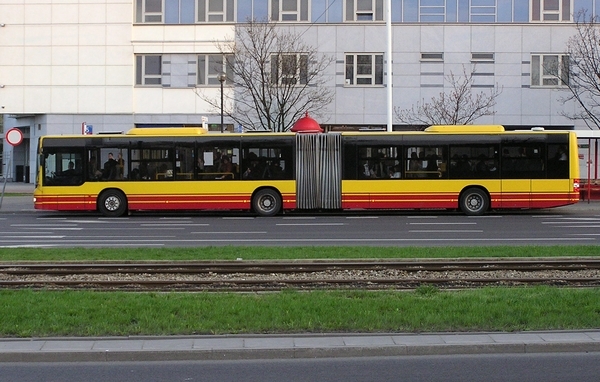
Urban transport, also known as public transport, is used for the movement of people in urbanized areas within cities. In economic practice, the term urban transport can be defined as regular public collective transport provided on behalf of a local government transport organizer. The organizer of urban transport undertakes much broader activities than the organization of the passenger transport process itself. It also deals with, among other things, fleet maintenance, infrastructure management, providing passenger information, etc.
The most commonly used means of collective transport are buses. Their popularity stems from the fact that they use generally accessible road infrastructure. Elements of urban transport infrastructure include routes, stops, transfer hubs, depots, and all equipment used to serve passengers (including ticket machines, passenger information systems, etc.). Technical solutions for the design of bus stops depend on the road class, the number of traffic lanes on the carriageway, and the intensity of car, bus, and passenger traffic. The average distance between bus stops in Poland is 0.4-0.6 km. A shorter distance between stops is possible for “on-demand” stops. Around the world, bus-based public transport systems are organized in very different ways. For example, in some cities, “on-demand” stops do not function at all, in some they are an addition to the transport network, while in some cities, optional stops are the basis of the public transport network.
The purpose of this article is to compare the organization of bus-based public transport in various cities around the world and in Poland, and to determine the role that “on-demand” stops play in different transport networks.
Research material and methods
The methods used for data collection were literature review and documentary analysis. As part of the research, data on public transport in 27 selected cities around the world and 15 cities in Poland were obtained. The source material consisted of studies and reports on public transport worldwide and in Poland, data available on the internet, and information obtained through email contacts with representatives of various foreign institutions involved in the organization of public transport in individual agglomerations. In terms of processing and presenting the research results, the tabular method, comparative analysis method, and descriptive method were used. (…)
The article contains 23,295 characters.
Source: Logistyka Magazine 6/2012