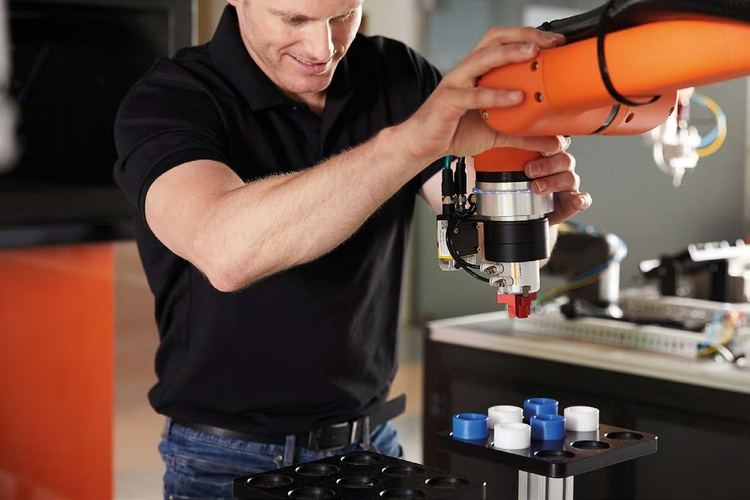
Cobots are easy to program and flexible in a changing production layout, effectively reducing investment and operating costs. As a result, they not only automate manual labor but also provide employees with a safe and comfortable working environment.
Robotization is currently developing very dynamically. According to data from the IFR (International Federation of Robotics), the number of collaborative robots, or cobots, is increasing by 23% annually. Another important indicator is the density of robotization, expressed as the number of robots per 10,000 employees. Asian countries are the clear leaders here: Singapore has the highest robotization density with 831 robots per 10,000 employees, followed by South Korea with 774 robots. Among European countries, Germany stands out with 338 robots. Poland occupies a distant position with 42 robots, but it is positive that just a year earlier it was only 36 robots. Historically, robotization began in the automotive industry in the 1960s. To this day, it remains the most heavily robotized industry. Currently, robotics is also intensively appearing in other industries where repetitive and precise human hand movements are needed. Looking at robotization by industry, production processes are most often automated in the automotive, pharmaceutical, cosmetic, furniture, electronic, home appliance/consumer electronics, metalworking, plastics processing, and research sectors. Today, robotic applications using cobots allow for easy and fast palletizing, packaging, assembly, machine tending (CNC, presses, injection molding machines, etc.), finishing operations, testing and quality control, screwing, riveting, polishing, painting, and gluing. I would say that the technology available today allows for the robotization of almost any activity.
Collaborative robots, or cobots, play a special role in the dynamic robotization of industry. Collaborative robots have become popular for several reasons. Firstly, their ease of programming is comparable to using a smartphone. After an hour of training, we can program basic applications ourselves, and consequently, we have the ability to robotize even short- and medium-series production. Secondly, flexibility, which results from the possibility of using them in almost any application. Added to this is the ability to move them quickly between workstations on mobile bases. Thirdly, safe work alongside an operator, without expensive fencing and the need to build foundations. Fourthly, 100% repeatable quality, and in the case of industrial collaborative robots, the ability to work at full speed 24 hours a day. As a result, we get an easy, fast, precise, and efficient tool that pays for itself after just 6 months. It is hard to find a better investment. I think this is the key to efficient production in applications such as: machine tending (CNC, presses, injection molding machines) and production lines, packaging, screwing, testing and inspection, palletizing, welding, polishing, gluing, painting, and many others where a robotic arm precisely performs its tasks 24 hours a day.

One of the most frequently automated processes is palletizing. This is a monotonous process that involves long-term movement of significant weights in non-ergonomic positions. Robotizing this process using a cobot is relatively simple. It is enough to choose the right vacuum gripper, e.g., CoGRIP, which is mounted in a Plug’n’Play system on HCR robots. Then we set the robot at the end of the line, showing the place from which it will pick up the load. In the next part, we show the corners of the pallet and enter the dimensions of the cartons and their number along and across the layer. Finally, we just set the number of layers and the robot can work. Of course, to increase operational certainty, we can connect a photocell at the end of the line that will signal that the goods are on the line to be picked up. Many companies report that manual palletizing involves stacking cartons weighing about 70-80 tons daily, which is, unfortunately, a harmful factor for working people. Cobots are an excellent tool for fast robotization of palletizing at the end of the line.
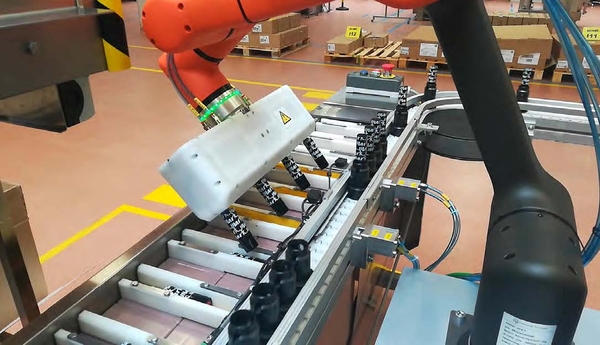
Another eagerly automated process in which cobots perform perfectly is the operation of machines, lines, and production cells. This is a monotonous task requiring precision. To robotize machine tending, one should choose a robot with the appropriate reach and payload. Then, it is necessary to calculate what buffer is needed for raw materials and finished products. The size of this buffer will determine how often operator intervention will be necessary to replenish raw materials and collect finished products. Programming consists of showing the location of the machine cell and the places with raw material and finished product. Additionally, we can easily connect the machine’s control signals to the inputs and outputs in the HCR robot controller so that the robot can initiate the work cycle after loading. To optimize efficiency, it is reasonable to use a double gripper, which picks up the finished product with one side and holds the raw material in the other part, loading it for the next machining cycle. As an example, I can cite a company from southern Poland that carries out long-term orders for the aviation sector in the field of contract production of aluminum components on CNC machines. This company has several highly specialized CNC machines. Unfortunately, it is increasingly difficult for them to staff the night shift. Similarly on days off and holidays. This enterprise decided to invest in HCR robots, ROBOTIQ grippers, training, and implementation assistance. Thanks to this approach, the company built internal competencies for programming robots, and every loading and unloading of a CNC machine for any new product is implemented within a few minutes. After introducing HCR robots, CNC machines can work 24 hours a day, and only one person is needed to operate them, who deals with replenishing material feeders and collecting pallets with finished products.
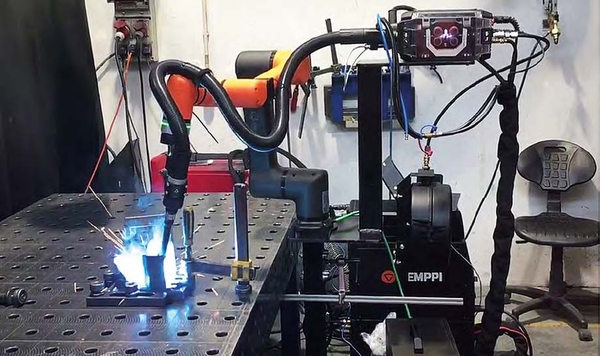
Another process worth discussing is welding. This is a process associated with working in difficult conditions, where the welder’s efficiency decreases with every hour of work. And special caution and accuracy must be maintained here so that the welds are made precisely. EasyWelder, based on the HCR collaborative robot, comes to the rescue here. Thanks to the use of a cobot, movements can be programmed in an easy and simple way by showing several points between which the weld is to be made. Additionally, for each weld, we set the technology from a library of ready-made settings; we can also enter our own settings. Welding programming is fast and easy – we select the appropriate icons and guide the arm in teaching mode from point to point. As a result, we get an efficient tool ensuring 100% repeatable welds. All this makes welding robotization one of the most frequently chosen applications for cobots. Especially considering the ease and speed of implementation in the face of the limited number of welders in Poland.
I often encounter questions about which cobot to choose. There are many different cobots on the market that fulfill their functions quite similarly. However, one should pay attention to important details that are of great importance in daily operation, such as:
– Payload and reach. It is worth assuming that the cobot may work on a different application tomorrow, and if we have the opportunity to choose a cobot with better parameters, it is worth keeping this in mind.
– Manufacturer – the technological potential of the supplier is a key issue. It is worth betting on proven and serious suppliers who will offer a guarantee of equipment development, service, and software updates for years to come.
– Fully metal housing, ensuring work in difficult conditions 24 hours a day, with a protection rating of at least IP54, and in the case of laboratory applications – a Cleanroom certificate.
– Number of inputs and outputs, both in the controller and in the robot’s wrist. A larger number of interfaces allows for connecting many different accessories.
– Technical support provided by a given product, e.g., training, service.
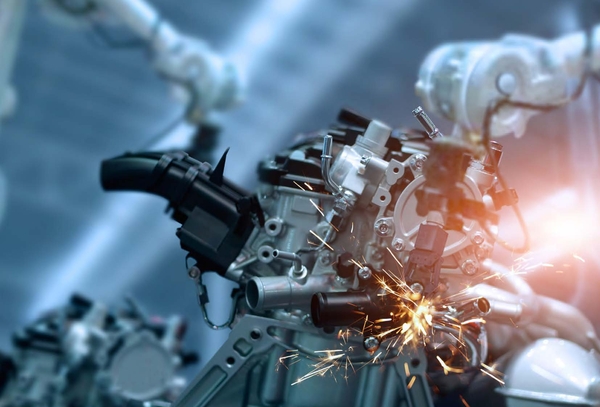
Observing today’s cobot functions, it should be kept in mind that manufacturers have not yet said the last word. Many phases of development of these devices are still ahead of us. The most important of these include increasing operating parameters, especially work speed, while maintaining safe interaction with humans. Thanks to this, it will become possible to use cobots in places with even shorter cycle times, and at the same time in factories where the layout of the production space does not allow for the use of traditional industrial robots.
Another direction for the development of cobots will certainly be better interaction with the environment and gathering knowledge from the processes performed. The dynamic development of vision systems, safety scanners, force sensors, but also communication between cobots themselves within the factory comes to the rescue here. Thanks to increasingly intelligent sensing and communication, the cobot will be able to position itself precisely and see all changes in its environment. There will be no problem if an unauthorized person enters. Today, zone violation triggers a specific action. In the near future, the robot will assess the type of movement and human behavior in its environment. Based on this, it will make optimal decisions to, on the one hand, maintain safety, and on the other – not stop the production process. The same will be true if an element on the conveyor belt arrives poorly positioned or is incomplete. The robot, having experience from previous cycles and operations, will be able to adapt to differently arranged elements or notify the staff that an error has occurred.
Another advantage resulting from increasingly efficient and intelligent software and hardware will be the possibility for the robot to automatically find itself in space. There will no longer be a need for precise positioning of elements at the workstation – the cobot will work like a human, independently making adjustments for dynamic changes in the environment.
I observe that the process of robotization is constantly accelerating. Firstly, demographics – not only in Poland but also globally. According to GUS data, by 2030, the number of professionally active people in Poland will decrease by 20%. This means wage growth and a drastic drop in the availability of the workforce. Companies that do not robotize will lose competitiveness. On the other hand, the McKinsey report “Side by side with a robot” from 2018 shows that there is potential for robotization in Poland: 49% of operations are currently performed manually, which translates into the automation of 7.3 million jobs. The same report predicts that with widespread robotization, we can achieve an additional 15% GDP growth. Thanks to widespread automation, new jobs will be created, and employees will upgrade their skills. We are currently observing increased interest from entrepreneurs in robots.
It is worth mentioning an example where we recently implemented a collaborative robot for palletizing. On one hand, the company was struggling with a lack of hands to work, and on the other, no one wanted to lift heavy loads for 8 hours of work. It turned out that during 24 hours of work, people were reloading almost 80 tons of products. This is definitely monotonous and harmful work that is worth giving to robots. This plant works 24 hours, 7 days a week, thanks to which it recovered 4 full-time positions for work with higher added value.
The article comes from the magazine LOGISTYKA 1/2020.
The e-edition of the magazine is available in our offer!
Stay up to date, subscribe to the LOGISTYKA magazine!