








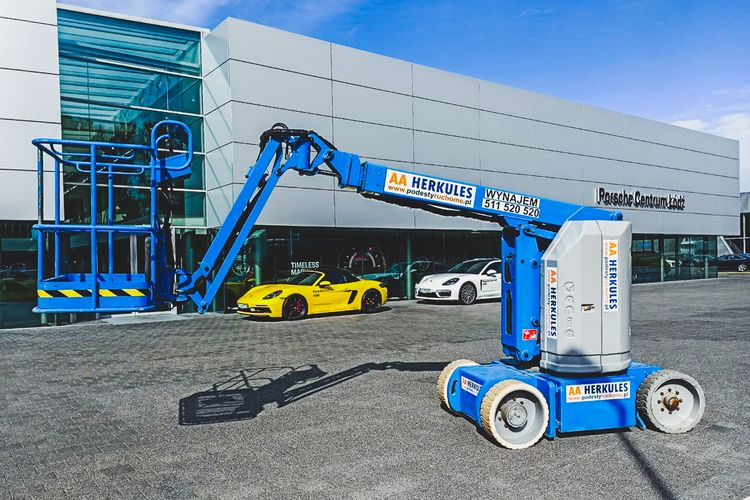
Close-range transport equipment is an essential part of the equipment of almost every industrial plant, and increasingly also of construction sites. They ensure the safe movement of loads and people in a small area. The equipment requires specialized supervision, and its operation is possible only by authorized operators. Employees of the rental department of the industry leader, AA HERKULES, will point out the possibilities and applications of aerial work platforms, which belong to the category of lifting equipment.
Classification of aerial work platforms/mobile elevating work platforms in the group of lifting equipment and close-range transport devices and their division
Close-range/internal transport equipment (UTB) is a very broad and diverse range of machines, in which 2 main groups can be distinguished – these are lifting devices (cranes/hoists) and transport devices (trucks and conveyors). Due to their design and purpose, aerial work platforms and mobile elevating work platforms are classified as lifting equipment. The group of mobile elevating work platforms itself can be divided into machines: self-propelled (integrated with a vehicle chassis), mobile (having their own drive), and transportable (on trailers).
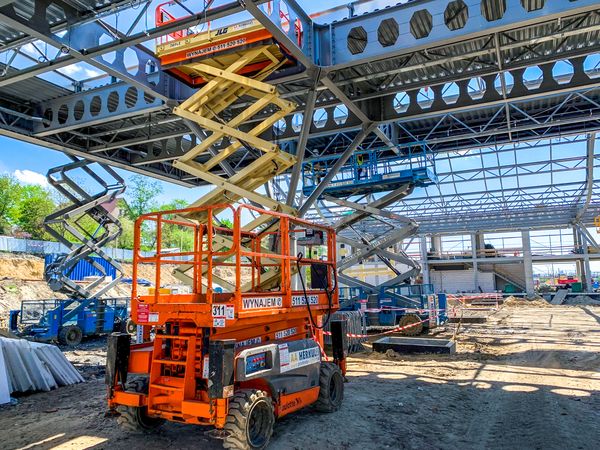
Where can self-propelled lifts be used?
The main purpose of aerial work platforms is high-altitude work performed in various conditions. Self-propelled lifts have many applications. They can be found in factories, warehouses, commercial facilities, and public spaces. Thanks to zero emissions, electric lifts are used in indoor spaces, while combustion models ensure the possibility of multi-hour work outside buildings, including on unpaved ground.
Types and logistical capabilities of specific lift models
In addition to the drive version, mobile elevating work platform models are also differentiated in terms of design. Thanks to the diversity in terms of construction, the machines provide different properties, i.e., lifting height, lateral outreach, maximum load capacity, and maximum permissible number of people in the basket. Taking into account the logistical capabilities of specific models, we distinguish:
– scissor lifts; they provide a vertical lifting direction (up-down), without the possibility of achieving long lateral reaches. They are distinguished by the highest load capacity, up to 1034 kg, which allows up to 7 people to work on the platform simultaneously. The highest models allow transporting workers to a height of up to 18.5 m.
– telescopic-articulated lifts; thanks to the basket mounted on an articulated arm and a rotating body, they provide the possibility of transport in any direction (360-degree rotation). Models with a telescopic design provide the possibility of lifting both in the up-down direction and in the lateral direction. The lateral direction is particularly important when work needs to be done over subsequent obstacles (it is not possible to drive directly under the workplace). The maximum height to which they can transport people is as much as 25.6 m, while the lateral outreach is 16.2 m. The load capacity is a maximum of 250 kg, which translates into 2 people in the basket at the same time.
– mast lifts, provide the possibility of transporting people and working at a height of up to 12.5 m, load capacity up to 200 kg, and lateral outreach up to 6 m. The models are distinguished by compact dimensions and low weight, thanks to which they fit through doors and can be transported in elevators. Mast lifts are used in narrow rooms, corridors, and communication routes.
– spider lifts; they constitute the most specialized group. In terms of transport, they provide properties similar to telescopic lifts with joints (load capacity up to 200 kg, maximum working height is 23 m, lateral outreach is 11.2 m) – however, they differ in widely spread out supports and drive, where tracks are used instead of wheels. The supports allowed for a significant reduction in weight, thanks to which tracked lifts provide transport to the greatest heights in relation to the total weight of the machine. Tracks adjustable in terms of height and width allow for driving along inclined surfaces (no other lift offers such a possibility).
Lifts are used for transport in many situations
Bearing in mind the specific applications of lifts, they most often transport people in the case of all assembly, service, maintenance, and inspection works, e.g., for air conditioning/ventilation, steel structures (halls, overhead cranes), ICT/fiber optic networks, alarms and monitoring systems, production lines (from bakeries, through glue manufacturers, to the automotive industry), facade works, and roofing works. Lifts are also used for safety audits/assessments and fire safety inspections.
Self-propelled lifts can be used in many industries – from the obvious, i.e., the broadly understood industrial sector, construction industry, in commercial facilities, at airports, railway stations, to the unusual, such as professional sessions in photo studios, preparation of scenography on a film set, or realization of video material at a concert (creativity and customer needs are sometimes so unobvious that they surprise us despite our dozen or so years of experience in rental).
Help in choosing a lift and promotional rental prices
Aerial work platforms are close-range transport devices used more and more commonly, as evidenced by the constantly growing number of inquiries about equipment rental. Caring for the safety and comfort of employees, it is worth remembering the possibility of using them in case of the need for transport and performing any work at height. As a rental company, we encourage you to take advantage of our offer of renting lifts at attractive prices. In case of the need to select a machine for your needs, our specialists provide professional advice and support. All information about services and the offer is available on our company website: https://www.wypozyczalniapodnosnikow.pl/. We also encourage you to contact us directly by phone at: +48 511 520 520.