In search of a competitive advantage, more and more retail chains are pinning high hopes on the “click & collect” service. In this distribution model, retail chains see an opportunity to promote their own brand and, consequently, build customer loyalty. An additional impulse for retail is the possibility of testing and utilizing new technologies. This popular service is also an excellent tool for predicting purchasing preferences and studying what we call the “shopping experience”. From a business model perspective, it is a source of omnichannel retail development; from a technology perspective, it is a sophisticated IT solution, additionally “wrapped” in analytical tools. Moreover, it opens up new perspectives for the development of automation.
“Click & collect” – “click”, meaning place an order, and “collect”, is more of a marketing slogan than a service name. More precise terms are (most commonly used in reports and analyses) BOPIS (Buy Online – Pick up In Store) and BOPIL (Buy Online – Pick up In Locker), because – apart from the obvious fact of purchasing online – they emphasize self-collection in a store or at a parcel locker, which is the essence of this service.
In the era of online shopping, we forget that the popular “click & collect” service also has non-commercial applications. More and more university libraries around the world allow readers to collect books (ordered/reserved electronically) using a special terminal. In this case, an adequate name and at the same time an encouraging recommendation for this convenient option would be: “click, collect … and read”.
The attractiveness of shopping in the “click & collect” model for customers is obvious. Although there are certain limitations, such as access to the chain chosen by the customer and the assortment it offers, or the possibility of collection only during store opening hours. Of course, these do not have to be factors discouraging the use of the service itself. There are many more stimuli and benefits to using it. According to Boniversum research from 2018, 55 percent of surveyed customers in Germany point to savings on shipping costs, 48 percent to collection while doing other shopping, 44 percent value the flexibility of collection, and 34 percent appreciate the possibility of making a free return in the store. The recognition of the service is noteworthy – as many as 60% of respondents have used “click & collect”, ordering goods at least once. What is a simple activity and a life convenience for customers involves various challenges for retailers operating in the “click & collect” model. According to research published by Invesp, 45.6 percent of stores point to problems with logistics and inventory management, far fewer, at 22 percent, to staff training, 16 percent to ensuring transaction security, and only 6 percent to return on investment (ROI).
There are many indications that the propensity of retailers to make decisions about implementing this model will continue to grow, which is confirmed by Invesp research. It turns out that for 33 percent of respondents, the impulse is to maintain competitiveness, while 34 percent intend to acquire customers who do other shopping this way.
According to Order Dynamics research from 2019, the “click & collect” service is most popular in the UK, where as many as 64 percent of stores offer it, in France – 43 percent, and in Germany and Austria (combined) – 50 percent. Experts point to a clear difference between the European and American markets. It turns out that in the USA, only about 30 percent of retailers offer shopping in this model.
Selected examples
Stores generally post a precise description of the service on their website, indicating, among other things, the lead time, the method of informing about the shipment status, the storage time of the ordered goods ready for collection, and the resolution of specific problems, such as collection by a third party or cancellation/resignation from collection. “Click & collect” is already a “standard” in the clothing industry, but it is enjoying increasing interest from the food and cosmetics industry, which may bring significant changes to these retail segments. The German drugstore chain DM tested it in the autumn of 2019 in 54 stores in Munich. By the beginning of June this year, and thus at a record pace, it expanded its scope to the entire country, including as many as 2,000 stores in the system. Was the pandemic the impulse for such a rapid implementation of the solution on such a large scale? One can guess that to some extent, yes. For registered customers, the service is free; others must count on an additional fee (approx. 3 euros). The buyer can choose any DM store in any location – preparation (completion) of the order takes 6 hours. The REWE Group conducted a pilot of its solution back in 2016. In the case of this chain, the customer receives the completed goods ready for collection 3 hours after placing the order via a special application.
Also in our country, we have observed an acceleration in this area over the last year. An example is Auchan, which in mid-July launched the possibility of collecting goods ordered online at the chain’s stores in several cities (customers can choose from 6,000 products). Since August – on a large scale – a similar service for food products has been offered by Carrefour (since 2017, the offer in the “click & collect” model included only non-food products) – individual collection of goods ordered in the e-store is possible at 200 of the chain’s locations.
The present – semi-automatic self-service systems
Parcel lockers, which have been appearing for several years, have become a permanent part of the city landscape, just like ATMs did many years ago. The service is offered by CEP operators, so – after all – intermediaries. Now it is the turn of retailers’ proprietary solutions, who in the stores themselves or on open areas adjacent to the stores – using the scale effect – utilize the potential of their own networks – they complete the ordered items (in a physical sense, because the customer places them in a virtual basket) and prepare them for direct collection. In most cases, the goods pass through the checkout. Although special checkout stands dedicated to this purpose are installed in some points of sale, which significantly speeds up this stage of the customer service process. But the potential of this solution is not exhausted by the possibility of collection at the checkout. This is just the beginning. Certainly, an important step into the future of retail is the possibility of collecting goods in the store in special parcel lockers. In recent months, Castorama operating in Poland (as the first in the Kingfisher Group) installed the first so-called “castomat” in Warsaw, and this fact resonated in specialized media abroad. As we learn from the press release, Castorama guarantees 24/7 access to the device. The very fast reaction of the chain is noteworthy – the goods are to be ready for collection within just 2 hours of placing the order. It is to be hoped that the service will also be available in other cities, which will increase the safety of shopping in times of a pandemic. Will other retail chains follow in Castorama’s footsteps? It seems that implementing such solutions will be a source of competitive advantage for them, which are an attractive shopping option for customers.
The future – automatic self-service systems
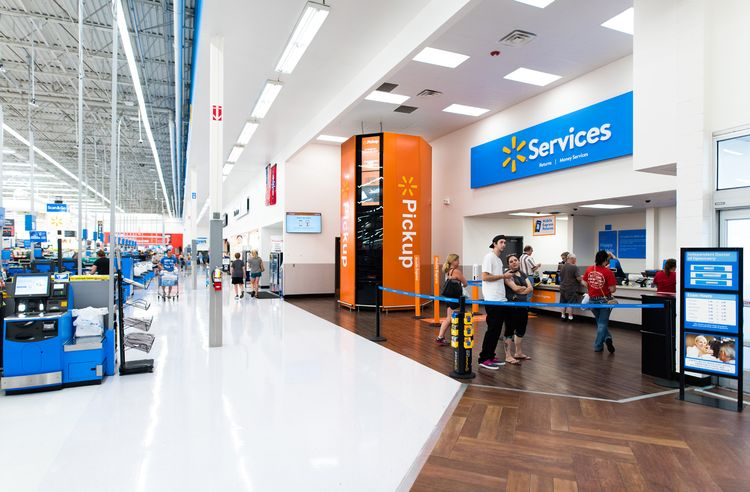
A breakthrough, especially in the technological dimension, also testifying to the evolution of the “click & collect” model and the possibilities of using new solutions based on automation, may turn out to be the popularization of fully automatic self-service systems. What distinguishes them from “traditional” lockers is precisely the automation of not only the collection itself but also the entire warehouse service process. In the parcel lockers we encounter today, the completed goods are placed by a store employee (or courier) in a specific dedicated locker. In the case of devices such as the Cleveron 401 Pick Up Tower from the Estonian company Cleveron, packages are delivered by a human, but the entire process of moving and dispensing them takes place automatically, using internal transport devices. Thanks to such a system configuration, the device is in reality an automatic “micro-warehouse”. In the case of the Cleveron 401, the parcel locker has the shape of a 5m high tower, the capacity of which allows for placing up to 500 packages (depending on size) weighing up to 25 kg. Packages – using special conveyors – are placed on shelves at different heights and then addressed to the collection station with a terminal. The time for direct dispensing of the shipment to a customer waiting at the console declared by the manufacturer is on average 12 seconds (during this time, the package must reach the terminal from the appropriate shelf). In the case of the discussed solution, the innovation is certainly the automatic measurement of the package height, which is only placed on the appropriate shelf after its completion. An innovative solution in the area of “click & collect” was the automatic shipment collection station developed as early as 2003 by the Fraunhofer Institute IML under the name “Tower 24” (which indicated 24-hour operation). The 10m high tower (of which 4m was underground) with a capacity allowing for 400 containers with a diverse assortment was installed on the premises of the University of Dortmund. “Tower 24” was intended for temporary storage and collection primarily of food products requiring controlled temperature. Market leaders were involved in the venture: SSI Schäfer Noell (as the equipment manufacturer) and the Hermes company (as a CEP operator). Unfortunately, the solution – from a commercial perspective – turned out to be a false start; it appeared at a time when e-commerce was only “crawling”, and retail was not prepared to implement such a useful solution on a wider scale today. A spectacular venture was the pilot implementation of the device by the Walmart chain in 2016. At the end of 2019, there were already 1,600 Cleveron collection stations in the USA. Another important player that decided on such a solution was the British supermarket chain ASDA, choosing the famous Trafford Park in Manchester as the location for the first Cleveron 401 installation. The system was also implemented by Inditex; in this case, an even faster and more efficient Cleveron 402 parcel locker was installed in one of the Zara salons (the difference is that in the Zara salon, the device is built into the wall, so the buyer only sees the console with a screen).
To sum up, the value of a fully automatic solution – from the store’s point of view – is the elimination of the need to store packages in the store itself (most often in the counter area) and thus the manual handling of each transaction at the checkout stand. An obvious advantage for the customer is that they do not have to wait in line for the goods to be dispensed.
The article comes from the magazine Logistyka 5/2020.
The e-edition of the magazine is available in our offer!