After a year of cooperation within the Lean&Green program, three giants: CHEP, Unilever, and Biedronka have presented their business and environmental achievements.
In the face of progressing climate change, many companies around the world are taking steps to reduce CO2 emissions in a verifiable and systematically analyzed manner. This is also the goal of the Lean&Green program, which brings together over 600 companies in 14 countries across Europe – to build a platform for cooperation, to evaluate, analyze, and reward the pro-ecological actions of its members based on systematized and transparent criteria.
Logistics solutions provider CHEP, together with the Biedronka chain – the largest retail company in the country, and Unilever – a global FMCG sector giant, as members and the first participants of the program in Poland, presented the results of their annual cooperation within Lean&Green.
The starting point for the cooperation was defining synergies in the partners’ distribution networks. Thanks to a comprehensive analysis of data on millions of pallet movements across Poland, CHEP optimizes, shortens, and proposes the sharing of transport routes between entities. Companies can also plan for the full utilization of cargo space in delivery vehicles – without “empty runs” and wasted space. Reducing excess kilometers directly translates into reduced CO2 emissions and is an excellent example of reconciling pro-ecological solutions with business profitability.
The vision of a sustainable lifestyle for everyone, promoted by Unilever, determines a series of actions to reduce CO2 emissions. Comparing 2020 and 2021, the company achieved a 15 percent reduction in the distribution area. Within the scope of cooperation with CHEP alone (using shared service centers, pallet pooling), Unilever reduced carbon dioxide emissions by 2,462,013 kg, saving 14,000 excess kilometers.
– For our company, the program means new opportunities for cooperation with partners – says Jerzy Glinkowski, Head of Supply Chain Poland and Baltics, Unilever. – Through joint initiatives, we are able to meet consumer expectations regarding the greatest possible reduction of the final product’s carbon footprint. Actions aimed at a significant reduction of CO2 emissions mean measurable benefits for the planet, cost reductions within our operations, as well as an aspect of competitive advantage.
The logistics structure of the Biedronka chain consists of over 1,200 trailers, covering over 152 million kilometers annually, which is associated with CO2 emissions at the level of approx. 100,000 tons. Such a scale of operations gives the chain’s pro-ecological initiatives special importance. In the context of the 20 percent CO2 emission reduction target set at the first level of the Lean&Green program, this means real environmental benefits. The largest, 250 percent growth dynamic (2020-2021) in generated environmental savings was recorded in the area of so-called backhauling (refilling the cargo space of returning vehicles). Current joint efforts to optimize loading processes within the cooperation with CHEP have resulted in a reduction of CO2 emissions by 70.8 tons and a reduction of empty runs by 53,000 km.
– At CHEP, we believe that our mission is to build sustainable supply chains that have a positive impact on the natural environment – claims Izabella Maczkowska-Ciborowska – General Manager for Poland and the Baltic States, CHEP.
As a pioneer of the circular economy and one of the largest logistics operators, the company set a goal to reduce CO2 emissions by 20% by 2023 as part of the Lean&Green project. From the point of view of the CHEP business model, the implementation of Lean&Green assumptions takes place mainly in the field of delivery and collection of carriers. The action plan created for the program is primarily about improving the common supply chain, i.e., streamlining deliveries and collections. A strategic contribution to this optimization is made by projects related to opening, but also relocating, existing Service Centers. It also involves cooperation with key clients on the collection and inspection of pallets, as well as transport cooperation and a constant striving for 100 percent vehicle fill.
– Optimizing logistics processes in cooperation with our partners allows for a significant reduction in carbon dioxide emissions – says Lucyna Bartuzi, Logistics Process Manager for the Biedronka chain. – The achievements recorded by our companies lead to minimizing the impact of transport activities on the environment, and all this is possible thanks to mutual trust and sharing knowledge.
Source: CHEP
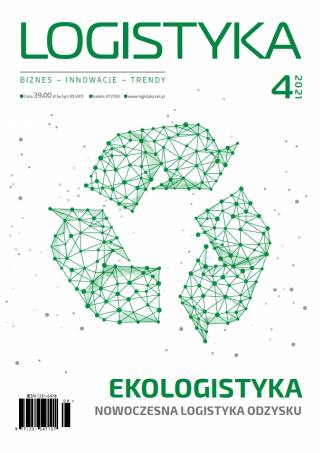
More articles on ecological solutions can be found in the magazine LOGISTYKA 4/2021.
The e-edition of the magazine is available in our offer!
Stay up to date, subscribe to the LOGISTYKA magazine!