









Electric vehicles are a way to reduce carbon dioxide emissions. Decisions to invest in an electric fleet are hindered by concerns about the convenience of charging it – there is a lack of adequate infrastructure.
Within 10 years, the European Union could reduce carbon dioxide emissions in road freight transport by more than a fifth (22%) by obliging the largest cities to provide charging infrastructure for electric trucks, according to an analysis of freight routes that covered 173 cities and urban areas in the EU, including those in Poland.1 For European road transport to move towards zero carbon dioxide emissions, electric truck charging points must be installed across the Union by 2030. In Poland, chargers should appear in cities including Warsaw, Łódź, Poznań, Szczecin, and Wrocław.
– These Polish cities face a huge challenge, because in addition to plans for electrifying public transport and developing charging networks for passenger cars for residents, they should as soon as possible also add infrastructure for charging heavy-duty vehicles. Part of this work will also be on the side of the private sector – especially chargers in logistics centers and warehouses. However, both cities and companies will need financial support if changes are to happen as quickly as is needed from the point of view of protecting the health of residents and the environment – explains Urszula Stefanowicz from the Polish Ecological Club, Mazovian District.
The organization Transport & Environment (T&E) suggests that next year the European Union should set ambitious and achievable targets for the availability of chargers for e-trucks. The analysis shows that providing 40,000 chargers in logistics centers and publicly accessible locations by 2030 would require an investment of 28 billion euros. This would represent less than 5% of the 750 billion euro post-COVID-19 recovery fund proposed by the EU. The cost of the Union’s investment in road infrastructure is as much as 100 billion euros per year. Therefore, the investment in infrastructure for charging electric vehicles is not too large.
– Electric trucks are clean, cheaper to operate, and available today. However, the lack of a European strategy regarding charging infrastructure and the insufficient supply of vehicles from European truck manufacturers are blocking this market segment. The EU must set ambitious goals for infrastructure development and enable the heavy-duty vehicle fleet to break free from emissions. This will pave the way for clean and quiet deliveries in cities. Zero-emission vehicles will improve the quality of life for millions of Europeans by reducing air pollution and noise levels – explains Lucien Mathieu, transport and e-mobility analyst at T&E.
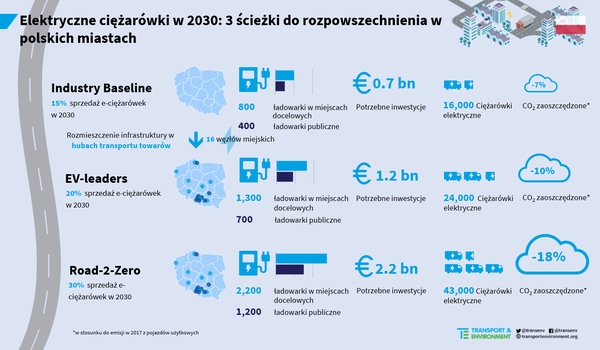
Chargers would enable the operation of half a million e-trucks. Thanks to this, by 2030, as much as 43% of truck journeys in the EU would be free of CO2 emissions. Residents of cities and towns would benefit from this, as they would receive clean and quiet vehicles ecologically supplying their supermarkets.
– Establishing clean transport zones in Polish cities will be an important element in promoting zero-emission trucks in cities. If such zones are designated, we will create demand for such vehicles. Building charging infrastructure in logistics centers will then be much more effective – notes Rafał Bajczuk from the Electric Vehicle Promotion Foundation.
According to analysts, next year’s revision of the Alternative Fuels Infrastructure Directive (AFID) should focus exclusively on electrical and green hydrogen infrastructure so that the regulation is consistent with the climate ambitions contained in the European Green Deal. The authors of the report believe that infrastructure for refueling trucks powered by natural gas, which can be up to five times worse in terms of air pollution than diesel and whose use does not lead to decarbonization, should be excluded from the regulation. It should also not be financially supported by EU funds. T&E also points to the need to encourage truck manufacturers to increase the supply of zero-emission vehicles.
Source: T&E
1 Cities and urban areas are a combination of existing urban nodes covered by the TEN-T regulation and “hotspots” – places with the highest intensification of road freight traffic identified based on T&E analysis.