








With the rising number of cargo theft incidents in global and European supply chains, the protection of high-value goods in road transport is becoming increasingly important. Girteka, Europe’s largest asset-based transport company, analyzes the risks and evolving methods of theft, and demonstrates how the TAPA TSR standard supports carriers, customers, and end-recipients in mitigating risks and building safer supply chains..
The situation in global and European markets
Cargo theft is becoming an increasingly serious threat to global supply chains. The consequences affect all stakeholders, including end customers and consumers who lose goods or receive them damaged.
In North America, the value of stolen cargo in 2024 reached approximately 455 million USD (approx. 414 million EUR), 27% more than in 2023¹.
In Europe, the total value of losses recorded in the EU in 2023 amounted to 549 million EUR, which represents an increase of 438% compared to the previous year (and over 1,000% compared to 2021)². A European Parliament study estimated that cargo theft-related crime costs companies over 8.2 billion EUR annually³.
Over a three-year period, from 2022 to 2024, the TAPA EMEA Intelligence System (TIS) recorded 157,421 cases of cargo theft in 129 countries⁴. In June 2025 alone, 634 incidents were reported, including the largest single loss – the theft of cosmetics worth 4 million EUR from a trailer in Lombardy, Italy⁵.
In June 2025, cargo-related crime in Europe particularly affected several countries. Germany topped the list, followed by Italy, France, Spain, and the United Kingdom⁶.
Most frequently stolen goods: high value, high demand, high risk
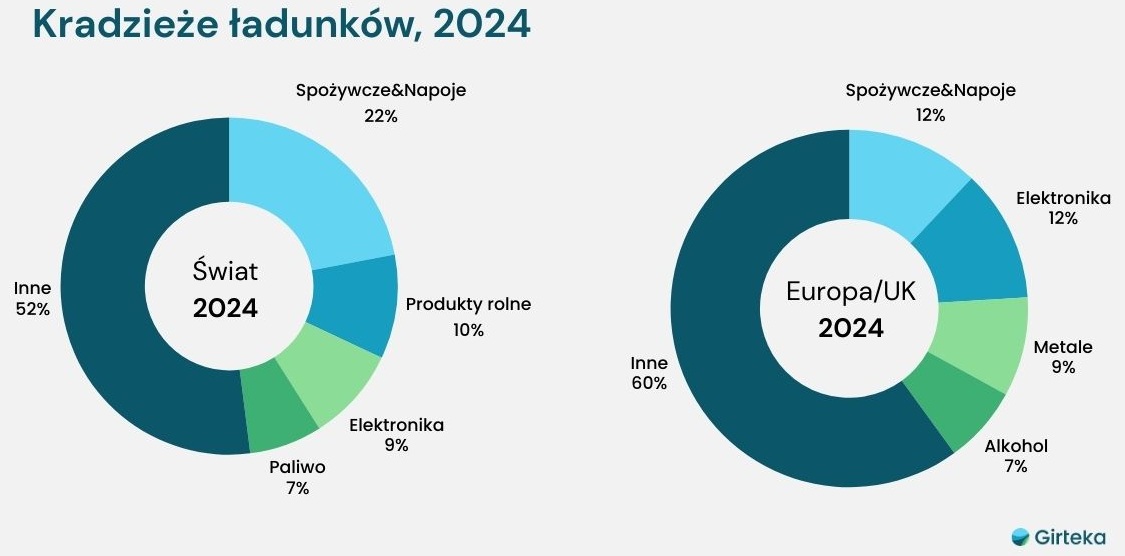
Criminals target high-value loads that are easy to transport, in constant demand, and can be quickly resold on the black market. According to 2024 data⁷, food and beverage items dominated the list of the most frequently stolen goods globally. 76% of theft cases involved road transport, compared to 68% in 2023.
Pharmaceutical products are high-value and high-risk goods. Their small size combined with high value makes them easy to conceal. Their theft involves not only financial losses but also a serious threat to public health in the event of improper storage or spoilage.
Increasingly sophisticated methods of organized crime
Cargo theft has evolved from opportunistic acts committed by small groups at unsecured parking areas to well-organized, sophisticated international operations.
In Europe, thefts using modern technology are becoming more frequent. Fake carriers, identity theft, online fraud, or collusion with insiders are becoming the primary methods for criminals to bypass or break security measures. In France, Germany, Italy, Spain, and the UK, their main targets are vehicles left in unsecured parking lots and warehouses.
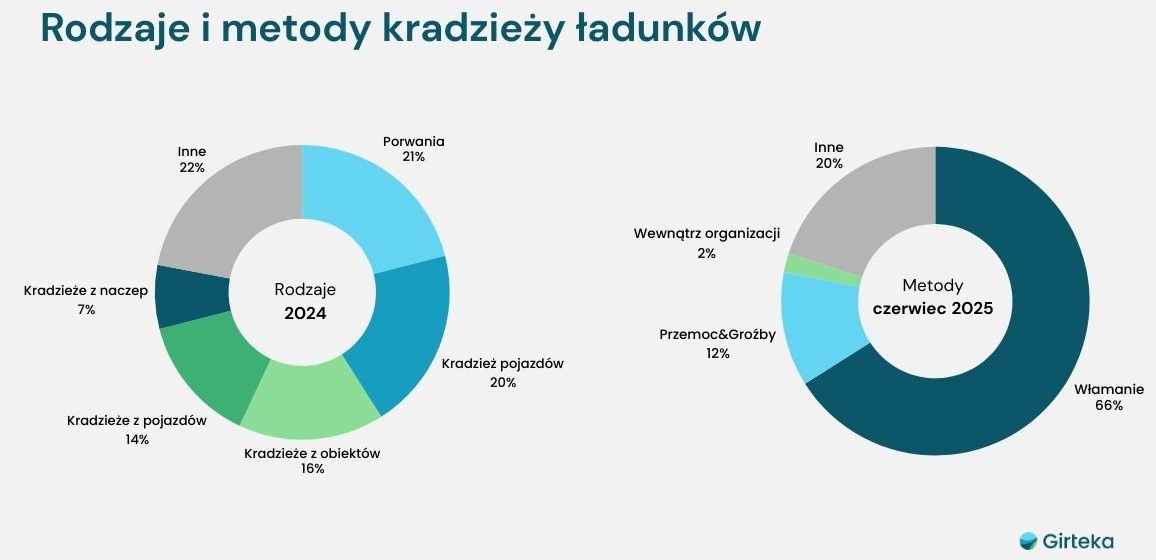
According to 2024 data, the most common incidents were hijackings (21%), vehicle thefts (20%), followed by thefts from facilities (16%), from vehicles (14%), and from containers/trailers (7%)⁸.
An analysis of the methods used by criminals, based on the latest data from June 2025 for the EMEA region (Europe, Middle East, and Africa), shows that the dominant method was intrusion, such as cutting vehicle tarpaulins or breaking locks, used in 66.5% of cases. Attacks involving violence or threats of violence accounted for 12.6%, while insider involvement was noted in 2.2% of incidents. Deception-based tactics, including fake cargo pickups, occurred less frequently but were still recorded⁹.
As theft methods change and losses increase, more transport companies and their customers are investing in advanced security measures and collaborating with industry associations to monitor threats in real-time. Although carriers and shippers bear the direct costs, end customers also feel the impact through higher prices and product shortages. In response to these risks, companies are increasingly committing to standards such as TAPA TSR, which allows for more effective protection of cargo in road transport.
TAPA TSR: The global standard for road transport security
The TAPA Trucking Security Requirements (TSR) is a globally recognized, specialized standard developed to ensure the safety of drivers, vehicles, and transported cargo by minimizing the risk of theft and other security-related incidents in the supply chain¹⁰.
The TSR standard defines minimum security requirements for road transport operations, covering curtain-sided and container trailers, trucks and vans, as well as the road transport of sea containers. It contains a detailed description of the processes, technologies, and procedures that transport companies must implement to protect cargo from theft.
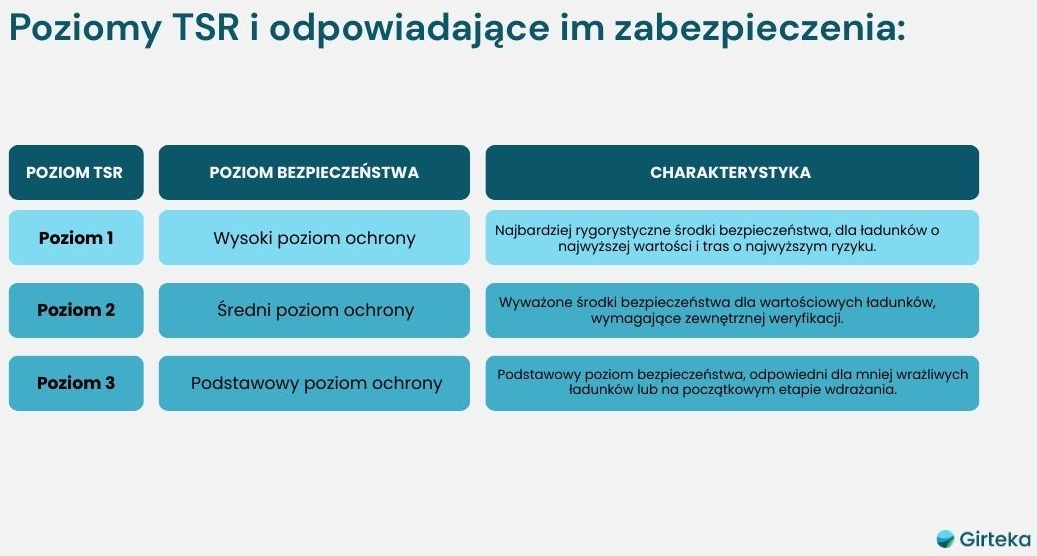
What distinguishes TAPA TSR is continuous improvement. It is reviewed and updated every three years, ensuring effective protection and supporting risk management. TAPA TSR has three levels of certification, with Level 1 being the most demanding.
TAPA TSR: A priority for logistics operators, cargo owners, and the supply chain ecosystem
Logistics Service Providers & Carriers
For logistics service providers like Girteka, security assurance according to the TAPA TSR standard means not only implementing technical security measures but also end-to-end operational protocols.
In practice, high security standards apply to key areas of transport services, i.e., own fleet (tractors, reefers, and box trailers), operational planning, response procedures, and even team competencies.
- Monitoring – 24/7 GPS tracking, geofencing, and anomaly alerts enabling rapid response.
- Vehicle security – truck alarms and SOS buttons for emergency situations.
- Trailer security – mechanical locking systems, unique keys, ISO 17712 seals, and door alarms.
- Route planning – route risk assessment, secure parking locations.
- Emergency procedures – 24/7 monitoring center with rapid security response.
- Driver training – annual, mandatory safety training.
Cargo Owners & Shippers
For cargo owners, especially those with high-value or high-risk goods, TAPA TSR Level 1 provides a guarantee of operational security and reduces risk.
Whether transporting pharmaceuticals, electronics, or automotive components, choosing a logistics operator with TAPA TSR certification ensures greater security, meets insurance requirements, and protects reputation. It is a level of protection that not only secures the product but also strengthens customer trust within long and complex supply chains.
The supply chain ecosystem
TAPA TSR certification brings benefits that extend beyond the carrier-customer relationship. For the broader supply chain ecosystem, including insurers, regulators, freight forwarders, and manufacturers, it provides a consistent framework for risk assessment and management.
- Insurers: gain greater transparency regarding the practices of logistics operators and can factor certification into risk assessment and policy terms.
- Regulators: view certification as evidence of the proactive application of best practices in cargo protection and building supply chain resilience.
- Logistics partners and manufacturers: benefit from a uniform standard when selecting carriers for international deliveries, which increases operational consistency and accountability.
As Girteka emphasizes, today in logistics, cargo security is no longer an option but a factor determining competitive advantage. With the evolution of methods used by criminals, standards such as TAPA TSR indicate not only who delivers goods, but also who does so in a trustworthy, responsible, and reliable manner.
1 Total value of losses in the USA, 2024 – Verisk, accessed: August 11, 2025 https://tapa.memberclicks.net/assets/2025-National-Cargo-Theft-Conferfence/Presentations-for-Sharing/2024%20Annual%20Verisk%20CargoNet%E2%80%99s%20Supply%20Chain%20Risk%20Report.pdf
2,4 Total value of losses from all incidents in 2023; number of incidents in 2022–2024, TAPA EMEA TIS, accessed: August 7, 2025 https://database.tapa-global.org/site/dashboard
3 Cargo Theft Report 2022, annual costs of crime for companies, TT Club, TAPA EMEA & BSI Connect Screen Intelligence, accessed: August 7, 2025 https://www.ttclub.com/fileadmin/uploads/tt-club/Migrated/media/files/tt-club/bsi-tt-club-cargo-theft-report/2022-tt-club-tapa-emea-and-bsi-annual-cargo-theft-report.pdf#:~:text=can%20have%20a%20detrimental%20effect,Stan%02dards%20and%20cargo%20crime%20i
5,6,9 Number of new cargo theft cases, largest recorded loss, cargo thefts by country, perpetrator methods, Vigilant e-magazine, July 2025 issue, TAPA EMEA, accessed: August 13, 2025 https://cloud.3dissue.net/33970/33882/34212/135395/index.html?54029
7,8 Cargo Theft Report 2024, most frequently stolen goods, types of cargo theft globally, BSI Consulting & TT Club, accessed: August 11, 2025 https://www.ttclub.com/fileadmin/uploads/tt-club/Documents/TT_and_BSI_annual_theft_report/TT_Club_Report_-_Supply_Chain_Report_April_2025.pdf
10 Trucking Security Requirements, TAPA EMEA, accessed: August 13, 2025 https://tapaemea.org/standards-trainings/trucking-security-requirements/
Source: Girteka Group