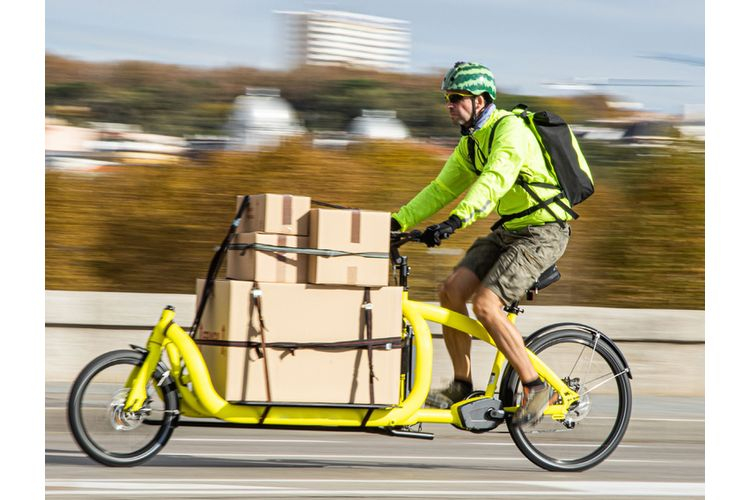
For all cargo bike enthusiasts interested in integrating them into urban logistics on a large scale, the most important piece of information is certainly that in December 2020, the importance of these means of transport was recognized by the European Union.
From the document “Greening Freight Transport”, which is part of the European Green Deal program, we learn that: “cargo bikes are part of the sustainable development and micromobility strategy (Sustainable and Smart Mobility Strategy) and will play an increasingly important role at the European Union decision-making level”. This strategic document, which formulates the new EU transport policy until 2030, explicitly defines them as a solution dedicated to urban logistics. The second piece of good news is that very soon (later this year), technical, safety, and terminological issues will be regulated by the announced European ISO standard.
It is in this latter context that it is also worth referring to the name itself. The American Webster’s dictionary – so far – has not recorded the term cargo bike / freight bike. Another reference dictionary, the English “Cambridge Dictionary”, has already introduced it into its lexical resources, although the definition of a cargo bike itself is very general. In Polish translation, it reads as follows: “a bicycle designed to carry goods using an attached container, which may be equipped with a set of wheels”. Let us hope that the aforementioned ISO standard will clarify the spectrum of design details, types, and varieties of cargo bikes, and thus precisely define the subject terminology. The topic of the diversity of cargo bike designs and models therefore deserves a separate discussion.
A good idea is always timeless
The idea of using bicycles for the distribution of goods is obviously not new, but in times of increasing environmental pollution, it is all the more worthy of attention. The “Bäckerrad”, known as early as the end of the 19th century, was a basic means of transport used by bakers to transport bread (today, bread has been replaced by… pizza delivered by couriers communicating with customers via dedicated applications). More historical examples from various countries can be cited.
The market niche is slowly filling up
Moving on to current realities and specific data, we must keep in mind that the market for bicycles used in urban logistics is in an early stage of development (it has essentially existed for only a few years), and its growth dynamics will be influenced by factors related to, among others:
– the implementation of pro-ecological measures resulting from the assumptions of the “Green Deal” policy,
– a favorable attitude of city authorities and the possibilities for the development of electromobility,
– financial subsidies for the purchase of these means of transport,
– new CEP (courier, express, parcel) concepts in the area of the last mile,
– the development of sharing services,
– infrastructure development, including the construction of urban hubs.
It seems, therefore, that we will hear more and more about such companies – manufacturers of the discussed means of transport, such as Urban Arrow, Sortimo, or Velofactur. In surveys conducted as part of the European project CityChangerCargoBike (implementation period 2013-2022) with the participation of 38 cargo bike manufacturers from Europe, it was estimated that their sales on our continent in 2019 amounted to 28,532 units, which was an increase of as much as 60 percent compared to 2018. It should be assumed that the upward trend will continue, which may be favored by the aforementioned subsidies (e.g., in Germany, since March of this year, subsidies of 25 percent of the price have been introduced for the purchase of a cargo bike for commercial purposes).
The European leader in bicycle sales is our western neighbor. According to data from the German Bicycle Industry Association (ZIV), sales of cargo bikes without electric drive in 2019 amounted to 54,400 units, and with electric drive to 21,550; in 2020, these figures were 78,000 and 25,200, respectively. Let us add that in 2016, there were only 15,125 of the former, and there were no cargo bikes with electric drive at all. The mood in the industry is very optimistic, as evidenced by surveys conducted among 100 German small and medium-sized enterprises operating in three different segments: customers using services, manufacturers, and entities conducting research (R&D) in this area. The findings show that as many as 75 percent of the surveyed companies forecast an increase in sales, none are planning layoffs, and as many as 68 percent intend to increase employment.
Cargo bikes and urban goods consolidation centers
Cargo bikes as means of transport only seemingly function as independent entities, moving discreetly around the city, transporting, for example, pizza. Of course, innovations in the sphere of design, construction, or ergonomics of the bikes themselves are extremely important, but an even greater challenge is designing a logistics system that will allow for the handling of shipments in a rational way, will allow for reconciling the interests of all so-called stakeholders, and, above all, will meet the expectations of residents. Hence the importance of the role of urban hubs (urban consolidation centers) as relatively new elements of resource-sharing logistics infrastructure. It is worth mentioning here the features of an ideal1 / model hub served by cargo bikes, which can simultaneously be a point of reference and a valuable tip for entities planning to design and install such facilities. Here are the most important of them, identified by the Otto von Guericke University in Magdeburg:
– It is a stationary hub (unlike mobile hubs that also exist).
– It is suitable for sharing by various CEP operators.
– It has access to appropriate equipment, such as a ramp, as well as charging stations.
– Residents are also involved in its planning (at the earliest possible stage).
– Its function is understandable to all users, and in particular to residents.
– It is located in places with a high density of residents,
– It has access to bicycle paths.
– Its usage / operation period is from 2 to 5 years.
– It is characterized by an aesthetic design that fits into the urban space.
As can be seen, according to the above recommendations, bicycle hubs should not be another “developer entity”, but a “living organism”, the existence and functioning of which can also be influenced by city residents. In this way, the bicycle fleet, operating in a specially configured logistics system, fits into the resource-sharing economy.
Let us hope that in Poland, too, we will not have to wait long for similar initiatives. An example is Stargard, where as part of the Low Carbon Logistics (LCL) project, they were tested on several routes as early as 2018 thanks to the involvement of city authorities. In 2020, thanks to the courier company GLS, cargo bikes appeared on the streets of Krakow.
Operational parameters of electric cargo bikes
– Possible daily distance: over 100 km
– Maximum speed: 25 km/h
– Average speed in urban traffic: from 11 to 16 km/h
– Range on a single battery charge: from 30 to 50 km (bike with load)
– Distance possible to cover on one route: 7-10 km
The German Federal Ministry of Transport, in its adopted cycling transport development plan, set a goal of shifting as much as 20 percent of urban deliveries to cargo bikes by 2030.
1 Planning of Cargo Bike Hubs. Otto von Guericke Universität Magdeburg. 2019.
The article comes from the magazine LOGISTYKA 3/2021.
The e-edition of the magazine is available in our offer!

Stay up to date, subscribe to the LOGISTYKA magazine!