









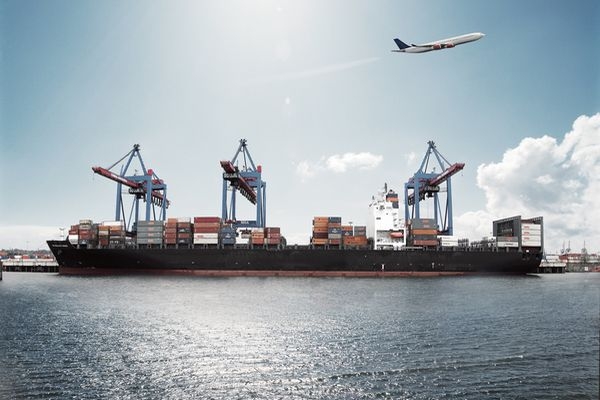
A small parcel, a pallet, or perhaps an entire container or oversized transport? There is no cargo that cannot be transported using sea and air freight. We talk about how this looks in practice with Arkadiusz Mirek, CEO of DSV Air & Sea.
Which directions are gaining importance recently in the area of sea and air logistics?
A.M.: We are noting continuous growth on routes to the Far East, but also to North and South America. The Middle East is also a developing direction for our company. Recently, we have also been seeing rapid development in the African market, which is why we have expanded our influence there by acquiring several small companies specializing in local transport. Meanwhile, on our continent, Short Sea shipping is developing very dynamically.
Which directions does DSV Air & Sea serve on a regular freight basis?
A.M.: Thanks to a dense network of offices spread all over the world, we have the ability to serve every continent and practically every country. Statistically, the most frequently served directions are the Far East, both Americas, the Middle East, Africa, and also Australia. However, in regions where we do not have our own offices, customers are served by our trusted agents, while maintaining all the highest standards of service and safety of DSV. In summary, we reach everywhere – starting from the largest directions, ending with less popular airports and seaports of the world.
What is the situation with pallet units in air and sea transport?
A.M.: In sea transport, we most often deal with a standard cargo pallet (800 x 1200 x 144), i.e., the so-called Euro-pallet, but ISO also allows the use of pallets with dimensions of 1000×800 / 1200×144 mm. Besides flat pallets, other types are also used, e.g., post pallets, box pallets, and special ones. A palletized unit should have a shape close to a rectangular cuboid defined by the pallet dimensions. The height of the cargo hold in transport vehicles is also taken into account here. Such pallets are placed in various containers of all types, DV 20’, 40’, 40HC, or OT 20’, 40’, FR, Hard Top, etc.
Naturally, the customer can also send a parcel with us in the DSV XPress system. We handle the transport of both a single pallet in sea LCL (less than container load), as well as a full container or an entire ship as part of project logistics. We specialize, among other things, in professional ship chartering for the transport of oversized shipments. In short, we handle a full range of transports – from a small parcel to a full ship.
Similarly in air freight, where DSV XPress is a product enjoying increasing popularity. Our customers, sending typical cargo shipments with us, no longer have to use the services of other courier companies. The standard pallet unit in such transport is the ULD pallet, which we can also build in Poland at local airports. We have the ability to load it onto trucks, which then head to the nearest cargo ports in Europe. Other solutions are also ex-shipper pallets, built for special projects.
In air transport, we work with clients on shipments from A to Z, i.e., from courier shipments, through Courier on Board, general cargo, DGR, temperature-controlled, the possibility of animal transport, as well as part air charter and air charter. Naturally, we also carry out project forwarding as part of air transport. Our motto at Air&Sea is One Stop Shopping.
Is the service of an in-house customs agency a market standard today in the case of air and sea freight among logistics operators?
A.M.: Generally, for larger and medium-sized freight forwarders, the service of an in-house customs agency is common, but not unconditional. We decided to permanently expand this business profile many years ago, and with all the simplifications, fiscal clearances, and AEO certificate we possess, we combine and optimize the forwarding service process. In my understanding of standards, in-house customs service is essential to maintain very high quality of services and short clearance times.