








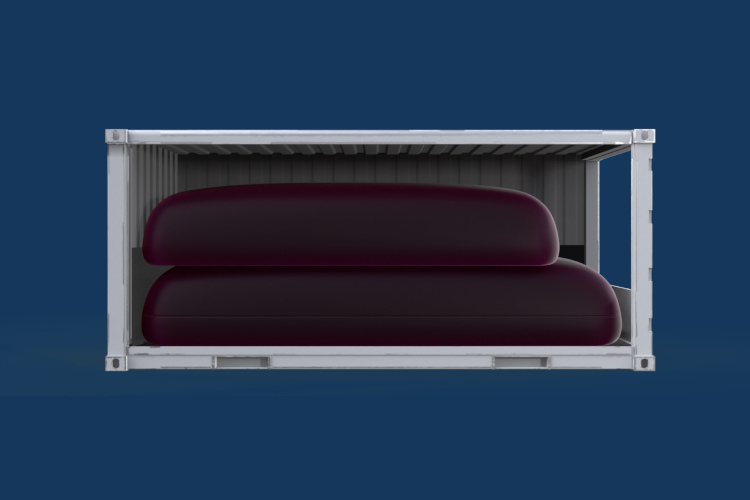
The biggest challenges for liquid bulk supply chains today are maritime transport disruptions, container shortages, changes in sailing schedules, and cargo space allocation. In response, Hillebrand, a global logistics operator for the beverage industry, has developed and introduced an innovative solution that allows for the transport of up to 27,000 liters of liquid in a single container. This is the XL flexitank, one of the largest flexible tanks available on the market.
– The impetus for developing the concept of the new solution was feedback from customers expecting increased load capacity – says Jacob Moe, Chief Operating Officer for Bulk Liquids at Hillebrand. – The ability to deliver even more cargo in a single container allows for both cost reduction and lower carbon dioxide emissions per liter. And that is exactly what our customers around the world expect.
The new Hillebrand solution is used in bulk deliveries of various types of liquid substances. The XL flexitank has a capacity of 27,000 liters, fits into a 20’ container, and allows for transporting 15% more liquid at once. The flexible tank has been specially designed to eliminate the risk of container bulging and features a separate valve system for loading and unloading. The use of special, patented technology facilitates quick emptying. As with single-layer flexitanks, the installation of the XL flexitank in a container, as well as the loading and unloading of goods, is very simple.
It is also worth emphasizing that when developing the concept of the new flexitank, Hillebrand specialists considered the possibility of adapting it to transport various types of liquid substances in order to maintain their quality and freshness. For the transport of liquids particularly sensitive to external conditions, an XL flexitank with Hillebrand’s patented and unique protective technology, built from polyethylene and reinforced with an additional polyester coating, can be used. It is designed to protect them against oxidation, as well as contamination and water vapor penetration. XL flexitanks are also available in a two-compartment version. Using this option allows for the transport of two different types of liquid substances in one container.
100% recyclable
As with all Hillebrand flexible tanks, the new XL flexitanks are for single use and are 100% recyclable. CO2 emissions per liter are also significantly lower, both compared to transport in standard 24,000-liter flexitanks and goods transported in packaging. For example, only about 9,000 liters of bottled liquids can be transported in a container. XL flexitanks are installed in a container using only one reusable bulkhead (steel partition). Like all bulkheads used by Hillebrand, it is refurbished after each use and designated for reuse.
Flexitanks for beverages
Hillebrand uses modern systems in bulk transport for the beverage and alcoholic beverage industry. It employs innovative, patented, and unique solutions on the market that guarantee safe delivery of liquid substances – flexitanks, single and multi-layer, of various sizes and purposes. For example, the Pulse flexitank is dedicated to transporting high-density liquids or those with a tendency to solidify. The technology used here enables rapid mixing of thick liquids and prevents sediment from settling at the bottom. The Heat flexitank is used for transporting high-viscosity liquids. Equipped with a heating liner, it allows for loading and unloading at temperatures up to 90°C. The flexitank for 40’ containers is used for bulk transport of liquid substances, such as dairy products, fruit juices, or beer, in refrigerated conditions and ambient temperatures (-30°C/+30°C). The solution used here prevents excessive liquid movement. The I-Shield flexitank, with an inner protective layer made of ethylene vinyl alcohol (EVOH), is used for transporting, for example, white oils. Interesting solutions also include the E-Shield flexitank for bulk transport of liquids that oxidize easily, such as olive oil, or Vinbulk for wine deliveries. The technologies used in them protect against oxidation, contamination, and water vapor penetration.