








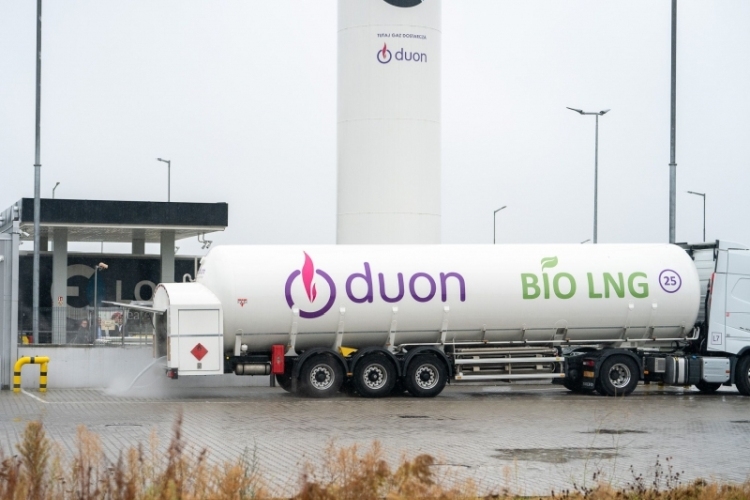
After the first refueling of a heavy-duty vehicle with green fuel in Poland, questions remained: why is bioLNG not yet common in heavy transport in Poland? Are we even getting closer to greening this sector? It is worth fighting for bioLNG, because it is the most readily available fuel for Poland among all eco-options. And we have less and less time. The new EU climate targets for 2030 involve reducing the carbon footprint of the transport sector by 45%. In light of the Green Deal assumptions, the carbon footprint of Polish heavy transport is becoming an increasing burden on our economy, as it hits the competitiveness of companies and the security of jobs.
The need to decarbonize Polish heavy transport is becoming increasingly urgent, but transport companies are looking primarily at direct fuel costs. In the short term, bioLNG cannot compete on price with traditional raw materials. It is more expensive because the biomethane liquefaction plant is a significant expense – it can equal or even exceed the cost of building an entire biogas plant. However, focusing solely on price is a dead end. Short-term savings will come back to haunt us in the near future. Other EU countries know this and are investing in bioLNG production because they are thinking long-term (in Germany, there are at least several plants producing from a few to several hundred tons of bioLNG per day).
– Every MWh of biomethane or bioLNG produced here, from our waste, reduces gas imports and increases energy independence. Europe’s dependence on fossil fuel imports always carries huge risks, regardless of the direction of supply. Smartly arranging all the pieces of the puzzle, from the level of substrate availability to the level of end users, would allow for the optimization of the overall costs of this ecosystem. I am convinced that in that case, the benefits would definitely outweigh the costs – says Dr. Lech Wojciechowski, head of the research and strategy team at Grupa DUON, the company that delivered bioLNG to the E-LOGIS station in Rzepin in September.
In the final economic analysis, besides freeing the state from the costs and risks of imports, bioLNG also supports the strengthening of company competitiveness. Using renewable fuel reduces the carbon footprint, and with the right technology, the emissions of bioLNG are even negative – this is a major asset for organizations operating on an international scale, which must demonstrate a pro-ecological attitude in the race for business partners and customers.
Furthermore, bioLNG is a fuel that can be used directly to achieve, among other things, the National Indicative Target (NCW). – An entity obliged to implement the NCW regarding the provision of a minimum share of biocomponents and biofuels in the volume of transport fuels supplied to the Polish market can double-count the energy contained in biocomponents and biofuels produced from substrates listed in Annex 9 to the RED 2 directive for the implementation of this target – explains Dr. Wojciechowski.
Finally, bioLNG allows for the large-scale use of existing gas infrastructure. We are not starting from scratch. BioLNG is a fuel with the same properties as LNG, except that it is, of course, a renewable energy source.
– For bioLNG, we already have vehicles on the road, a service network, refueling stations, etc. You just need to pour in the decarbonized fuel and you can go. For any other technology in heavy transport, costs are generally higher because they require the implementation of vehicles, significant expansion of refueling or charging infrastructure, construction of a new service network, and everything associated with building a new means of transport from scratch. With bioLNG, you can decarbonize heavy transport today. Other decarbonization directions in this area mean waiting for tomorrow – notes Dr. Wojciechowski.
Will the first bioLNG refueling in Poland change anything?
For now, refueling heavy-duty vehicles with bioLNG is a challenge in our country.
– To be able to supply bioLNG with appropriate proof that it is biomethane, you must have ISCC EU certification or equivalent. Besides, we do not have biomethane plants in Poland, so we do not produce bioLNG, which means such a product must be imported. Not everyone is able to meet all these conditions at once, i.e., have the appropriate concessions, have experience in importing gas fuel, have the appropriate certification regarding the ability to trade biomethane, and have a supplier of biomethane with the appropriate parameters and price. If you fail to meet even one of these requirements, the whole puzzle falls apart – highlights Dr. Wojciechowski.
Powering the heavy transport sector with bioLNG will not become an everyday occurrence too quickly, but the historic refueling in Rzepin has enlivened the discussion about the urgency of decarbonizing this branch. – We have turned the spotlight on bioLNG, which is worth fighting for, considering Poland’s potential for biomethane production – says Dr. Wojciechowski.
Is Poland really getting closer to greening heavy transport?
It is said that the sectoral agreement for the development of biogas and biomethane signed in 2021 was the first significant step to unlock the biomethane production market in Poland. What are the prospects for stimulating this market today, after 3 years?
– After 3 years, we have a support system for biomethane injected into the grid for small installations (up to 1 MW of electrical power equivalent) in the Fit in Premium formula. A draft support system for installations over 1 MW is under consultation. We are waiting for the implementation of RED 2 and RED 3 into Polish law. There are many projects that are in various stages of development because the market believes that biomethane will allow for a good return on investment. There is still a lot to be done, but there is light at the end of the tunnel. However, the formula of the agreement itself seems to have exhausted itself a bit. The Ministry of Climate and Environment will probably propose a new format for the functioning of this initiative – concludes Dr. Wojciechowski.
Source: Newseria / Press Office