









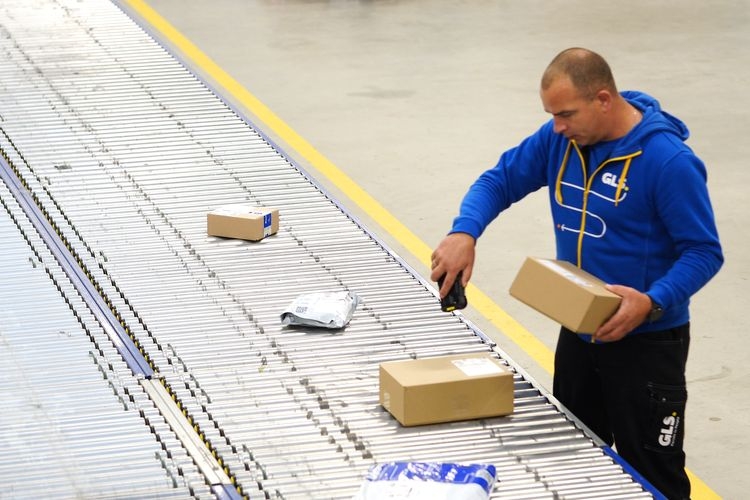
As senders and recipients of parcels, we rarely think about what happens to our package after we click the “order” button or generate a shipping label. From the customer’s perspective, this process seems deceptively simple – we perceive it as a mere transport of goods from point A to point B. In reality, parcel logistics is a precisely designed operational machine, full of non-obvious elements, where every movement is the result of advanced planning and optimization.
To shed light on these often invisible processes, the editorial team of Media Logistyka, in cooperation with the Digital Transformation Center of Łukasiewicz – PIT and the Poznań branch of GLS Poland, carried out the “Parcel’s Journey” research project. We sent a parcel, “armed” with various types of sensors, from our institute in Poznań to a parcel locker in Wrocław. In this way, we conducted what is likely the first such detailed analysis of the entire life cycle of a parcel from the moment of dispatch to final delivery.
What exactly did we study during the project?
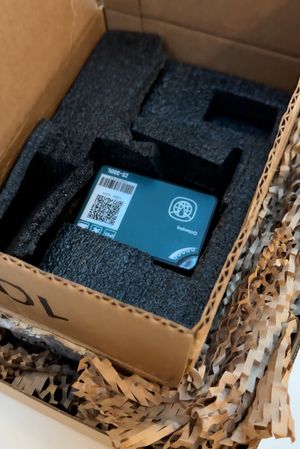 The study involved sending a parcel equipped with a specialized monitoring device, prepared for us by the research team at the Łukasiewicz – PIT Digital Transformation Center. Thanks to this, we were able to:
- Track the parcel’s route in real-time: A GPS module was used to precisely determine the parcel’s location at every stage of its journey from the sender (Łukasiewicz – PIT headquarters in Poznań) to the recipient (in this case, a parcel locker in Wrocław).
- Monitor physical parameters: The device recorded the G-forces the parcel was subjected to, as well as temperature changes inside the transport.
- Analyze operational processes: Thanks to the courtesy of the GLS Poland branch in Poznań, we were able to observe the work of couriers, processes in local sorting centers, and the central sorting hub, checking how logistics theory translates into practice during the peak parcel season.
- Verify the new GLS Live Tracking service: We checked the accuracy of the estimated delivery time and the usability of the map for the end recipient.
In our joint study with GLS, we utilized our previous experience from R&D projects concerning parcel tracking, such as the intelligent ePack packaging or the logistics flow of the Silk Road (shipments from China to Europe). Technological progress means that something that was once the subject of R&D work is now available to virtually every recipient. Our study allowed us to collect additional data related to the parcel, such as temperature, G-force, and an exact GPS trace. We used an additional device placed inside the parcel to compare the data it collected with information from the standard service already offered by GLS. I think the data we managed to collect is valuable for both sides – for GLS, it is certainly a confirmation of service quality but also a portion of data for further analysis, and for Łukasiewicz – PIT, it is primarily the practical, business aspect of applying the technologies we have at our disposal.
– says Tomasz Markowski, Director of the Łukasiewicz – PIT Digital Transformation Center.
It is worth emphasizing that the choice of timing for the study was not accidental, as the “Parcel’s Journey” project took place in mid-December 2025. This was the very peak of the parcel season, a period traditionally characterized by the highest volumes of the year, when logistics operators face the largest number of parcels entering the system. This allowed us to reliably test the operational efficiency of the entire supply chain under conditions of maximum infrastructure load.
Dispatch and the “first mile”
The initiation of the logistics process occurs even before the parcel physically leaves the point of origin. The first step is generating a logistics label in the IT system, which becomes the parcel’s digital passport, containing all the data necessary for its correct identification and transport. Next, the courier arrives at the dispatch point, where the following occurs:
- Parameter verification: The courier checks that the parcel does not exceed the permissible dimensions (standardly up to 2 meters in length and 300 cm in girth including the longest side) and weight.
- First scan: This is the key moment of entering the parcel into the IT system, which enables its further tracking.
- Loading: The parcel is placed into the courier van, where it is arranged according to safety procedures.
Sorting at the local branch
After completing the collection route, which in the case of our parcel lasted about eight hours and included numerous pickup points in Poznań and the surrounding area, the parcel arrived at the local GLS Poland branch located in Głuchów near Poznań. There, the sorting and distribution stage begins, where the serpentine conveyor belts and rollers take center stage. Every parcel goes through processes such as:
- Unloading scan: This is how the courier confirms the physical presence of the parcel at the branch.
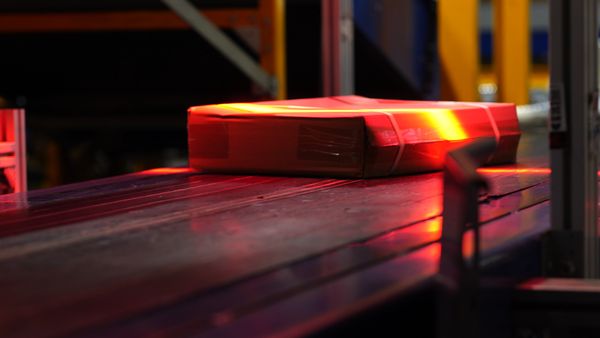
- Automatic measurements: Using volumetric scanners and certified scales, the system precisely determines the weight and dimensions of the parcel.
- Parcel separation: The parcel hits the “serpentines” of conveyor belts and rollers, which sort the parcels to the appropriate destinations.
The sorting center infrastructure is configured in such a way that even heavier parcels do not cause a slowdown in the internal transport line. In this organized mechanism, there is no room for improvisation, and every operation is recorded in the system, which minimizes the risk of errors and damage.
Line-haul transport and the central sorting hub
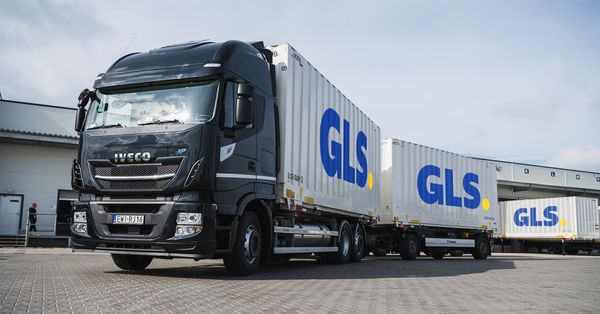
Once the parcel is assigned to the correct destination, it is placed in a container and begins its inter-branch journey. And this was one of the most intriguing aspects of network logistics for us. The GPS study pointed to the logic of seemingly illogical routes. A parcel sent from Poznań with a destination address in Wrocław did not go directly south, but headed east to the central sorting hub in Stryków near Łódź. Such a structure, based on a hub and spoke system, results from constant optimization of costs, time, and carbon footprint. Operational logisticians make decisions about consolidating loads into full containers going to the main hub instead of sending half-empty trucks on direct routes, which is significantly more economically and ecologically efficient. In the studied case, the choice of the route through Stryków was dictated by the optimal filling of the available fleet, and the night sorting cycle, taking place between 8:00 PM and 3:00 AM, ensured that the parcel still arrived at the destination branch at 5:30 AM, without delaying the final delivery.
“Last mile” and Live Tracking
After leaving the sorting hub in Stryków, our parcel arrived at the local GLS Poland branch in Wrocław, where it was again sorted into specific courier zones. At the moment the parcel was picked up for the route by the courier and scanned for the last time at the branch, the Live Tracking service was automatically activated. Thanks to this, the recipient receives a notification with a link to a map where they can track the courier’s location in real-time, see the number of stops remaining until delivery, and the precise delivery time.
Delivery and Pickup
The final stage of the journey is the delivery of the parcel to the parcel locker:
- Final scan: The courier scans the label at the destination, which ends the process in the system.
- Parcel locker: If the parcel goes to a locker, the courier scans it at the terminal and places it in a compartment.
- Notification: The recipient receives a message (e-mail/SMS) with a pickup code or information in the app.
- Finalization: The recipient opens the compartment with the code or remotely via the app and removes the parcel, which closes the entire logistics chain.
What did we learn from the study?
GPS data from our test showed something seemingly illogical: a parcel sent from Poznań to Wrocław instead of taking the shortest route (about 180 km), ended up in Stryków near Łódź, traveling almost 490 km. From the point of view of the average recipient, this is unnecessary extra mileage, but in line-haul transport engineering, it is pure optimization. Sending the parcel to the central hub (Stryków) allows for the consolidation of goods into huge containers, which drastically lowers costs and the carbon footprint. Even if the shipment covers more kilometers, thanks to the night shift (main sorting operations take place in the window between 8:00 PM and 3:00 AM) it still arrives at the delivery branch at 5:30 AM.
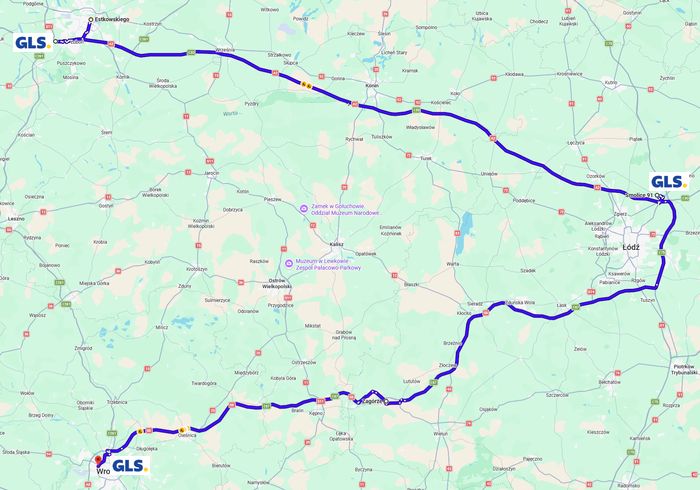
“Non-obvious” route from Poznań to Wrocław
Analysis of data from the accelerometer installed in the parcel yielded surprising conclusions regarding the physics of transport. The recorded G-force spikes reaching from 15G to over 21G seemed alarming to us at first. In reality, however, it turned out that such values are generated by mundane activities, such as quickly lifting the parcel, placing it on a conveyor belt, or a courier dynamically setting down a basket of parcels. Experts emphasize that these forces primarily affect the outer cardboard, while the contents, protected by fillers such as bubble wrap or newspapers, experience much smaller accelerations. This scale is completely different from the G-forces experienced by jet pilots, because in logistics we are dealing with a very short duration of impact and small distances, which, with proper packaging, does not threaten the goods.
Equally important in the transport process is the temperature dynamics, which the research device recorded throughout the entire test. The parcel began its journey at a comfortable room temperature of 24.8°C, but as it moved between branches and during the night line-haul transport, the temperature inside the parcel systematically dropped. The lowest values, oscillating around -1.5°C, were recorded during a frosty night in the delivery van and while waiting for pickup at the parcel locker. Such a large amplitude of temperature changes, amounting to over 26 degrees Celsius, is key information for senders of thermally sensitive goods and highlights the importance of using appropriate thermal insulation packaging in such cases.
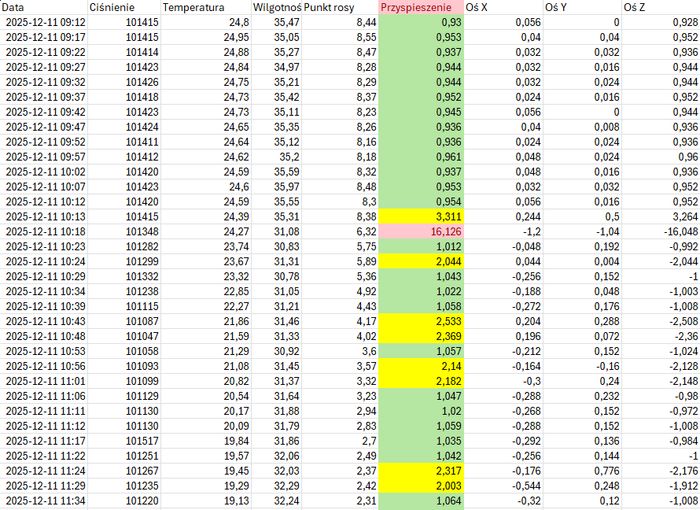
Fragment of the data we received from the measuring device. We analyzed over 8720 such measurement points.
Interesting facts from our parcel’s route:
- Extreme (but safe) G-forces: The highest recorded force acting on the parcel during standard handling reached a record 21.5 G.
- “Illogical” logistics: The parcel from Poznań to Wrocław traveled a total of almost 490 kilometers because its route led through the central sorting hub in Stryków near Łódź in order to optimize fleet utilization.
- Temperature amplitude: During the entire journey, the difference between the highest recorded temperature (+24.8°C) and the lowest (-1.5°C) was as much as 26.3 degrees Celsius.
- Primacy of information: In a modern courier terminal, a parcel can spend anywhere from a dozen minutes to several hours, depending on the speed of filling the container for a given direction, but information about its status is available in the system immediately after every scan.
- Time in transit: The journey from the vicinity of Estkowskiego Street in Poznań to the parcel locker on Na Ostatnim Groszu Street in Wrocław took exactly 27 hours.
- Flexibility of connections: The hub and spoke system is not rigid. Parcel transport can take place in three ways: through the central sorting hub in Stryków (as was the case with our parcel), through regional sorting centers, or directly, if a sufficiently large volume of parcels is generated between two branches (e.g., Poznań and another large center).
In summary, the study showed that modern logistics is a precisely designed system in which information precedes the physical goods. What is a simple parcel pickup for the customer is, in reality, a sequence of dynamic operations based on Big Data and advanced automation.
Behind one seemingly simple delivery of an ordered parcel lies a complex and precisely synchronized chain of logistics operations. From the moment of the first scan and entry of the parcel into the IT system, through subsequent stages of sorting and verification of its parameters, to the final delivery to the recipient. This is not – as it might seem – a simple path “from point A to point B”, but a passage through successive stages of the logistics network, in which every action has its defined sequence and is reflected in the IT system. That is why the close connection of the physical movement of the parcel with the flow of information – and Live Tracking at the last-mile delivery stage, available in GLS in real-time – makes the entire process predictable, transparent, and functioning as one coherent mechanism.
– says Gabriel Gawron, Business Owner GLS Live Tracking.
Click on the photo and download the diagram with the individual elements of the logistics process.
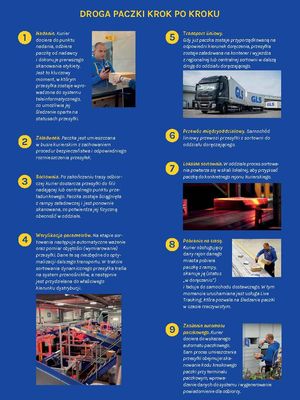
We also encourage you to listen to the podcast, in which our editor, Marcin Tomkowiak, talks with GLS representatives – Marek Matysik and Gabriel Gawron – about the “non-obvious” route, G-forces, and other interesting facts from our parcel’s journey.