








As part of the “Safe Crossing – Barrier to Risk!” social campaign, partnered by entities including Poczta Polska, PKP is marking railway crossings and level crossings. The goal of the project is to increase the level of safety in railway areas and eliminate potential threats caused by improper driver behavior or random incidents.
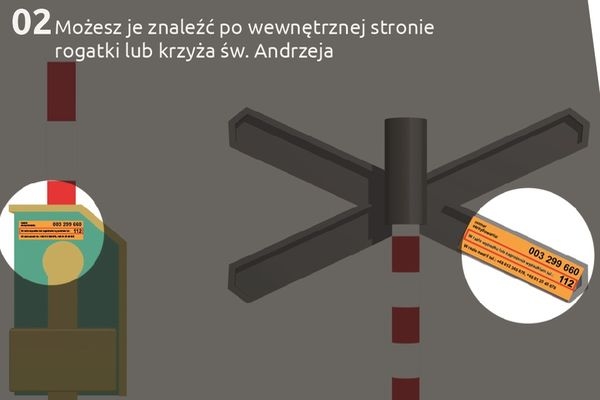
Reflective stickers are used for marking, containing an individual identification number for the railway-road crossing, the 112 emergency number, and emergency contact numbers. In the event of a car breakdown at a crossing, calling 112 allows for the precise location of the incident to be determined, enabling railway workers to quickly halt train traffic. A rapid response increases the chance of, for example, stopping a speeding train at a safe distance, which can prevent a tragic event.
Reflective stickers are located on the inside of St. Andrew’s crosses or on gate drives (the posts to which the gate arm is attached). PKP Polskie Linie Kolejowe S.A. has marked 14,000 railway-road crossings in this way.
The yellow stickers are another initiative that reduces risks resulting from improper driver behavior or random events. As part of the “Safe Crossing – Barrier to Risk!” campaign, conducted by PKP for over a dozen years, a series of activities aimed at drivers, driving instructors, and pedestrians (children, youth, and adults) is being implemented. These include appeals for safety, education, training, seminars, and the analysis of car-train accidents.
Every year, there are about 200 accidents and collisions at crossings, resulting in dozens of deaths. Last year, on average, an accident or collision occurred at a railway-road crossing in Poland every 42 hours, and on average, a person died at a railway-road crossing in Poland every 8 days. Statistics kept by the PLK Safety Office show that up to 99% of the events described above occur due to driver fault. Most of them were caused by recklessness, irresponsible behavior, blatant disregard for traffic regulations, or failure to comply with signals prohibiting entry onto the crossing.