








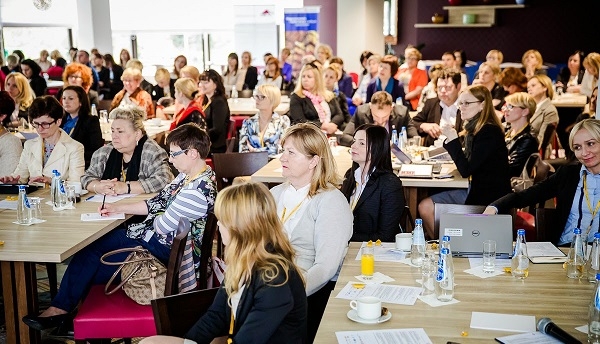
“Good and bad logistics” – do good and bad practices exist in logistics, where are their boundaries – under this slogan, the 3rd Women in Logistics Forum was held in Gdańsk on June 2-3, organized by Beata Trochymiak, publisher of the Pracujwlogistyce.pl portal.
This year’s forum gathered over 150 people, and the speakers included top experts known not only in Poland but also worldwide! The conference is the only one of its kind and the most intriguing meeting in the TSL industry, as it is dedicated to women working in logistics, as well as management staff on both the supplier and recipient sides of logistics services. The forum’s topics concern the business side, not the operational side of logistics.
The goal of the Women in Logistics Forum is to enrich the industry with a new perspective and approach to the logistics business, industry networking, and above all, promoting and supporting women in their professional development. Managers are also invited to participate in the conference, and their participation is growing year by year.
It is a tradition of the Women in Logistics Forum that it begins with the topic of “Women’s leadership in the Polish world of logistics,” which has been presented since the first edition of the conference by Prof. Halina Brdulak from the Warsaw School of Economics (SGH). In addition to presenting the latest research on the participation of women in management positions in companies – which is unfortunately still at a very low level, and Poland is far behind many EU countries in this respect – Professor Brdulak presented “mega trends” in modern supply chains.
– We used to talk about globalization, today many companies are striving for regionalization. This results from economic instability and cost-cutting. Regionalization allows for risk reduction, as it is easier to exercise control over supply chains locally than globally. The pursuit of building a network economy, in which trust in cooperation counts the most, can be considered a mega trend. Those who do something together rather than individually have a chance – said Prof. Halina Brdulak.
The topic of “Leadership and opportunities for development” was broadly expanded upon and presented in his lecture by Prof. Cezary Wójcik, director and founder of the Center for Leadership, professor at the Polish Academy of Sciences (PAN) and SGH. Professor Wójcik is one of the world’s top experts in leadership and one of the youngest economics professors. – Leadership is important regardless of the relationships in which we build it, whether among employees, on the market, or in terms of cooperation with the client. What we do together is also important. Only joint identification gives the strength to get through difficult moments – explained Prof. Cezary Wójcik.
The next thematic session, titled “The economics of logistics according to the logistics service provider,” began with speeches on the main logistics hubs in Poland – social obligations versus business and logistics rights, which have their origins right here in Gdańsk. – It is in Gdańsk that the pan-European transport corridors on the Baltic-Adriatic route have their beginning. Therefore, we bear a huge responsibility for the construction and development of the entire maritime and land infrastructure to ensure very good access from the sea and road side. Only good infrastructure will ensure the competitiveness and intermodality of the Polish economy – said Dorota Raben, President of the Management Board of the Port of Gdańsk Authority.
Lidia Dziewierska, President of the Management Board of Loconi Intermodal S.A., presented an example of interoperability possibilities and intermodal market challenges in her speech. – Achieving synergy and cooperation among several cooperating companies is possible. Intermodal transport is the best example of implementing a network economy and an example that it pays off. Thanks to the fact that it connects many links and branches of transport and involves many entities, cooperation at a high level of trust and partnership becomes the standard. Such cooperation is possible among companies that are aware of participating in a large undertaking, which ultimately provides huge economic and social value – emphasized Lidia Dziewierska.
However, how the logistics services market will develop will ultimately depend on the consumer, i.e., the end recipient of goods. Monika Hapter, Head of Contract Logistics Development at DB Schenker Logistics, spoke about this. – Customer expectations are constantly changing, and they set the trends for logisticians. The customer expects the possibility of real control over the supply chain. They require non-standard actions, innovation, proactivity, transparency, and partnership, which means, in short, that logistics must strive for excellence – said Monika Hapter.
The second session was interestingly summarized in a discussion panel moderated by Prof. Halina Brdulak, which included: Ewa Zawadzka, Vice President and Head of Development at Prologis for Poland, Beata Jakubowska, Contract Manager at CEVA Logistics, Barbara Janczaruk, Proxy at Dedicated Logistics/WISTA Poland, Julian Skelnik from the Port of Gdańsk Authority, as well as speakers: Lidia Dziewierska from Loconi Intermodal S.A. and Monika Hapter from DB Schenker Logistics.
The discussion revolved around good and bad practices in logistics and the future of logistics in 10 years. The conclusion was that e-commerce and modern technologies will be the main drivers of their development.
The third thematic session of this year’s Women in Logistics Forum concerned the economics of logistics according to the recipient of logistics services, which began with a speech by Dagmara Głowacka, Global Logistics Manager at Kongsberg Automotive, titled “Logistics as a cost center or cost optimization.” Dagmara Głowacka presented the problem from the perspective of relationships and cooperation with the board in manufacturing companies, which often look at logistics processes only in the context of operations that do not bring business but only generate costs. How to change this, how to talk to the board, in what language, and how to understand logistics in general – these are the questions Dagmara Głowacka answered.
Before the speeches on cooperation in logistics based on the “win-win” principle, participants could familiarize themselves with an example of such cooperation in the Volvo Trucks Poland Group – the merger of two brands – Volvo Trucks and Renault Trucks, which until recently were competing with each other, and today operate in one Volvo Trucks concern, as an example of a partnership merger of two strong brands on the market.
Subsequent presentations concerned case studies that showed the possibilities of cooperation on a “win-win” basis, when and how to cooperate so that each party feels like a winner in this cooperation? Alina Nikodem, Logistics Operations Manager – UK & IE, UltraLogistik, Unilever Poland Services, said – Customer satisfaction and their expectations are the driving force of logistics. The supplier delivers what the customer wants, and then they will benefit if this cooperation is based on trust, clear rules, i.e., informing each other about everything that happens at every stage of cooperation. Alina Nikodem raised an important problem that has recently been affecting the TSL market and, in her opinion, is spoiling the market and fostering the development of bad practices in logistics. The problem arises when a service provider’s employee changes jobs and moves to another, competing company. Then they call their previous employer’s client and propose cooperation because, since they know the rates they offered the client at the previous company, they can offer more competitive ones. – There should be only one answer to such behavior from us as clients – NO, because we work together, because we act according to the rules and partnership – said Alina Nikodem.
The next case study, also concerning the “win-win” principle, but seen through the eyes of a transport and logistics service provider, was presented by Andrzej Szymański, Managing Director of DARTOM Sp. z o.o. – As a rule, the service provider does not define the rules of cooperation, because the Client defines them, and we depend on them. However, another issue is whether we will be able to start cooperation with a given client, e.g., by participating in tenders, and when are they good? If a tender is announced only to lower transport prices, it will not be good, but if it is to increase quality and efficiency, we can talk about a good tender. High client requirements always speak for win-win cooperation – said Andrzej Szymański.
The last two speeches were devoted to logistics in the cosmetics and pharmaceutical industries. Violetta Wojciechowska, Director of the Domestic Transport Operations Office, Farmada Transport in the Neuca Group, showed in her presentation the transition from internal distribution to the external market of services and the benefits that the service provider market and other clients can gain. Home delivery, i.e., deliveries directly to the patient, high requirements for precision in supply chains, trust, and continuous quality improvement while maintaining absolute punctuality – these are the most important values that an operator with experience gained in their own organization can bring to the market.
– When I started working at Farmada Transport, having already over a dozen years of experience in transport, I had to accept that transport optimization understood as cost-cutting is important, but not at any price. Here, precision, knowledge of procedures, and mutual trust count – explained Violetta Wojciechowska.
The last speech, titled “Customer requirements and challenges for logistics departments – new trends in cooperation with subcontractors and cooperators,” was an interesting conclusion to all the lectures of the 3rd Women in Logistics Forum. Katarzyna Śliwińska, Supply Chain Manager at Oceanic S.A., presented a case study on the example of the “AA” cosmetics series, showing the evolution of customer requirements for cosmetic products and the changes that the logistics department must follow.
The entire conference was summarized by Prof. Danuta Kisperska-Moroń from the University of Economics in Katowice, who, to everyone’s surprise, did not necessarily agree with the theses put forward in some speeches during the 3rd Women in Logistics Forum.
– We decided to define good logistics today, and I don’t know what it is. However, it turned out that good logistics is when it takes into account the customer’s requirements. If we use tricks against the client, the client will also use them against us. So can there be a partnership with the client? No, because it is the client who imposes certain requirements and obligations on the logistics and transport service provider. And the “win-win” principle is a slogan of consulting firms, because in business such a situation is difficult to achieve – said Prof. Danuta Kisperska-Moroń to the surprise of the participants. – It is easier to define what bad logistics is. Bad logistics does not bring customer satisfaction. Bad logistics generates high costs. There are often hidden costs of poor customer service that are not counted or noticed, e.g., costs of lost sales or costs of excessive inventory and the risks associated with it. Management staff often forget the basic principle – if you cannot measure something, you cannot manage it. If we can calculate the balance of costs and losses, we can also talk to the board about logistics. It is important to know various issues and understand them – explained Prof. Danuta Kisperska-Moroń. In the last sentence of the summary, she emphasized that in logistics, one must be more humble towards the uncertainty of operations.
After the proceedings, the participants had time to finish the discussion in the corridors, waiting for the gala dinner, during which the “Woman in Logistics 2013” award and statuette were presented to Ms. Dagmara Głowacka from Kongsberg Automotive, and the evening was graced by a concert by the Tri-City vocalist “Islet”.
On June 3, participants of the 3rd Women in Logistics Forum had the opportunity to participate in port visits, during which they could see for themselves the potential and development opportunities of logistics and TSL services around the most important logistics hubs in Poland. The first visit took place at the L. Wałęsa Airport in Gdańsk. After the visit to the airport, the Forum participants had the opportunity to take a boat trip, which was organized by the Port of Gdańsk Authority. During the cruise, it was possible to see the outer port, including the container terminal quays and part of the inner port, while having the opportunity to listen to a presentation on the history of changes in the port and future possibilities.
Although the weather was not favorable, as always, the atmosphere during the Women in Logistics Forum was exceptionally warm and served to exchange experiences and contacts, thanks to the participants themselves, among whom was an exceptional group – Managers of Polish logistics, but there was no shortage of Managers, for whose greater participation the organizers hope next year. We already invite you to participate in the 4th Women in Logistics Forum in 2015.
Partners of this year’s Women in Logistics Forum were: DB Schenker, Prologis, L. Wałęsa Airport in Gdańsk, Port of Gdańsk Authority, CEVA Logistics, Dartom, Farmada Transport, Loconi Intermodal, Volvo Trucks, and Renault Trucks Polska.
Patronage over the conference was taken by: WISTA Poland, Polish Logistics Association, Polish Chamber of Forwarding and Logistics, Institute of Logistics and Warehousing, GS1, ECR Poland, and Vital Voices Poland.
Media patronage: magazines – Transport Manager, Logistyka, Logistyka a Jakość, Nowoczesny Magazyn, TSL Biznes, BusinessWomen&Life, and portals: Sukcespisanyszminka.pl, Spedycje.pl, etransport.pl, nm.pl, logistyka.net.pl, log4.pl, warehousemonitor.pl.