








According to data from the Office of Electronic Communications, 921.6 million courier and traditional postal parcels were delivered in Poland last year. This is an increase of 14.5 percent year-on-year. Along with the growth of the CEP (courier and postal services) market, the demand for people working as couriers is also increasing. According to the Randstad employment agency, most courier companies recruit self-employed individuals who own their own vehicles. These are self-employed drivers (on B2B contracts) who handle the transport of parcels between sorting centers and branches, as well as directly to recipients, performing so-called last-mile logistics services.
Self-employment for couriers has many benefits, but it is also the cause of their financial problems. Achieving an adequate income requires incurring costs. When these are higher than revenues, a company may lose the ability to settle its financial obligations.
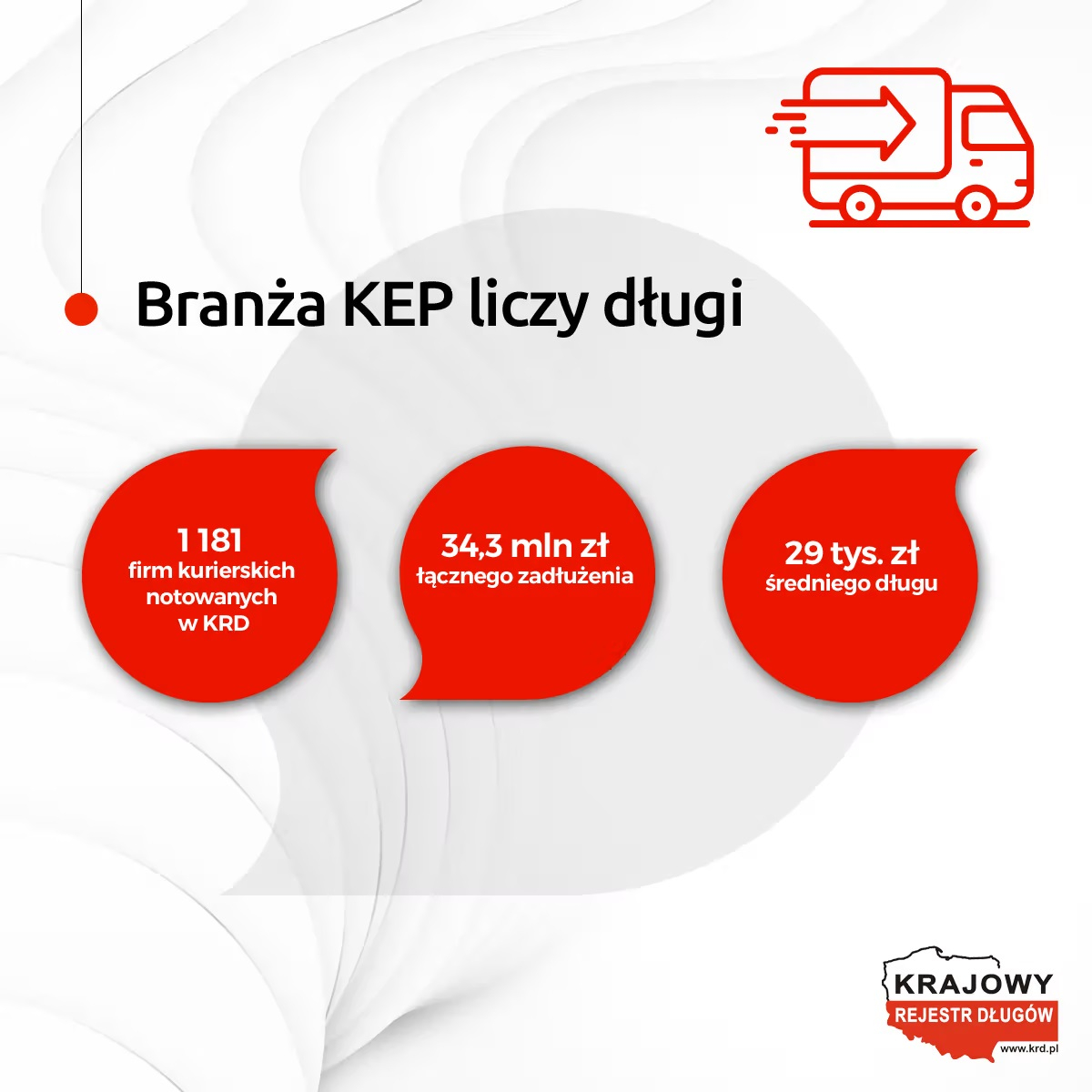
The National Debt Register lists 1,180 companies engaged in postal and courier activities, with debts totaling PLN 34.3 million. The vast majority of them, 75 percent, are sole proprietorships, i.e., people working as subcontractors for large companies. But not only them, as 1/4 of all debtors are commercial law companies that have over PLN 10 million in overdue financial obligations.
– B2B cooperation instead of employment in the CEP industry has many advantages, but it involves the necessity of setting up a sole proprietorship and purchasing a vehicle. For this purpose, many self-employed people take out a loan or lease. As long as couriers receive transport orders and payment for their services, they settle their obligations on time. Problems arise when clients start cutting costs and questioning existing price lists, or when they stop paying for deliveries. That is when couriers fall into debt – says Adam Łącki President of the Management Board of the National Debt Register Economic Information Bureau
Couriers owe money primarily to financial institutions (banks, factoring and leasing companies) – PLN 19.3 million, and to companies providing consulting services in the field of business management – PLN 6.2 million. They also fail to pay on time for car rentals – PLN 1.1 million, office administration – PLN 1.2 million, transport services – PLN 2.8 million, or trade services – PLN 1.6 million. Suppliers with the highest debt operate in the following voivodeships: Masovian (PLN 7.5 million), Silesian (PLN 4 million), and Lower Silesian (PLN 3.3 million). Conversely, payers with the lowest debt in the KRD deliver parcels in the following voivodeships: Lublin (PLN 324,000), Podlaskie (PLN 410,000), and Lubusz (PLN 642,100). The average debt of one courier company is PLN 29,000, but there are regions in the country, such as the Opole voivodeship, where the average debt of a company in the CEP industry is nearly PLN 130,000. That is also where the record holder comes from – a sole proprietorship with a debt of PLN 2.3 million to, among others, a van rental company.
Trade does not pay couriers for deliveries
– The reliability of courier companies has, as you can see, two sides. Timeliness in delivering parcels is one thing, and settling financial obligations on time is a completely different matter. The financial condition of these entities is, on one hand, the result of how they manage their own financial liquidity, and on the other – what kind of business partners they encounter. Because when other companies do not pay them for deliveries, they themselves also become insolvent – says Katarzyna Starostka expert at Rzetelna Firma
According to KRD data, other companies owe couriers PLN 27.1 million. This is almost 80 percent of the total debt of the CEP industry. And the number of unreliable payers is 4,269 companies, which is 3.6 times more than the number of indebted parcel suppliers. The leader among debtors is the trade industry. In this sector, 2,284 companies have PLN 15.1 million to pay for postal and courier services. The second largest debtor of the CEP industry is the industrial sector (PLN 3.1 million), followed by the TSL industry (nearly PLN 3 million). The study “Relationships between contractors after commissioning debt collection,” conducted on behalf of the debt collection company Kaczmarski Inkasso in 2021, shows that the smallest companies approach the recovery of receivables from business partners with great distance and have problems with enforcing payment for their work. Compared to companies employing more than 10 employees, micro-firms more often conduct debt collection on their own.
– The vast majority, more than three-quarters of sole proprietorships, used the services of professional debt collection companies against less than 5 percent of their debtors. Such conclusions were brought by a study on micro-entrepreneurs, and our practice confirms it. We observe that the smallest companies, including sole proprietorships, rarely hand over their receivables for collection. The main reason is the fear of losing a contractor. Commissioning professionals to recover debts is a clear signal to the environment that the entrepreneur cares about their finances – comments Jakub Kostecki President of the Management Board of Kaczmarski Inkasso.
Source: National Debt Register.