








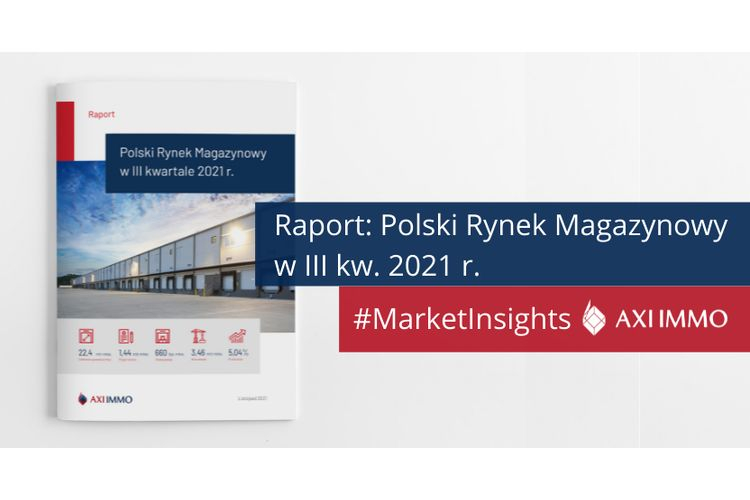
Developer activity in the Polish warehouse market at the end of September 2021 remains at a high level. The delivery of 660,000 sqm in the third quarter of this year increased total logistics and industrial stock to 22.4 million sqm. There is 3.46 million sqm under construction, of which over 1.22 million sqm (+120% y/y) are speculative investments without secured lease agreements. In the analyzed period, gross demand amounted to 1.44 million sqm (+16% y/y), where, as expected, the e-commerce and logistics segments remained the main drivers. The correlation between strong demand and moderate new supply affects the vacancy rate, which stood at 5.04% (-2.66 pp y/y) at the end of September. AXI IMMO presents the results of its latest report, “Polish warehouse market in Q3 2021.”
Warehouses with a nearly 50% share in the investment market after the first three quarters of 2021
The total volume of investment transactions in the commercial real estate market in Poland after summing up the first three quarters of 2021 amounted to EUR 3.53 billion. The warehouse real estate segment accounts for nearly half (approx. EUR 1.7 billion) of the capital generated during this time, with transactions at the level of EUR 800 million in Q3 alone.
Among the largest selected transactions in Q3 2021 in the investment market in the warehouse sector were the sale of the Tristar portfolio (160,000 sqm) with properties located in Poznań, Wrocław, Warsaw, Czeladź, and Gdańsk to the Exeter fund. In turn, the Savills IM – ELF3 Fund decided to buy Panattoni A2 Warsaw Park (103,700 sqm) located in Grodzisk Mazowiecki from Invesco Real Estate. In Q3, the company 7R was also active, selling its three warehouse parks, i.e., 7R Park Kowale II (52,000 sqm) was acquired by Generali Real Estate, and the new owner of 7R Park Poznań East and 7R Park Sosnowiec (a total of over 44,800 sqm) became CBRE IM. The strong investor appetite observed in Q3 2021 caused further yield compression, where big-box facilities are valued at 4.5% – 5.0%, while urban warehouses at approx. 4.25% – 4.50%.
– The warehouse real estate sector is fully taking advantage of its opportunity, and after years of dominance by office and retail real estate, it is now at the forefront of interest from foreign entities. The greatest attention of investors is focused on large multi-tenant warehouse hubs, which this year account for more than half of the transactions carried out. The rapid development of the urban logistics segment, as well as the increased number of BTS-type projects, means that these asset classes are also increasingly being considered as a good opportunity to monetize capital – says Renata Osiecka, Managing Partner, AXI IMMO.
Five main warehouse markets accounted for over 73% of total demand in Q3 2021
From the beginning of July to the end of September this year, gross demand in the Polish warehouse market amounted to 1.44 million sqm (+16% y/y). In the analyzed period, tenants were most active in Warsaw (365,000 sqm), Upper Silesia (266,000 sqm), the Kuyavian-Pomeranian region (171,000 sqm), Lower Silesia (148,000 sqm), and Poznań (147,000 sqm). In the demand structure in Q3, transactions for logistics operators and e-commerce dominated, which together accounted for over 50% of leases. Among the five largest transactions in Q3 2021 were the lease (new agreement) of over 104,000 sqm by an international e-commerce company in Hillwood Bydgoszcz, followed by three logistics operators who decided to sign new agreements for over 53,000 sqm in 7R Park Goleniów II, 34,000 sqm in Panattoni Park Głogów, and 29,700 sqm in Segro LP Poznań Komorniki, respectively. In turn, a tool industry company signed an agreement for 26,000 sqm in Segro Business Park Gliwice.
The total leasing volume in the period from January to September 2021 in the Polish warehouse market amounted to 4.38 million sqm; this result translates into a 25% increase year-on-year. The highest tenant activity in the first three quarters of 2021 was recorded in Warsaw (944,000 sqm), Upper Silesia (816,000 sqm), Poznań (797,000 sqm), Lower Silesia (585,000 sqm), and Central Poland (487,000 sqm). At the same time, new lease agreements and expansions accounted for as much as 75% of the demand structure.
– We are on the best path to match or beat last year’s result in demand in the Polish warehouse market. Breaking the 5.2 million sqm barrier is very realistic, as reflected by the excellent results for the first three quarters of this year and a 25% increase in tenant activity compared to last year’s leasing indicators. The development of e-commerce and industries serving this sector is driving the market. One should also carefully monitor the activity of courier companies, which have announced that they will introduce a same-day-delivery service in selected cities by the end of 2021. Nevertheless, we expect that greater regionalization of supply chains will intensify trends such as nearshoring or cross-border in the coming months – says Anna Głowacz, Director of the Logistics and Industrial Department, AXI IMMO.
Record level of space under construction along with a growing share of speculative projects
Developer activity in the Polish warehouse market in Q3 2021 amounted to over 660,000 sqm (+5.6% y/y), which translated into an increase in the total stock of modern warehouse space to 22.4 million sqm. In the analyzed period, the most new supply was delivered in the Western Poland region (316,000 sqm), Poznań (88,000 sqm), Lower Silesia (66,000 sqm), and Upper Silesia (61,000 sqm). In the case of Western Poland, a significant accumulation was the result of the commissioning of the Panattoni BTS project in Świebodzin (over 200,000 sqm of usable space) for Amazon. In the first three quarters of 2021, 1.77 million sqm of new space was delivered to the warehouse market, which is a result similar to the reference period a year ago. During the analyzed time, the most new supply was delivered in Western Poland (337,000 sqm), Upper Silesia (310,000 sqm), and Warsaw (259,000 sqm).
Good forecasts for the development of the warehouse market, as well as high demand, influence the decisive moves of developers. At the end of September 2021, 3.46 million sqm was under construction, of which 35% was space built in a speculative model. The volume of investments without secured lease agreements amounts to 1.22 million sqm, which is an increase of over 120% compared to last year. Among the largest warehouse parks under construction are GLP Lędziny (111,500 sqm), Hillwood Bydgoszcz (104,300 sqm), Panattoni Park Głogów (73,000 sqm), and two projects from 7R, i.e., 7R Mysłowice (50,770 sqm) and 7R City Flex Katowice II (41,100 sqm).
– We expect that in the next few months, the developer market will face a certain challenge related, firstly, to the security and availability of investment land, and secondly, to rising labor costs and the extension of project implementation by about 2-3 months. Limited investment alternatives make negotiations with owners of investment land difficult, as they expect higher starting rates – adds Anna Głowacz.
The high level of developer activity along with unflagging demand contributes to a decrease in the vacancy rate. At the end of Q3 2021, there was approx. 1,129,000 sqm of space available immediately in all of Poland, i.e., approx. 5.04% (-2.66 pp y/y) of the total warehouse market stock. The highest vacancy rate among the analyzed markets remains in Upper Silesia (7.6%), Central Poland (6.6%), and Warsaw (5.2%). In principle, there is a lack of space for rent immediately in Szczecin and Eastern Poland. The demand-to-supply ratio did not significantly affect changes in asking rent rates in the last quarter, which remained at the previous level.
– We expect that in the coming months, the results of new supply in the Polish warehouse market will not significantly deviate from the current average. Nevertheless, one should keep in mind the increasing challenges related to the availability of investment land along with labor shortages. A large volume of investments carried out in the speculative model should soon help regulate average rent rates and satisfy the sudden demand for space from the two most active tenant groups, i.e., e-commerce and logistics operators. In turn, on the threshold of actions related to limiting the sector’s impact on climate change, we predict a deepening of the trend related to introducing green solutions to warehouses, where certification will be one of the standards – concludes Renata Osiecka.
Source: AXI IMMO