Experts from the Polish Economic Institute and the Ministry of Infrastructure have developed a report titled “Autonomous Transport of the Future.” The document points to the most important components of a new vision for transport in light of dynamic changes in the transport industry and technological development.
The study was created in the context of economic problems during the coronavirus epidemic and discusses the current state and future of technology application in transport, as well as the development of autonomous transport.
Key findings of the report
Autonomous transport is no longer a futuristic vision, but a reality currently taking shape. Examples include automatic metro systems, shuttle buses, and drones. Technological development is being followed by increasing investments in autonomous ventures. Cars with level 2 autonomy, equipped with advanced driver-assistance systems, are already available for sale. Work is also underway on fully autonomous vehicles. In Poland, the most intensive progress in the area of autonomous transport concerns drones. In 2018, the Central European Drone Demonstrator was established in the Upper Silesian-Zagłębie Metropolis – a joint initiative of the government and the metropolis for the development of urban drone transport, including autonomous transport. A government research project on autonomous vehicles is also being implemented. Autonomous transport relies on sensors that analyze the surroundings, and the movement of autonomous vehicles is based on continuous vehicle-to-vehicle communication (using the ITS-G5 system based on Wi-Fi or C-V2X based on 4G or 5G cellular networks) and vehicle-to-infrastructure communication. The development of autonomous road transport will require equipping infrastructure and protection against cyber threats. It will also be necessary to create appropriate regulations governing the issue of liability and the rules for shared use of transport infrastructure.
Benefits of automation
Automation can be an answer to problems related to the shortage of drivers and a source of savings. Savings will certainly be influenced by improved road safety associated with reducing or eliminating accidents caused by human error. Total automation could bring up to PLN 51 billion in savings from saved lives and health of road users. The automation of freight transport alone could allow for savings of PLN 3.6-4.9 billion due to improved road safety. Autonomous transport can bring savings in fuel consumption (or energy in the case of electric vehicles). This, of course, translates into reduced air pollution. Total savings for the logistics industry due to lower labor costs and fuel costs could amount to as much as PLN 2.4 billion annually.
Experts from the Ministry of Infrastructure and the Polish Economic Institute believe that the acceleration of transport technology development in Poland, including autonomous ones, will occur thanks to investments implemented in connection with the Central Communication Port (CPK).
– It is certain that the Central Communication Port will be a stimulus for the economy during the expected slowdown resulting from the pandemic. Such a large public investment is a panacea for a potential economic downturn. At the same time, the CPK is a place for integrating technologies of various calibers. This investment will build and develop the capacity to produce new technologies based on national scientific and production potential. The CPK is a project thanks to which Polish technological thought and domestic technologies, including those currently at an early stage of development, will find application. An example could be infrastructure for managing unmanned aerial vehicle traffic, already successfully implemented in controlled airport zones, or last-mile transport using drones. In the case of UAVs, investments should not be postponed; on the contrary, they should be intensified – said Deputy Minister of Infrastructure and Government Plenipotentiary for the CPK, Marcin Horała.
As part of the CPK, the following will be built: a transfer airport between Warsaw and Łódź, serving up to 45 million passengers annually in the first stage, and railway investments enabling travel between Warsaw and the largest Polish cities in no more than 2.5 hours.
– We are facing preparations for the accelerated implementation of new technologies. Good organization of this process and its effectiveness will determine the future of the Polish technological ecosystem. Transport technologies are undergoing a transformation related to digitalization and autonomization. We have huge potential in this area, which is confirmed by experiences with the development of a technological environment for the automation of airspace management. The CPK will be a recipient of many solutions that are currently being tested – emphasizes the Plenipotentiary of the Minister of Infrastructure for Unmanned Aerial Vehicles and the Central European Drone Demonstrator program, Małgorzata Darowska.
It is not known what scope of transport will be automated. Autonomous solutions will be introduced gradually into road, rail, sea, and air transport. In the coming years, work will be carried out on developing a development policy in the field of transport and selecting technical solutions.
Source: Ministry of Infrastructure
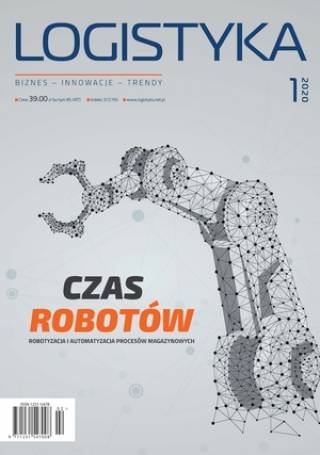
We wrote more about automation in Logistyka magazine 1/2020.
The e-edition of the magazine is available in our offer!