








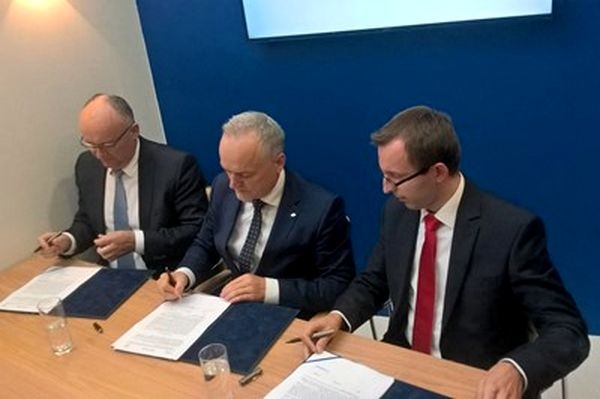
PKP CARGO S.A. will cooperate with Pesa Bydgoszcz S.A. and the Rail Vehicle Institute “TABOR” in Poznań on research and development work for the construction of a dual-system autonomous locomotive.
The agreement in this regard was signed in Berlin during the InnoTrans trade fair by the CEO of PKP CARGO S.A. Czesław Warsewicz, the head of Pesa Bydgoszcz S.A. Krzysztof Sędzikowski, and the director of IPS “TABOR” Maciej Andrzejewski. It stipulates that PKP CARGO and Pesa will develop the technical specifications and configuration of the designed locomotive, which will be verified by scientists from IPS “TABOR”. The second stage will involve design and research work, after which Pesa will proceed to build a dual-system, electric-diesel autonomous locomotive. The first vehicle will be tested by PKP CARGO, which will allow for checking the locomotive’s operation under normal track working conditions and introducing corrections and improvements to its design.
Czesław Warsewicz, CEO of PKP CARGO S.A., points out that dual-system locomotives are versatile, as they allow for both shunting and line operations without the need to change vehicles.
– We are optimistic about the joint research and development work on new locomotives, and we hope that the result will be the construction of innovative vehicles that will increase the efficiency of our work – emphasizes Czesław Warsewicz. – New locomotives will be more efficient and will contribute to cost reduction, which is of significant importance in the situation of rising fuel and energy prices – adds the head of PKP CARGO S.A.
– This agreement is an example of our good cooperation with PKP CARGO. It is important to us and shows that we are not only dealing with the restructuring of the company, but we are also thinking about innovation – said Krzysztof Sędzikowski, CEO of Pesa Bydgoszcz.
The project for an electric-diesel autonomous locomotive, based on the Gama family of locomotive platforms, received a positive assessment and a recommendation for funding under the Innotabor program announced by the National Centre for Research and Development. The autonomous locomotive, after completing all tests and obtaining the required legal permits, is expected to enter service in four years. The vehicle is intended to reach the GoA3 level of automation. In practice, this will mean that the locomotive will not require the driver to monitor the route, as safety will be ensured by an autonomous control system guided by artificial intelligence (AI). It will consist of a system of sensors, cameras, gyroscopes, and other devices. However, a driver will be present in the cabin, primarily to take control of the locomotive in the event of unusual situations.