








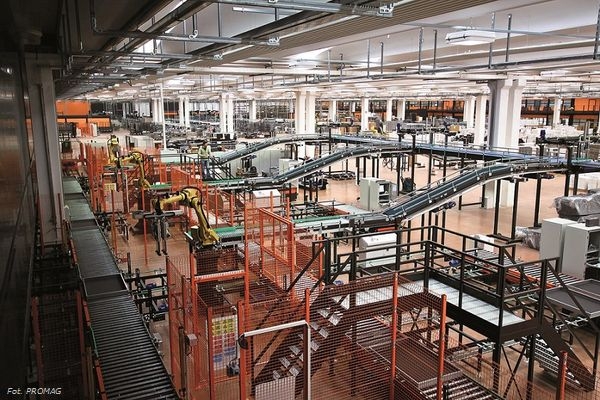
Optimizing logistics processes in a warehouse requires maximizing the use of available resources and may involve changes to infrastructure, the layout of storage zones, process flows, or work organization. Typically, activities related to receiving, storing, picking, and shipping goods take place in different locations. Thanks to, for example, conveyor systems, we can not only accelerate the flow of goods between warehouse zones but also make better use of the available space.
Polish companies want to modernize through investments in infrastructure and modern technological solutions. This applies to both the production and warehousing areas. However, the fundamental problem they must face is the lack of sufficient space.
Additional square meters can always be found
Of course, the simplest but also the most expensive solution is to expand or build entirely new production and warehouse halls, which often unfortunately involves the need to purchase land. Not every company can afford this, partly for financial reasons, but also due to location barriers. Sometimes the only, and at the same time most cost-optimal solution, is 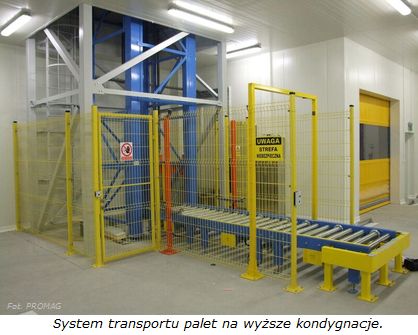 to make maximum use of the existing hall area, utility rooms, unused office spaces, and the entire volume of the building. And this is where modern transport systems come in, allowing materials, products, or packed finished goods to be delivered to any part of the facility.
Efficient picking is the foundation for the functioning of any well-organized distribution center. Optimization of this critical warehousing element is possible through the use of horizontal transport systems, such as roller, belt, or wheel conveyors. Conveyor systems are used to connect several distant warehouse zones (for example, connecting the receiving zone with the picking and shipping zone).
– Fast transport and smooth goods flows contribute to improving the efficiency of the order picking process for customers. The key to expanding warehouse space, however, is multi-level transport, utilizing all kinds of lifts, vertical conveyors, or freight elevators that fill the space above standard communication routes. These devices work with transport systems located on platforms, mezzanines, and bridges, as well as inside tunnels connecting buildings. Multi-level transport significantly contributes to increasing the freedom of investment and the introduction of new solutions where limited space ceases to be a problem – emphasizes Karolina Tokarz, Vice President of the Board and Director of Sales and Marketing at PROMAG S.A.
Transport systems must be, above all, reliable and durable
Automatic transport lines are increasingly playing a very important role in supporting technological processes. They complement production by moving goods through heating chambers or cooling tunnels. This contributes not only to increasing the efficiency of warehouse and production processes but also to accelerating the delivery of products directly to the loading point.
– Transport systems are used in places that are difficult for staff and service to access, and this forces the use of reliable technologies and components from proven and reputable companies. It is important that the complete system is equipped with automatic solutions that eliminate errors and allow for remote monitoring, diagnosis, and maintenance response from a control panel or computer. Moreover, when designing technological transport equipment, the principle of simplicity and robustness should be maintained – classic conveyors equipped with driven galvanized steel rollers have been moving goods for years without requiring significant maintenance involvement – adds Marek Łabęda, Technical Director at PROMAG S.A.
Vertical conveyors based on a solid structure using chains to lift very heavy loads connect lines at different levels in an efficient and fast way. These machines are gradually replacing hydraulic lifts, whose performance is limited by heating hydraulic systems. Downtime associated with hydraulic failures and ubiquitous leaks contributes to increasingly frequent modernizations and the replacement of equipment with electrically driven devices.
Complementary solutions
An interesting solution and a complement to transport systems are scissor-belt lifts, which are also replacing existing hydraulic solutions. Mainly due to the short lifting time and nearly twice the efficiency. With the use of high-quality steels, properly surface-hardened scissor system components, and reliable drives, the number of work cycles after which these machines require service intervention reaches 100,000. The key to success and reliability in this case is the lifting belt. The 2.5 mm polyurethane flat belts reinforced with steel cord used in the industry are resistant to oils, greases, gasoline, and UV radiation. They work perfectly during operation in hard-to-reach places and extreme temperatures, both in refrigeration, where 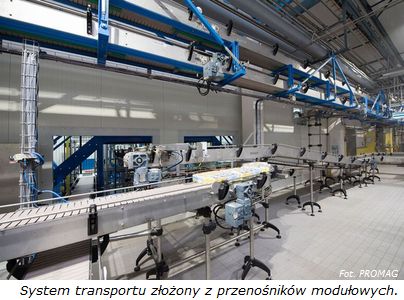 the temperature drops to -30°C, and in rooms with heating equipment, where it reaches up to +80°C.
Lifts are most often used at loading and unloading points of transport lines. This results, among other things, from restrictions on the use of higher-tonnage trucks on platforms and ceilings, but also from the possibility of cost reduction (these devices work well with standard manual pallet trucks).
Another complement to high-performance transport systems are support devices, such as pallet magazines feeding palletizing systems (manipulators and robots) and advanced systems for checking and “repairing” damaged pallets. The use of machines of this type is necessary to achieve appropriate efficiency and to ensure a smooth and safe flow of cargo through a series of devices without failures and downtime associated with the improper quality of the transport unit.
Utilizing every free space in halls significantly contributes to reducing investment and expansion costs. Thanks to the work of designers, transport systems effectively adapt to even the most demanding needs and conditions. They expand warehouse space, providing room and opportunity for the development of production machines in order to increase their efficiency, and consequently, the company’s profits.