









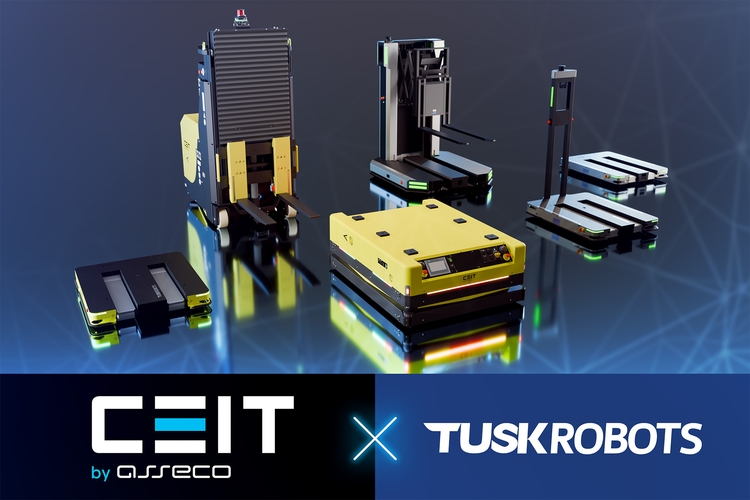
For years, LogiMAT has been setting the direction for intralogistics, but today it is becoming increasingly clear that automation alone is not enough. Autonomous vehicles can move, yet a plant may still lose time due to unpredictable deliveries, lack of WIP visibility, manual dispatch decisions, or safety compliance that is difficult to prove. This is the exact problem addressed by the joint appearance of Asseco CEIT and Tuskrobots Europe, which simultaneously inaugurates their new strategic partnership. Meet the team: LogiMAT 2026, Hall 8, Booth 8D71 (March 24–26, 2026).
What the new partnership brings
From a market perspective, the key is simple: combining the execution layer (AGVs/AMRs performing transport) with the control and transparency layer (software that sees the process, measures it, and allows it to be managed). The Asseco CEIT–Tuskrobots Europe partnership is built precisely around this logic: vehicles + orchestration + real-time data, so that intralogistics is predictable, scalable, and audit-ready.
Software: Twiserion Digital Manager, RTLS, and digital twin as the “language of operations”
The central element of the demonstration is Twiserion, developed by Asseco CEIT (including Twiserion Digital and Twiserion Fleet Manager). Thanks to RTLS, the system builds a digital twin of key flows and provides real-time insight into what is actually happening in production and logistics: where resources are, how material moves, the status of devices, and how operator work is progressing.
From the user’s perspective, the most important aspect is the “one interface” approach: the platform consolidates WIP monitoring, AGV management, delivery planning, and safety monitoring into a single environment, while the modular architecture allows the scope to be adjusted to the plant’s real needs. Additionally, analytics support the identification of bottlenecks and continuous optimization.
Hardware: TuskES-S AMR – heavy pallets, fast commissioning, high safety level
At the hardware level, the premiere TuskES-S AMR, aimed at demanding intralogistics tasks, draws attention. Key parameters include a load capacity of up to 1,000 kg, dual-track navigation (SLAM + DM code), and a standalone scheduling mode, designed for stable operation even where network infrastructure may be weaker.
The implementation aspect is also significant: the solution is intended to support fast commissioning through one-click deployment. In terms of OHS, the vehicle offers 360° obstacle avoidance, using dual laser scanners at the front and rear, along with additional warning and protective functions.
F1000 Series: compact pallet automation for tight spaces
Alongside the AMRs, the partners are showcasing the F1000 AGV family for use in limited spaces.
- F1000AC: a compact, counterbalanced AGV forklift for up to 1,000 kg and lifting up to 1,800 mm, with an emphasis on maneuverability thanks to contour navigation.
- F1000AP: a variant with an “invisible forks” concept (retractable forks) for very dense storage layouts, with hybrid navigation (DM Code/SLAM) and multi-layer safety.
What to check out at the booth
The most interesting theme at Hall 8, Booth 8D71 is not “another robot,” but the entire integration architecture: autonomous transport as the execution layer and digital twin and fleet coordination in real-time as the layer that turns automation into a controllable, measurable, and auditable system. This is the essence of the Asseco CEIT–Tuskrobots Europe partnership — and the reason why their presence at LogiMAT matters to anyone who thinks of intralogistics as an operational advantage, rather than just a single implementation.