









In many organizations, the warehouse management system has served as a stable operational backbone for years. It was responsible for inventory records, location management, and handling basic orders. In an environment of increasing warehouse automation and growing pressure on order fulfillment times, this scope of functions is no longer sufficient. Intralogistics is becoming an environment composed of many collaborating technologies, and the WMS is increasingly taking on the role of an element that integrates them into one coherent operating system.
Modern logistics centers rarely have a homogeneous character today. Alongside manual zones, there are automated warehouses, shuttle systems, packaging lines, sorters, and mobile robots. Each of these elements operates at a different rhythm and according to its own logic. The real challenge is no longer just the implementation of automation, but its sensible integration into existing processes in such a way that the whole system operates smoothly and predictably. This is where the role of the WMS begins to extend beyond classic operations management. The system must not only record events but also actively control workflow, taking into account infrastructure constraints and changing business priorities.
Logistics under pressure of time and scale
This is particularly evident in companies handling large-scale investment projects with high variability. In such environments, logistics is not limited to the regular distribution of repetitive assortments. Equally important is the ability to quickly pick diverse orders, often involving tens of thousands of items, and deliver them in a short time to construction sites, industrial plants, or large infrastructure projects. This requires working with a very large number of SKUs while simultaneously handling orders ranging from single pieces to large project batches, where both speed of execution and the completeness and reliability of deliveries matter.
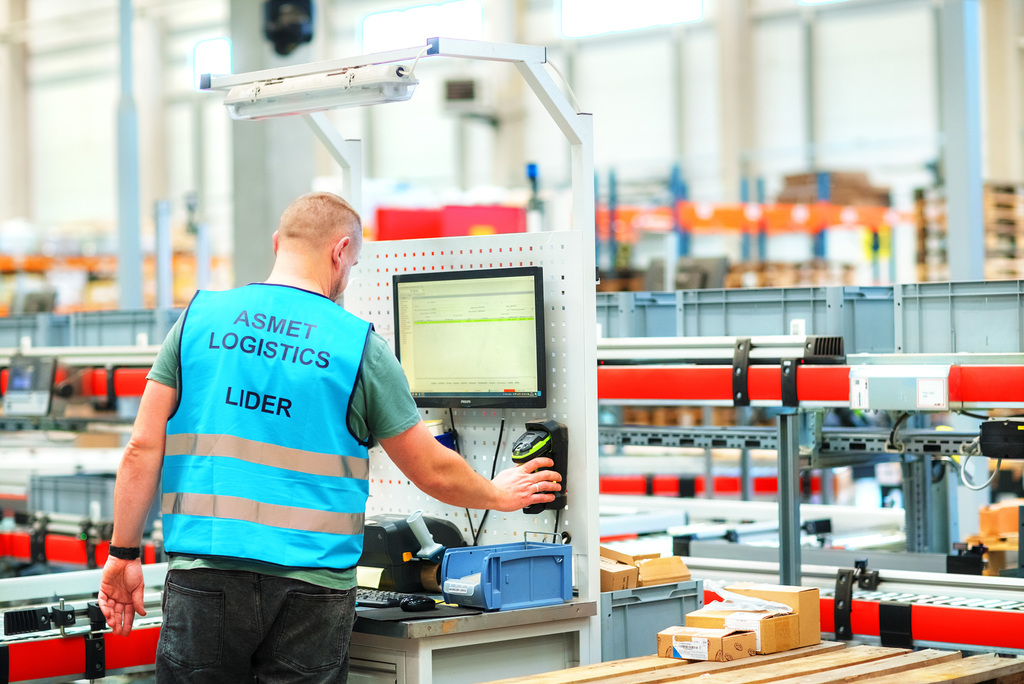
Such conditions are a daily reality for ASMET, one of the leading distributors of fasteners for industry, construction, and energy. The company handles the ongoing needs of manufacturing clients as well as deliveries for large investment projects, where the available time window for execution is often very short, and logistics delays can halt work on a construction site or in a factory. This means maintaining high availability of the assortment while managing high dynamics of warehouse operations and the ability to handle many different picking and shipping scenarios.
When a classic WMS is no longer enough
In such conditions, an approach to WMS limited to record-keeping and basic operation control quickly proves insufficient. With the expansion of ASMET’s warehouse infrastructure, including the launch of a shuttle-type warehouse and the implementation of subsequent automated devices and mobile robots, consistent flow control and the ability to further develop the system without destabilizing ongoing work became crucial.
The company decided to implement a dedicated PSIwms warehouse management system along with an MFC module for material flow control. The solution is developed by PSI Polska, a software provider for logistics, production, and the energy sector, belonging to the international PSI Software SE group. The system was designed from the beginning as an environment capable of working in a warehouse combining automation with manual processes and integrating with subsequent infrastructure elements.
An essential element of this architecture is the cooperation of the WMS with the warehouse automation control layer, i.e., the MFC. Thanks to this, PSIwms focuses on the logic of business processes—order priorities, picking strategies, or shipping wave management—while the MFC layer is responsible for the smooth movement of goods in automated systems. This approach enables the development of automation in stages, adding subsequent devices, and modifying processes without the need to rebuild the entire IT environment.
In the case of ASMET, this is of particular importance because the system must handle both fast unit orders and large project shipments requiring the synchronization of multiple picking and packing streams. PSIwms acts as a central coordinator, connecting various technologies into one coherent operational process and ensuring predictability of execution even with very high order variability.
Order flow under control
The most noticeable change after launching the system was the stability of warehouse operations. With a large number of parallel orders, estimating the actual lead time was previously difficult because operations depended on where bottlenecks occurred in the process. After implementation, the flow of goods was organized. The system decides on the sequence of tasks, and transport and picking stopped competing for resources.
The warehouse stopped reacting only to current events and began working according to a planned sequence of operations. Orders can be processed in parallel, and operators and devices perform tasks according to a single logic of priorities. The average lead time for a single order line is currently about 115 seconds.
The change was not limited to shortening lead times. Operations began to run at a similar pace regardless of the number of orders in the system, which translated into the stability of warehouse work. The company recorded an approximately 60 percent increase in process efficiency and a 35 percent increase in picking productivity. The system also organized the handling of specific requirements of the metal industry, such as different units of measure or deliveries carried out in the Kanban model, i.e., continuous replenishment of stock at the recipient according to their current consumption. Instead of expanding warehouse space, the organization gained the ability to further increase the scale of operations within the existing infrastructure.
The right WMS, properly prepared and implemented, is for us today a base to which we can add subsequent processes necessary for the further development of our company. Cooperation with PSI certainly gave us a lot of confidence. It helped build a system that can boldly compete with the biggest players in the fastener market, not only in Central and Eastern Europe but in all of Europe.
– comments Janusz Onyszczuk, Vice President of the Management Board of ASMET.
Scalability as a condition for development
The implementation was not a project closed in one final configuration. The system is successively developed and integrated with subsequent automation elements and IT systems, which allows for adapting logistics to the growing scale of operations and increasingly higher customer requirements.
In the ASMET project, it is particularly clear that a WMS is not a solution implemented once every few years in an unchanged form today. We design it as an open environment prepared for integration with subsequent technologies, both those available today and those that will appear in the future. Our task is to create a system that can grow along with the client’s strategy – whether it is the expansion of sorters, subsequent generations of AGV robots, or new analytical tools.
– emphasizes Bernadeta Wachowiak, Manager of the WMS Competence Center, PSI Polska.
In such environments, WMS scalability ceases to be a marketing slogan and becomes a condition for maintaining operational efficiency in the long term.
From the point of view of companies planning investments in intralogistics, this means the need to look at the WMS in a broader horizon than current operational needs. Increasingly, it constitutes the foundation upon which subsequent stages of automation and business development are built. When this foundation proves too rigid, every subsequent investment begins to generate disproportionate costs and risks. A system designed from the beginning as an open, scalable platform can, however, support the development of the organization without limiting its capabilities.
As a result, the role of the WMS is shifting from an operational tool toward a strategic intralogistics platform. The ASMET example shows that changing this approach today determines whether automation becomes a real business advantage or remains merely a complex project requiring maintenance.
Source: PSI Polska