








Artificial intelligence is becoming increasingly accessible, which means that entrepreneurs, including those in the transport industry, may be interested in its application. In response to the growing needs of companies, more AI-based tools are emerging that reduce the time spent on repetitive tasks. In road transport, one of the time-consuming processes is manually retyping data from orders into internal systems, which is why companies are looking for ways to automate. Modern AI solutions allow freight forwarders to recover up to 25 hours per month[1], enabling them to focus on strategic activities such as customer contact, route planning, or acquiring contracts. This is a good time to consider how to best utilize the potential of AI in transport.
AI in transport and the main challenges
Polish companies are increasingly turning to artificial intelligence, although these changes are still happening slowly. According to Statistics Poland (GUS) data, in 2024, nearly 6 percent of enterprises declared constant use of AI.[2] Large companies have the greatest potential, with as many as 33 percent of them already using solutions that apply artificial intelligence. In contrast, among small entrepreneurs, this percentage is much lower at 4 percent.[3] The level of AI tool usage also varies by industry. Although only a small portion of entrepreneurs in the transport and warehousing sector have decided to introduce AI-based innovations, this may change over time, especially when it is within reach and available in basic transport systems used for organization and planning.
It cannot be denied that this is only the beginning of using AI in transport. Lack of knowledge, qualified employees, or the false belief that it is too expensive a solution are factors that may still hinder its development. Therefore, it is important for the TSL industry to start noticing that it is present in tools they already know well and use on a daily basis, such as TMS systems. Only companies that keep up with the times and technology can gain a competitive advantage in the market.
– emphasizes Tomasz Czyż, Chief Expert for Technological Solutions, Inelo from the Eurowag Group.
Time is money – how does AI speed up transport order processing?
AI assistants are increasingly supporting IT tools in the transport industry, facilitating the daily work of freight forwarders. The quality of data entered into TMS systems is of key importance, without which it is difficult to imagine transport management today. Companies often struggle with errors in orders or their delayed issuance, which results from a lack of time and focus when manually entering data such as addresses, loading or delivery times, loading numbers, or freight payment terms. AI can automate these processes, reducing the risk of errors and relieving freight forwarders.
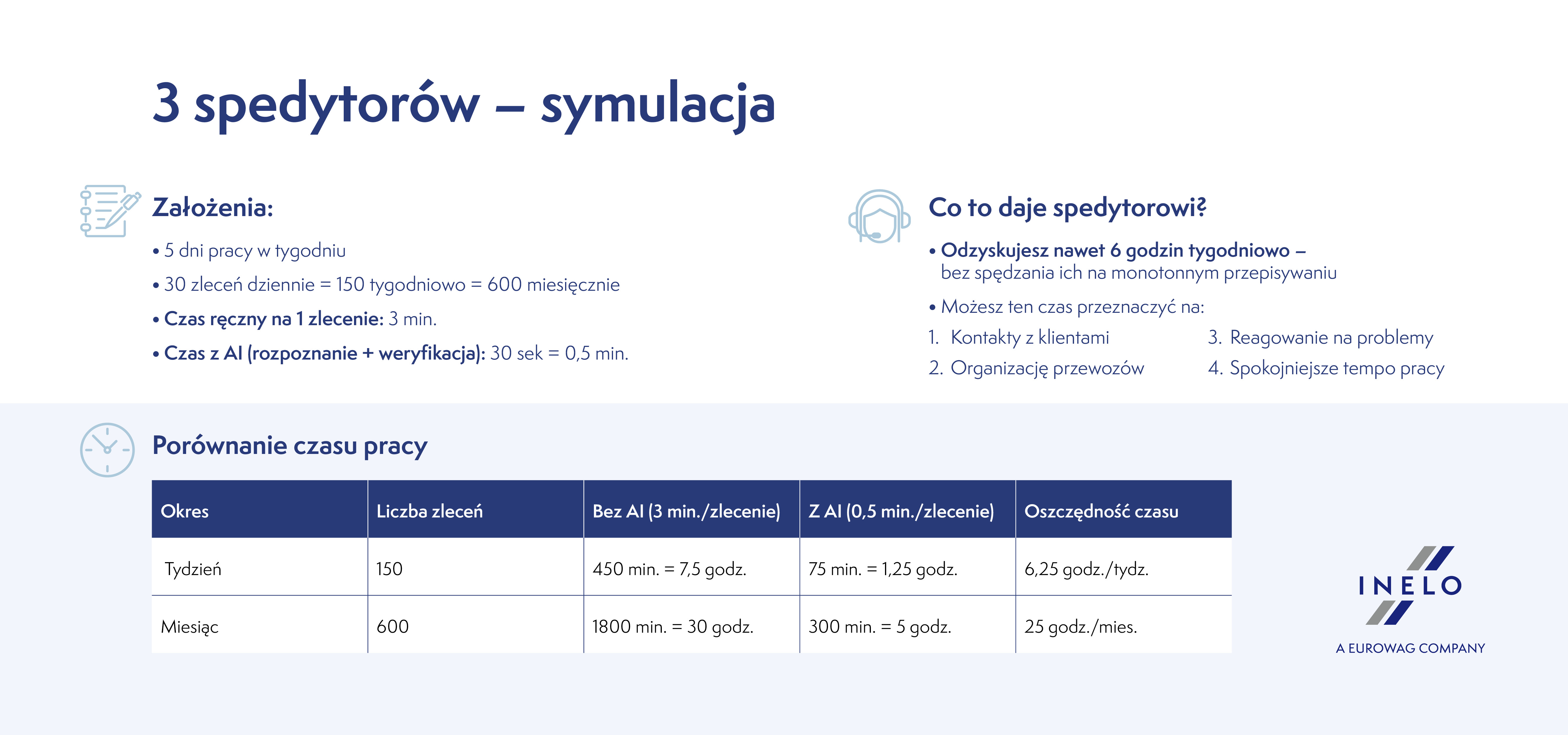
The latest tools using artificial intelligence remove the need for freight forwarders to tediously retype or copy data from source orders into the TMS system. AI assistants available in fireTMS or Marcos TMS from Inelo independently read all relevant data from source orders and create an order in the system based on them. The freight forwarder only needs to drag the source file to the indicated field, and the AI then transfers the necessary information itself. Moreover, the source order is immediately saved in the program, which facilitates invoicing the service after its completion. The role of the freight forwarder is therefore limited to verifying whether the data from documents, e.g., in PDF or JPG format, has been read correctly. The process of dragging information into the system and checking the data takes about 30 seconds, while manually entering all the information usually takes 3 to 5 minutes. In the case of processing 600 orders per month, a freight forwarder can therefore save up to 25 hours per month.
– emphasizes Krzysztof Manys, Implementation Specialist, Inelo from the Eurowag Group.
Expert Tomasz Czyż adds that artificial intelligence in TMS-class systems will not only speed up the work of freight forwarders but also facilitate the implementation of the tool itself at the start of cooperation.
Polish companies are increasingly willing to invest in the digitalization of transport and are looking for ways to optimize transport processes. AI in TMS tools contributes to much faster, automatic, and more efficient order processing. This, in turn, is a strong argument that can convince operational staff to reap the benefits of AI. Manual data entry, e.g., from orders into systems, is one of the biggest brakes on development and is often met with reluctance from freight forwarders or transport managers to perform these repetitive tasks – adds the expert.
AI in the work of a freight forwarder – how else does it support?
The shortage of drivers in road transport is widely known. Currently, however, the lack of freight forwarders on the market is also becoming increasingly felt. In response to growing staff shortages, transport companies are turning to technology to become as efficient and competitive as possible. They also care about meeting the needs of employees and fully utilizing their dormant potential.
Technology for transport, including AI-based solutions, allows freight forwarders primarily to recover time, and thanks to this, they can focus better on the most important issues in their work, i.e., building lasting relationships with contractors, strategic planning of transport, and checking the profitability of orders. Their decisions largely determine the financial result of a transport company, so it is all the more important to equip transport management staff with tools that enable them to achieve good results.
– emphasizes Tomasz Czyż.
Technology and easier transport organization
Entering data for order fulfillment, although sometimes very time-consuming when using classic technology, is just one of the stages of providing a transport service. The freight forwarder’s duties also often include planning the optimal route, verifying documents, and ensuring all data needed to invoice the completed transport is available. TMS systems combined with telematics significantly facilitate the execution of all these processes.
In an era of rising operating costs, optimizing routes allows for savings on fuel consumption expenses, as well as effectively utilizing drivers’ working time. Proven solutions for route planning, such as corridorization, i.e., defining the area within which a truck should move to its destination, allows for avoiding unnecessary kilometers. TMS systems connected with telematics allow for constant monitoring of the route progress, and information about any anomalies is immediately sent to the freight forwarder or dispatcher. Easy communication between the driver and the freight forwarder using telematics systems or mobile applications, e.g., fireTMS Driver, is also key. Thanks to sending the route directly from the system to the GBox device, the risk of communication errors is eliminated. In turn, after completing the transport, the driver can mark the current status of the transport via the tool and send documents, which allows for immediate invoicing of the completed service.
– comments Agnieszka Bulenda, Customer Care Team Leader at fireTMS.
[1] https://mailing.inelo.pl/landing/czasnatransport036?utm_source=wydarzenia&utm_medium=site&utm_campaign=webinar_036
[2] Statistics Poland, Information society in Poland in 2024
[3] As above.
Source: INELO Polska Sp. z o.o.