









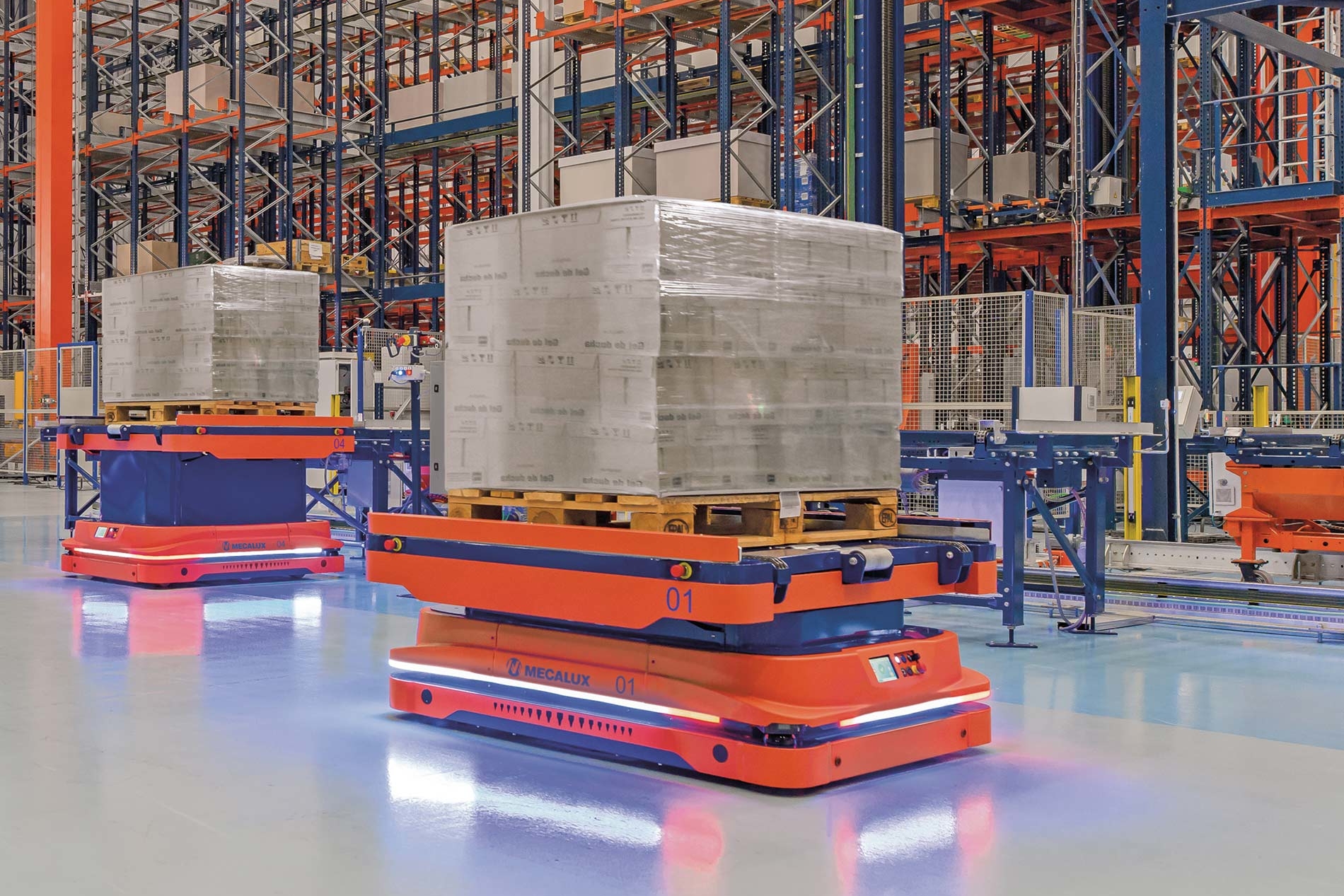
A report developed by Mecalux and the Intelligent Logistics Systems Lab at MIT, based on a survey of over 2,000 logistics professionals, points to the rapid pace of automation and artificial intelligence adoption, quick return on investment, and a growing demand for highly skilled warehouse workers.
Cambridge, MA, November 27, 2025. As retailers prepare for the annual Black Friday sales surge, a new report developed by Mecalux and the Intelligent Logistics Systems Lab (ILS) – a laboratory at the Massachusetts Institute of Technology’s Center for Transportation and Logistics – shows that warehouses serving global supply chains have entered a new era dominated by artificial intelligence. The study, based on responses from over 2,000 supply chain and warehousing professionals from 21 countries, shows that AI and machine learning are no longer experimental tools, but drivers of productivity, precision, and workforce evolution.
More than 9 out of 10 warehouses are already using some form of artificial intelligence or intelligent automation, meaning these technologies have reached a high level of maturity in this area at a surprising pace. In more than half of organizations, especially large companies with numerous facilities and complex logistics networks, processes are already significantly or fully automated. Warehouses have long moved past isolated pilot tests and are increasingly using AI in daily operations, including tasks such as order picking, inventory optimization, equipment maintenance, labor planning, and safety monitoring.
The data proves that companies with intelligent warehouses outperform their competitors in terms of productivity, accuracy, and flexibility. Enterprises investing in artificial intelligence are not only faster but also possess greater resilience and predictability, allowing them to deal with volatility more effectively and better prepare for the peak season.
– says Javier Carrillo, CEO of Mecalux.
The study also shows that investments in artificial intelligence pay off faster than anticipated. Most companies allocate 11% to 30% of their warehouse technology budgets to AI and machine learning initiatives, with the investment paying off on average within 2 to 3 years. Such a rapid rate of return is due to measurable effects: more accurate inventory management, higher process productivity, improved labor efficiency, and a reduction in errors. These investments are also driven by operational cost savings, customer expectations, labor shortages, sustainability goals, and competitive pressure, meaning the value of AI extends far beyond mere automation. All of this leads companies to focus more on long-term and more comprehensive projects rather than small, isolated experiments.
Despite rapid progress, enterprises still face challenges in implementing AI.
The most difficult part is the final phase of implementation: the seamless integration of people, data, and analytics with existing systems. The main barriers concern aspects such as technical expertise, system integration, data quality, and implementation costs, which shows how much effort is required to combine modern tools with legacy solutions. At the same time, many companies declare that they have solid foundations in data management and project execution, and the key catalysts for further development are the right tools, clear strategies, larger budgets, and more experienced personnel.
– notes Dr. Matthias Winkenbach, Director of the ILS Lab.
The report also dispels concerns about replacing human labor with automated solutions. It turns out that artificial intelligence not only does not displace the workforce but actually increases productivity and job satisfaction while creating new employment opportunities. More than three-quarters of the surveyed organizations reported an increase in the efficiency and satisfaction of their employees after implementing AI, and more than half declared that they had increased their headcount. New positions are emerging in all areas – for specialists in AI, machine learning, automation, process improvement, and data analytics – which suggests that intelligent automation expands, rather than limits, the human role in the warehouse process.
Almost all surveyed enterprises plan to expand their use of artificial intelligence within the next 2 to 3 years. As many as 87% of them anticipate an increase in their AI budget, while 92% are already implementing or planning new projects in this field. The report indicates that the next challenge will concern decision-support technologies, especially generative artificial intelligence. Companies see genAI as currently the most valuable method for improving logistics facility operations, citing applications such as automatic document creation, warehouse layout optimization, process design, and code generation for system automation. As these capabilities evolve, artificial intelligence will support more and more warehouses in transitioning from predictive analysis to autonomous work.
Traditional machine learning provides very high effectiveness in predicting problems, while generative artificial intelligence facilitates the design of solutions. That is why companies consider it the most valuable technology today. Its tangible benefits translate into smoother, faster, and more reliable system operation.
– notes Dr. Winkenbach.
The authors of the study emphasize that on the eve of Black Friday, warehouses fulfilling orders during this busiest time of the year are not only automating their processes but are actually transforming into intelligent systems. Thanks to artificial intelligence, which increases efficiency, supports employees, and creates new opportunities in global networks, the coming years in logistics promise to be even more promising in terms of data integration and decision-making processes.
Source: Mecalux