








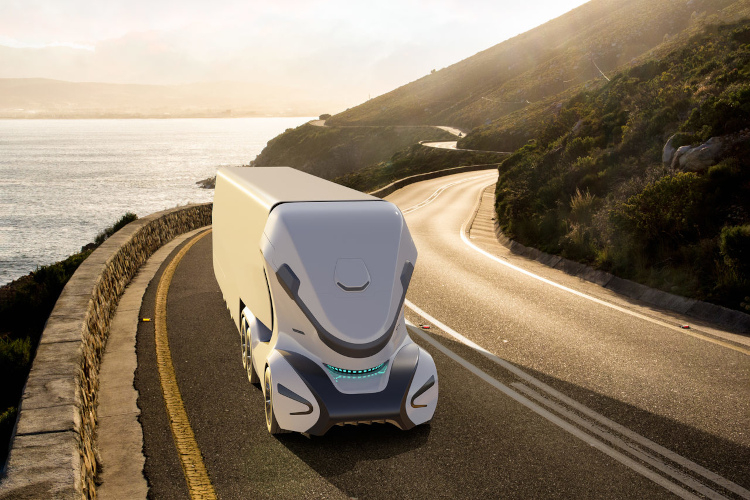
Autonomous transport, although until now it has been more of a science-fiction vision, is increasingly appearing as a realistic direction for change in communication in the broadest sense. Many transport companies are already starting to use technologically innovative solutions that enable the acceleration, improvement, and automation of transport and deliveries. At what level is this revolution currently? What are its benefits and risks?
Reducing traffic congestion and the number of collisions, significant savings in fuel and energy consumption, lower CO2 emissions, or perhaps solving the problem of driver shortages? There are many indications that autonomous transport could help solve the dilemmas that have plagued global communication for many years.
5 levels of autonomy in transport
– There is a five-level scale of autonomy created by SAE International, a professional organization of engineers involved in automotive, aerospace, and industrial machinery. At its two highest levels are vehicles that not only move independently but also monitor and react to changing road conditions – without even being equipped with elements such as a steering wheel. The only “human” intervention remains setting the travel route. Currently, examples of this are locally encountered unmanned taxis or prototypes from Tesla and General Motors. The lowest levels concern partial or conditional automation, where machines move autonomously only in specific situations, and the driver uses driving assistance systems – for example, a lane-keeping assistant. – explains Maciej Maroszyk, Chief Operating Officer at TC Kancelaria Prawna, noting that autonomous transport is the introduction of autonomous vehicles into circulation, ultimately driven without driver intervention:
This type of revolution concerns not only small devices transporting food or helping the disabled move around, and passenger cars, but also trucks and rail vehicles.
– In the automotive industry, the largest manufacturers are already introducing models to the market that qualify for the third level of the SAE International scale. Interestingly, the transport market in Germany has recently been conquered by the startup Einride, which, with the help of an electric and autonomous truck fleet, freight mobility, and charging and connectivity networks, enables intelligent and ecological transport of goods, thereby cooperating with the largest corporations from many different industrial sectors – says Maciej Maroszyk from TC Kancelaria Prawna.
Preparations for greater autonomy
Can we use vehicles from the highest level of the scale today? As the expert from TC Kancelaria Prawna points out, this is not yet possible – and the obstacle to this is not only the creation of safe and refined control software, but above all the lack of sufficiently developed infrastructure and detailed legal regulations.
This summer, the European Union introduced an amendment to Regulation No. 2019/2144, which allows for the automation of level 3 vehicles, which will allow for the introduction of systems that replace the driver’s control over the vehicle.
– Among them are signaling devices, steering, acceleration and braking systems, systems providing the vehicle with real-time information about the state of the vehicle and its surroundings, and driver availability monitoring systems. The regulation also concerns data recorders on events in automated vehicles, a harmonized data exchange format, for example regarding platooning of vehicles of different brands, and systems transmitting safety information to other road users. – explains Maciej Maroszyk from TC Kancelaria Prawna.
In turn, France introduced a decree in the Official Journal on August 7th of this year – a new article (R. 3152-3) to the transport code, defining “the powers of remote operators in the context of automated road transport systems.” The document defines the role and training method for people supervising autonomous vehicles. In the eyes of the law, control over such machines will be left only to qualified personnel who meet specific conditions.
Preparations in this aspect are also appearing in the United States and Australia, where tests of autonomous vehicles were conducted on national roads. Unfortunately, a very large number of collisions were recorded during these experiments, hence an important issue arose – criminal and civil liability in the event of road accidents involving autonomous vehicles.
As for Poland, all provisions contained in Art. 65k of the Road Traffic Act refer to conducting research work related to testing autonomous vehicles. During tests, there must be a person in the vehicle who is authorized to drive and who can take control of it at any time.
Time for 100% independence?
We still do not know who will be responsible in the event of a collision: the vehicle user, the software or GPS navigation creator, or perhaps the manufacturer? There are too many factors that can influence the scope of a given party’s liability, which – in the opinion of experts from TC Kancelaria Prawna – constitutes an additional difficulty in introducing adequate regulations. However, they point out that with the introduction of automatic vehicles, many accident-causing factors will disappear – including speeding, driving under the influence of prohibited substances, or ignoring road signs.
Perspectives and negatives
Autonomous transport can bring many tangible and positive changes – among them savings in fuel and energy consumption, lower CO2 emissions, reduction of traffic congestion and the number of accidents, as well as eliminating the problem of driver shortages.
– Autonomous transport is a range of possibilities – such a fleet could be in use 24 hours a day, seven days a week, while an “ordinary” vehicle with one driver can only drive 9 hours a day. In this way, productivity would increase significantly, with a decrease in emission and employment costs, which currently constitute a high percentage of the cost of total transport – says Maciej Maroszyk from TC Kancelaria Prawna.
On the other hand, full automation of transport means limiting the labor market for drivers. Since the demand for such specialists would decrease, many employees would lose not only bonuses and high earnings but often their jobs as well – for example, in the case of local suppliers or couriers.
– Poland is the largest carrier in Europe, and transport is one of the largest branches of GDP in our country. Hence, when introducing autonomous vehicles, one must take into account that many people will lose their jobs – adds the expert from TC Kancelaria Prawna.
Progress in autonomous transport lies not only in the hands of designers and programmers responsible for preparing such machines for daily work, but also in the hands of legislators. It is on their shoulders that the creation of legal regulations rests, thanks to which vehicles driven by artificial intelligence will be able to function alongside vehicles driven by human drivers. And the announced projects are dated only for the year 2040.