









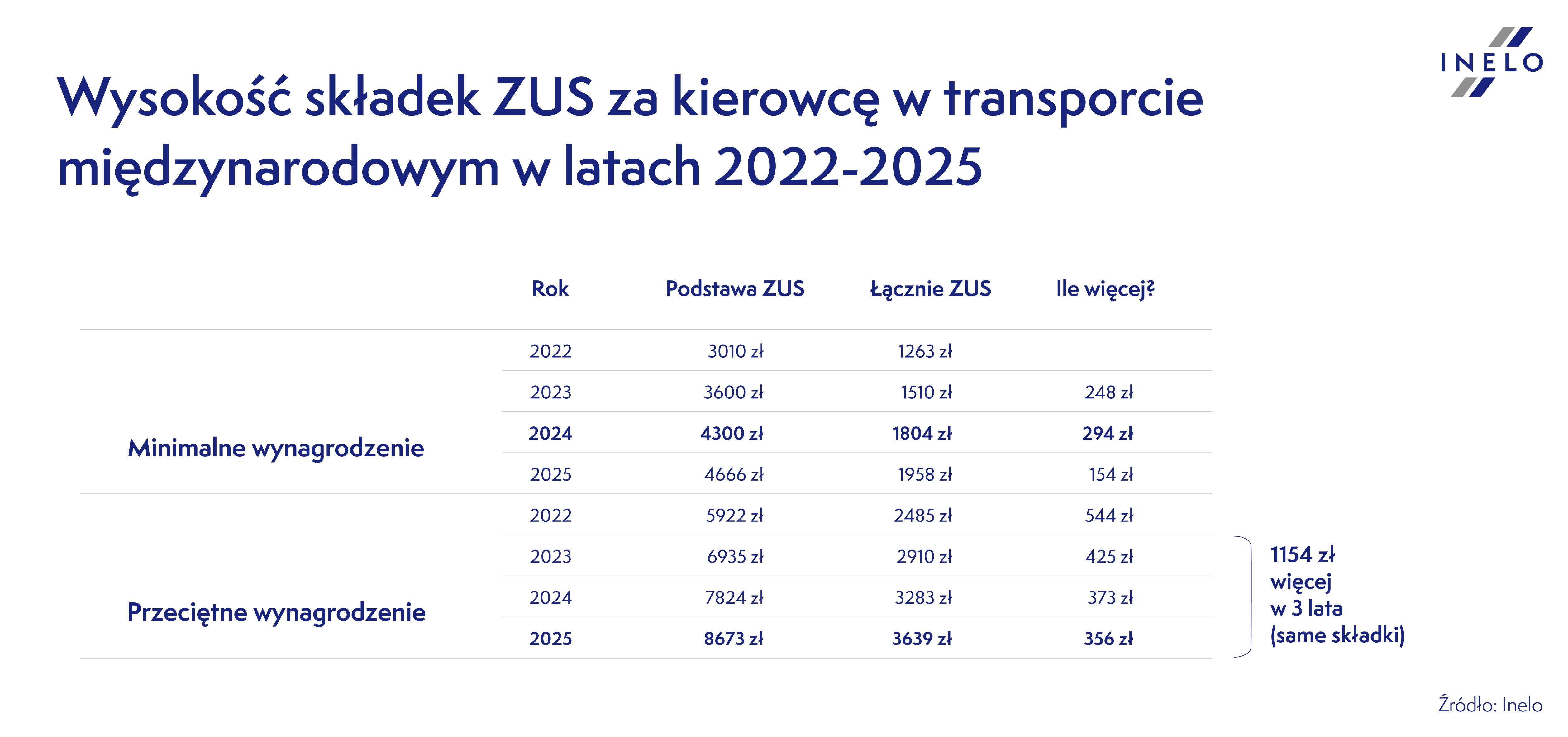
At the end of August, the government adopted the draft budget act for 2025, which indicates that the average projected salary will increase by nearly 850 PLN. For carriers, an increase in this amount means they must prepare for higher ZUS contributions, as this figure most often serves as the contribution base for the salaries of international drivers. The latest data from Inelo, part of the Eurowag Group, indicates that the contributions paid could be several hundred PLN higher per month for each driver, even assuming they do not receive a raise. How much exactly?
How much more will carriers pay to ZUS in 2025?
The adopted draft of the latest budget act assumes an increase in the projected average salary to 8,673 PLN (currently it is 7,824 PLN). This means an increase of 849 PLN compared to the 2024 figure. More importantly, it is precisely from this amount that ZUS contributions are most often paid from the salaries of drivers in international transport. The latest data follows the upward trend of previous years. The average salary in 2024 increased by 889 PLN compared to 2023 data.
– A significant increase in the level of minimum and average wages has been observed in the Polish economy for several years now, and with it, the level of expenses for PIT advances and ZUS contributions for drivers is increasing. The level of the average salary indicated in the draft budget act means an increase in ZUS burdens next year by 356 PLN to the amount of 3,639 PLN. This is the total amount of monthly contributions for one international driver whose contributions are paid based on the threshold of the average projected salary. It is worth emphasizing that back in 2021, the contributions paid for international drivers were almost three times lower. It is also significant that these contributions are rising without increasing the employee’s net salary, the so-called “take-home pay.” Employers who want to give a real raise to a driver incur even higher costs, and the advance tax on salary also increases. Additional burdens for carriers are becoming an increasingly serious challenge every year – comments Mateusz Włoch, expert in development and training, Inelo from the Eurowag Group.
It is worth adding that the last quarter of the year is a period when budgets for the following year are often planned. During this time, negotiations regarding contracts with clients that are to be in effect next year are also conducted. Estimating the level of expenses, including labor costs, allows for much better preparation for participating in tenders for transport services by submitting profitable transport rate offers. For this reason, it is worth familiarizing yourself with these changes now.
Due to the difficult market situation, carriers have been appealing for months for help, which is to concern subsidies for tachographs and a reduction in ZUS contributions. Recently, information appeared that there will be no subsidies for tachographs, and as for reducing contribution burdens, there is a lack of specifics from the government – it is unknown whether, when, and in what form help will come.
Are these changes certain?
The amount of the average projected salary from the draft budget act is not final. Although there will likely be no significant changes in the assumed average salary, it is worth keeping a finger on the pulse and observing the decisions made by the government. However, it should be noted that in the previous three years, the level of the average salary presented in the draft budget act remained unchanged at the further stage of work and began to apply from the official announcement of the Ministry, published in the fourth quarter.
– Independently monitoring changes related to labor law and salary levels is a rather time-consuming task, and the complexity of the regulations does not make settling drivers’ accounts any easier. Therefore, in case of any doubts, it is worth turning to our specialists at OCRK, who will advise carriers on what salary they should pay drivers and what necessary contributions to pay – notes Mateusz Włoch.
This is not the end of price hikes for carriers
A significant increase in costs is a phenomenon that has been gaining momentum in the transport industry for several years. The most frequently cited reasons for this state of affairs include inflation, economic slowdown, fuel price fluctuations, and a significant increase in road tolls. In the coming months, another major expense awaits many carriers. According to the changes, from January 1, 2025, all trucks performing international road transport within the European Union and equipped with analog and digital tachographs from before June 2019 will have to be equipped with second-generation smart devices (G2V2). Although information regarding this obligation was published several years ago, many carriers have been putting off replacing tachographs until later. Consequently, there may be long queues at installation points for these devices in the coming months.
– The cost of replacing one tachograph with a second-generation smart device is estimated at approx. 5,000 PLN. Considering that most companies will be replacing these devices in more than one truck, we are talking about amounts ranging from a dozen to even several dozen thousand PLN. Carriers have appealed to the government for funding for the replacement of tachographs, arguing this with the economic slowdown and the difficult situation in the transport sector. Despite talks on this matter between the government and industry representatives, the Ministry of Infrastructure recently stated that funding for the replacement of tachographs is unfortunately not possible.[1] For carriers, this means even higher expenses or the risk of immobilizing vehicles in international transport from next year – explains Mateusz Włoch.
[1] TLP, org.pl, There will be no funding for tachograph replacement
Source: INELO