










In the current era of a continuous increase in the number of motor vehicles on Polish roads, the problem of traffic noise is one of the greatest threats to our civilization. Noise is everywhere: we encounter it at home, at work, on the street, etc. However, it should be remembered that noise is a subjective feeling, and the same type of sound is not undesirable for everyone.
Regardless of whether a given sound is desirable to us or not, it can cause many negative effects. We are talking about high-intensity noise levels exceeding 85 dB (A), when it becomes dangerous to our body and can be the cause of numerous hearing impairments, circulatory system disorders, nervous system disorders, balance disorders, and even cause permanent or partial hearing loss.
Measuring the emitted noise level in a transport company allows for identifying areas where being present is particularly risky for employees’ hearing. The level of emitted noise is an aspect of environmental management. Thinking in terms of environmental protection and improving working conditions helps in more effective management of a transport company. Awareness of the negative impact of noise on the human body allows transport companies to take preventive or noise-reducing measures. Noise emitted by heavy goods vehicles is a burden on the environment. All activities related to its measurement and limitation are necessary to maintain proper relations between the company and the environment.
The article consists of a theoretical part, which presents definitions of noise, levels, and scales of nuisance of noise emitted by motor vehicles, and a practical part, where the noise level emitted by heavy goods vehicles during startup in the transport company’s yard was measured.
Noise – concept, types, levels, nuisance scales
Noise is defined as an undesirable, unpleasant, or annoying sound for a given person at a given place and time. As a rule, it is a sound with excessive intensity, i.e., too loud. Humans react to sounds with frequencies from 20 Hz to 20 kHz (some sources state from 16 Hz to 16 kHz). Both sounds below and above this limit are inaudible to us. These are so-called infrasound (below 20 Hz) and ultrasound (above 20 kHz). The volume level of the heard sound is determined by acoustic pressure. The range we react to is huge, which is why values expressed in decibels (dB) are used to determine their levels. Above 130 dB, the sound is so intense that instead of hearing it, one only feels pain.
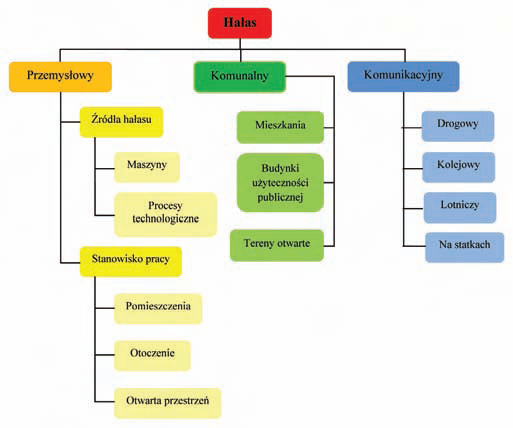
Many classifications of noise are found in the literature. Basic criteria include sound frequency, the type of environment in which the noise occurs, and the subject classification of noise emission (noise source). Taking into account the first criterion, i.e., sound frequency, noise is distinguished as: infrasonic (1 – 20 Hz); audible (20 – 20,000 Hz); ultrasonic (above 20,000 Hz).
According to the second classification criterion, we can speak of noise:
-
industrial, generated by sources located inside and outside various types of buildings,
-
municipal, which occurs in residential premises, public utility buildings, and open areas,
-
traffic, originating from air, rail, and road transport means.
This classification is general in nature. Considering the source of noise emission, a further division (detailed classification) can be made – Figure 1.
Noise phenomena are accompanied by mechanical vibrations (produced by vehicles, machines, devices) and shocks.
With the development of transport infrastructure, it is recognized that the most annoying sounds come from means of transport. Traffic noise is produced by individual transport vehicles. Table 1 shows the level of generated noise depending on the type of vehicle.
The external noise level of vehicles while driving should not exceed the permissible values given in Table 2.
An increase in the emitted noise level increases the harmfulness of this factor to human health and well-being. Taking into account the level of emitted noise and its impact on the human body, the following ranges have been established:
-
below 35 dB (A) – noise does not harm human health but can be very annoying or interfere with work requiring concentration
-
35 – 70 dB (A) – noise negatively affects the nervous system, leads to fatigue, decreased work efficiency, reduced speech intelligibility, and difficulty falling asleep and resting
-
70 – 85 dB (A) – noise significantly reduces work efficiency, can cause headaches and permanent hearing impairment
-
85 – 130 dB (A) – noise is the cause of numerous hearing impairments, circulatory system disorders, nervous system disorders, and makes speech unintelligible even from a distance of 0.5 m
-
130 – 150 dB (A) – noise causes permanent hearing damage, induces vibrations of some internal organs of the body, which can cause permanent diseases, and even complete destruction of these organs
-
above 150 dB (A) – after just 5 minutes, noise paralyzes the functioning of the body, causes nausea, balance disorders, inhibits the performance of coordinated limb movements, leads to changes in the proportions of blood components, causes anxiety and depressive states, and other manifestations of mental illness.
The article comes from the journal “Logistyka” 5/2011.