








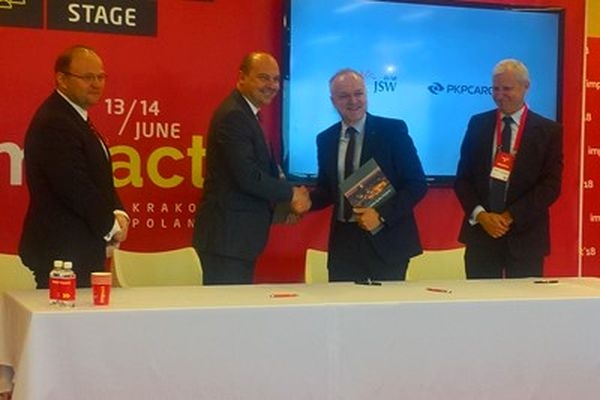
Representatives of the management boards of Jastrzębska Spółka Węglowa (JSW) and PKP CARGO signed a letter of intent on June 14th in Krakow, during the IMPACT’18 conference, for joint, innovative investment projects related to the commercial use of hydrogen fuel. The document provides, among other things, for cooperation in research, analysis, and in the future, the production of new types of hydrogen-powered wagons and shunting locomotives, as well as their subsequent maintenance and operation.
JSW and PKP CARGO have identified the possibility of implementing joint ventures, the key goal of which will be to develop innovative solutions that help reduce energy consumption, fuel usage, and exhaust emissions associated with the commercial operation of hydrogen-powered wagons and locomotives. The parties assume potential cooperation with other partners to a justified extent and will also analyze investment opportunities on the grounds of the former KWK Krupiński mine.
– JSW is betting on hydrogen as the fuel of the future. In accordance with the JSW Development Strategy for 2018-2030, we are working intensively on the development of clean hydrogen technologies. We are researching the possibilities of using hydrogen separated from coke oven gas, which is a by-product of the coking process, and we are actively involved in E-mobility projects – says Daniel Ozon, CEO of JSW. – We aim to use coke oven gas to produce clean hydrogen, which could in the future also become an emission-free propulsion fuel for modern PKP CARGO rolling stock.
Cooperation between JSW and PKP CARGO is the next stage of actions taken by JSW, the largest producer of coking coal in the EU, in the field of implementing hydrogen separation technology from coke oven gas. Separated and purified hydrogen can be used in hydrogen fuel cells for ecological and emission-free production of electricity, heat, and cooling, ecological public transport, and powering electrical devices and emergency power stations (hospitals, schools, offices).
– The signed letter of intent testifies to the great importance that the PKP CARGO management board attaches to optimizing processes and focusing on innovative solutions in our development strategy. Using hydrogen to power our locomotives will increase the competitiveness of our transport services. PKP CARGO is the largest freight carrier in Poland and one of the largest in Europe. And we want to be a company that is not only a leader in the transport market but also sets the tone for innovation on the railways. Cooperation with JSW is another step toward becoming a leader in innovation in rail transport, as hydrogen-powered locomotives would take us to a significantly higher level of development – emphasizes Czesław Warsewicz, CEO of PKP CARGO S.A.
CEO Warsewicz recalled that PKP CARGO is looking for sources of cheaper fuels, as currently, as much as 16-18% of costs are fuel purchase costs for locomotives. Czesław Warsewicz noted that hydrogen technology is already being used in rail transport, so the prospects for cooperation with JSW are very promising.
– In Germany, there is commercial use of hydrogen; trains and locomotives powered by this fuel are running there. Our project will be developed over several years, and we will be able to jointly develop technologically advanced hydrogen-powered engines. Everyone can win from this project – said Czesław Warsewicz.
The head of PKP CARGO also did not hide that he is counting on research cooperation with the National Centre for Research and Development and the National Fund for Environmental Protection and Water Management. Both institutions support activities aimed at developing power sources for engines in cars, buses, and trains that are alternatives to crude oil.