








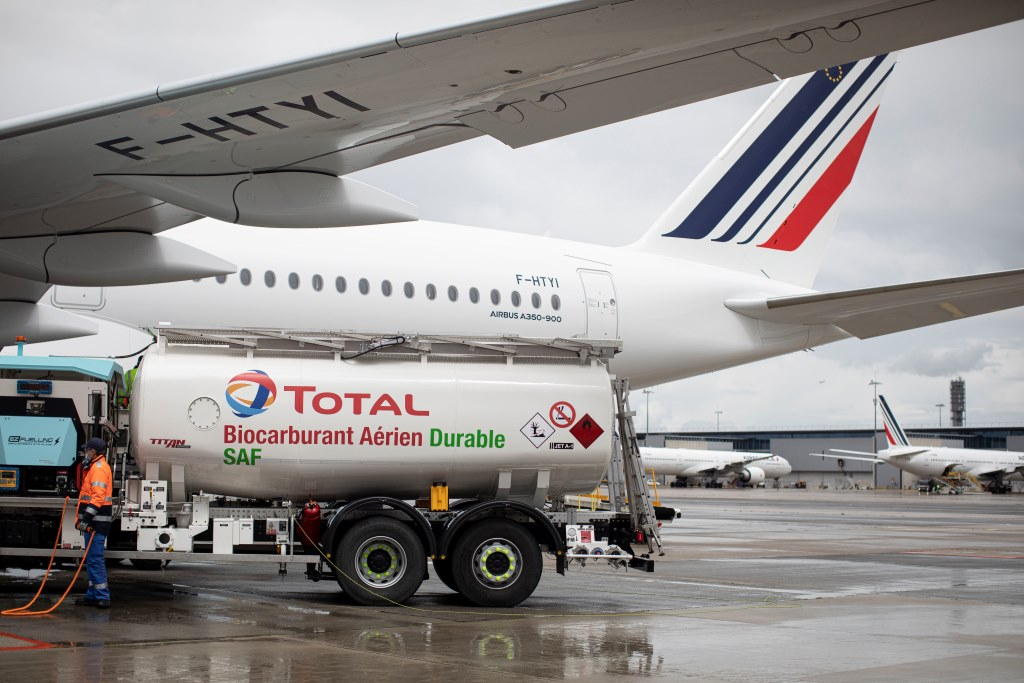
To achieve the goal set during the UN Climate Change Conference in Paris, which aims to limit global warming to below 2°C to counteract the effects of climate change, the aviation industry must accelerate the environmental transformation of its operations. In this regard, Air France is launching the “Air France ACT” program, which defines a new strategy for reducing CO2 emissions.
The “AIR FRANCE ACT” program, whose strategy is based on 3 main objectives:
- First, reducing emissions directly generated by Air France flight operations;
- Second, reducing indirect emissions in the supply chain that are generated before and after flight operations;
- Furthermore, supporting projects aimed at absorbing CO2 from the atmosphere.
“Air France ACT” embodies a transparent, realistic, and scientifically backed strategy adapted to the airline’s business, leading to the environmental transformation of its operations through concrete and measurable actions.
Decarbonizing aviation is difficult and takes time. This process is based on close cooperation between various stakeholders: aircraft and engine manufacturers, fuel suppliers, airports, air traffic control, authorities, as well as research and scientific institutes.
A 30 percent reduction in CO2 emissions per passenger/km by 2030 compared to 2019, which is a 12 percent lower emission in absolute terms
The new decarbonization strategy assumes that by 2030, Air France will reduce CO2 emissions per passenger per kilometer by 30 percent compared to 2019. The chosen target does not include so-called offsetting measures, but only methods leading to the reduction of direct and indirect emissions. This means a 12 percent drop in total emissions generated by the company in the 2019-2030 period, in line with expected changes in operations and after taking into account the 6 percent reduction already achieved between 2005 and 2019.
The chosen direction of change is based on a scientific assessment method developed by the independent reference organization SBTi (Science-Based Targets initiative), to which it has been submitted for approval. SBTi – Science Based Targets is a joint initiative of CDP (a non-profit organization promoting the measurement of the environmental footprint of companies and organizations), the UN Global Compact, and the WWF, which has set the level of CO2 emission reduction that the air transport sector must achieve in line with the Paris Agreement.
Net zero emissions by 2050
Air France aims to achieve net zero emissions by 2050. This will be achieved, first, by drastically minimizing CO2 emissions from its own operations. Second, the remaining emissions generated by Air France are to be neutralized through involvement in projects aimed at absorbing CO2 from the atmosphere (in amounts equal to the remaining emissions each year).
The airline is working on defining a precise and verifiable decarbonization path to 2050, based on a set of hypotheses – particularly regarding the evolution of air traffic – which may vary. Therefore, it is a process subject to change, but always determined in accordance with scientific benchmarks, as is the case with the 2030 strategy.
Five priority actions to reduce (and avoid) CO2 emissions
To achieve the set goal, Air France is launching all available decarbonization methods, such as:
- Fleet modernization using fuel-efficient new-generation aircraft, such as the Airbus A220 and Airbus A350, whose operation allows for a reduction in CO2 emissions of up to 25 percent and a noise reduction of 33 percent on average. Currently, these types of aircraft account for 7 percent of the Air France fleet. By 2030, thanks to investments of one billion Euros per year, which are planned until 2025, new energy-efficient aircraft will account for 70 percent of the Air France fleet.
- Increased use of Sustainable Aviation Fuel (SAF), which enables a reduction in CO2 emissions by an average of 80 percent over the entire life cycle. These fuels are produced within a circular economy and do not compete with the food supply chain. In accordance with French regulations, since January 1, 2022, all Air France flights departing from France use fuel containing the equivalent of a 1 percent SAF blend. The airline’s goal is to increase the share of SAF on all its flights to 10 percent by 2030, and then to 63 percent by 2050.
- Applying solutions for efficient flight operations and procedures that reduce fuel consumption, such as, among others: eco-piloting techniques, single-engine taxiing where possible, flight path optimization using artificial intelligence, and continuous descent approaches in close cooperation with air traffic control. These actions, made possible by properly trained crews, allow for a reduction in CO2 emissions by an average of 2-3 percent per year.
- Introducing a more responsible catering offer to reduce the carbon footprint. Both on board aircraft and in airport lounges, Air France strives to serve as many local and seasonal products as possible. Furthermore, to minimize food waste, the airline asks business class passengers on long-haul flights to pre-select their meals. The process of phasing out single-use tableware is also underway. By the end of 2022, Air France will eliminate 90 percent of single-use plastic tableware compared to 2018. Previously, in 2019, the airline replaced all plastic cups, cutlery, and stirrers with tableware made from alternative, environmentally friendly materials.
- Development of intermodal transport so that customers have the option to choose low-emission, alternative means of transport, especially for short-haul travel, with strengthened cooperation between Air France and SNCF.
Air France observes changing trends in its customers’ behavior, especially regarding travel planning. The airline declares that it will adapt its services to support its passengers, regardless of whether they decide to travel less frequently, plan longer trips, or combine business with private travel. The carrier wants to provide them with tools to carry out their travel according to their preferences, as well as continue to invest in the sustainable aviation fuel program beyond current requirements.
Detailed information on the new Air France environmental strategy “Air France ACT” is available on the dedicated website airfranceact.airfrance.com. A promotional campaign has also been launched, with a specially prepared video, which is available here.