








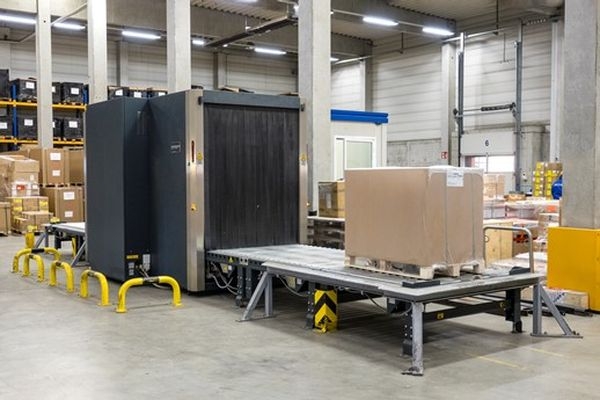
Global logistics operator Dachser uses a range of modern devices to improve the security screening of cargo loaded onto aircraft. X-ray scanners and explosive detectors are examples of the tools the company possesses, ensuring the efficiency and safety of air transport.
When body scanners were first tested at Hamburg Airport in 2016 to replace the metal detectors used until then, an outcry arose. There were concerns about privacy and health risks. Meanwhile, luggage has been undergoing every possible type of screening for years. The same applies to goods.
Before cargo is moved into an aircraft’s hold, Dachser also examines it using modern equipment, such as X-ray scanners or explosive detectors. These are used by the operator in locations including Munich, Frankfurt, Cologne, Dusseldorf, and Kaufbergen. The use of such tools allows for the thorough scanning and analysis of transported goods. Thanks to them, it is possible, for example, to take samples from contaminated surfaces, as well as from luggage and shipped items. Samples can be taken from the outside, from the inside, or from the contents of the shipment. Subsequently, particles and vapors are analyzed, and if traces of explosive materials are present, an alert is triggered.
Detectors are just one of many elements in a whole series of security screening measures that can, and sometimes must, be carried out. X-ray scanners can accommodate packages measuring up to 175 x 175 cm, which also limits their utility for larger shipments. In the case of high-density materials, such as products with a high metal content or granules, scanners sometimes cannot fully penetrate the packaging. This means that the presence of a prohibited item cannot be ruled out, which triggers a so-called “dark alarm,” leading to additional security checks, such as visual inspection, manual searching, or the involvement of sniffer dogs.
Thanks to multi-stage checks, one can be certain that absolutely nothing will be overlooked. After passing the inspection, the cargo is placed on a conveyor belt and directed to the aircraft’s hold – fully checked and secure.