








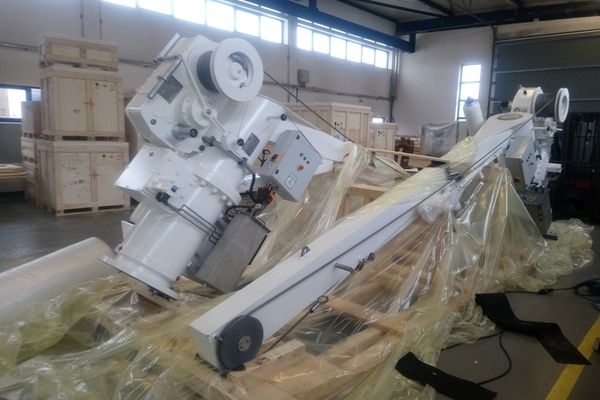
The Polish branch of Agility Logistics, a global provider of integrated logistics and freight forwarding solutions, has organized the sea transport of rescue cranes produced in Poland to Tasmania. The recipient was one of the world’s largest and most famous shipyards, specializing in the construction of catamarans and vessels. The organization of this transport was supported by the Australian branch of Agility.
The cargo consisted of two rescue cranes used for lifting and lowering lifeboats on catamarans. Each of them weighed 2.26 tons and measured 6 m in length, 2.3 m in width, and 1.1 m in height. Collected from the factory in Dąbrowa Tarnowska in southern Poland, the machines were delivered to Hobart, the capital of Tasmania (Australia). Key to preparing this delivery was the proper securing of the equipment for the long transport duration, efficiently organized loading into the container in which they were transported, and very good knowledge of regulations, which significantly streamlined the complex customs clearance.
– The whole process began with receiving an inquiry from our Australian branch; we had to check, among other things, loading capabilities and the container type. Together with the company Danpol, which cooperates with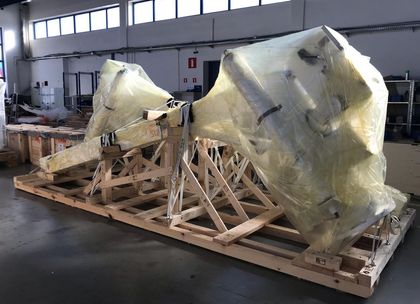 us and specializes in the production of industrial packaging and solutions guaranteeing safe transport, we decided that the best and cheapest solution would be sea transport of the cranes in a 40HC container – explains Anna Głyżewska, pricing specialist, Agility Logistics.
The tasks of the Polish branch of Agility Logistics included collecting the rescue cranes from the factory in Dąbrowa Tarnowska, transporting them to the port of Gdynia, and supervising the transshipment and loading onto the vessel. The Australian branch of Agility was responsible for delivering the machines from the Tasmanian port to the client’s premises.
– Crucial for us when transporting the rescue cranes was the proper securing of the cargo for the duration of transport, both road transport from the factory to the port and sea transport on the Gdynia – Hobart route, which was to last 53 days. For this purpose, a wooden frame was designed on which we placed the devices. We also prepared fastening structures and built a platform for the crane arms. The entire cargo was secured with VCI anti-corrosion film – adds Maciej Brandt, Operations Clerk Sea Freight, Agility Logistics.
Agility Logistics freight forwarders also provided support with the customs clearance of the cargo, which in the case of this transport proved to be more complex than standard export clearance. It required completing additional procedures related to, among other things, the shipper’s decision to use their own customs agency, which, when changing the means of transport (from truck to container), required obtaining separate approval from the Customs Office. The same applied to obtaining Customs Office permission for a one-time recognition of the transshipment site where activities provided for by customs law were performed.