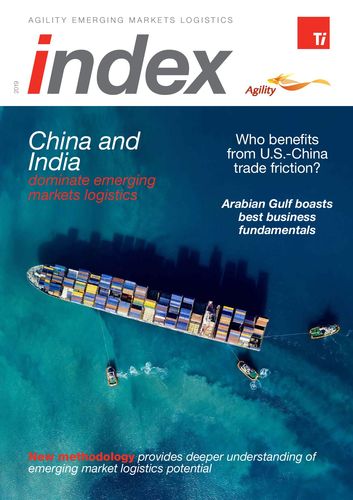
The logistics industry welcomes the 5 percent growth rate in emerging markets in 2019, yet a surprisingly large number of surveyed managers are preparing for a crisis related to US-China trade friction, interest rate changes, and uncertainty regarding Brexit. This conclusion comes from the 2019 Emerging Markets Logistics Index, published for the tenth time by Agility, a global provider of integrated logistics and supply chain solutions.
In the Agility survey, conducted among 500 logistics industry experts, 55.7 percent of respondents considered the 5 percent growth of developing economies to be a “quite good” result. In 2018, emerging markets grew by 4.7 percent, and current International Monetary Fund forecasts predict that this growth will reach 4.5 percent in 2019. At the same time, 47.1 percent of managers claim that a crisis in emerging markets is “likely” or “highly likely.” As the survey results show, rising tensions and the introduction of tariffs could cause a 10 percent decline in trade volume between China and the US.
The survey is part of the Agility Emerging Markets Logistics Index 2019, an annual review of industry sentiment combined with a ranking of the top 50 emerging markets. The Index shows their competitiveness based on domestic and international logistics potential and business conditions. The ranking takes into account factors important from the perspective of logistics operators, freight forwarders, shipowners, air carriers, and distributors. The top ten included: China, India, the United Arab Emirates, Indonesia, Malaysia, Saudi Arabia, Mexico, Qatar, Turkey, and Vietnam. In the area of domestic logistics, the highest positions were taken by: China, India, and Indonesia; in international logistics, China, India, and Mexico; while the best conditions for business activity are provided by the UAE, Malaysia, and Qatar.
– Companies looking for new opportunities are finding them in emerging markets, where small and medium-sized enterprises are a significant growth factor, benefiting from access to state-of-the-art technology and mobile banking – says Essa Al-Saleh, CEO of Agility Global Integrated Logistics. – At the same time, logistics industry experts fear that these markets may prove vulnerable to the negative effects of major geopolitical challenges.
2019 Emerging Markets Logistics Index – ranking and survey results
China and India, which took top spots in the 2019 ranking due to their strong positions as domestic and international logistics markets, lag behind smaller rivals when it comes to business conditions. This category considers factors such as: regulatory environment, credit and debt dynamics, contract enforcement, anti-corruption safeguards, price stability, and market access. Here, China ranked 7th and India 10th. The strongest clusters of emerging markets are in the Persian Gulf and Southeast Asia (ASEAN). They were formed thanks to business-friendly conditions and their strengths – the energy wealth of the Gulf region and the manufacturing power of Southeast Asian countries. Among the Gulf countries, high positions in the ranking were taken by: UAE (3), Saudi Arabia (6), Qatar (8), Oman (12), Bahrain (16), and Kuwait (18). The strongest ASEAN countries are: Indonesia (4), Malaysia (5), Vietnam (10), Thailand (11), and the Philippines (20). In the context of international trade friction and data showing a slowdown in the Chinese economy, respondents identified India as the market with the greatest potential, placing China in 2nd place. 56 percent of those surveyed believe that a prolonged impasse in US-China relations could prove beneficial for Southeast Asian countries, which represent an alternative source of manufacturing power to China. Brazil, with its economic turmoil, fell from 9th to 15th place, lower than smaller Latin American economies, Mexico (7) and Chile (13). In the business conditions category, Brazil ranked 39th. Despite such poor results, the surveyed managers see hope for the future: 44.5 percent are “optimistic” or “very optimistic” about Brazil’s development. Meanwhile, China’s “Belt and Road Initiative” (BRI), which assumes infrastructure development investments worth 4-4.8 trillion USD, brings much greater benefits to China than to the countries of Asia, the Middle East, Africa, and Europe that are covered by it. 64 percent of respondents believe that the BRI drives growth and trade development in China; and only 41.4 percent believe it will also help other emerging markets. The short-term potential of Iran has suffered significantly as a result of sanctions reinstated by the US. Nearly 75 percent of respondents believe that Iran is “less promising than before” or “not promising.” Iran ranked 49th out of 50 countries in the area of international logistics opportunities. At the top of the list in the business conditions category were the UAE and Malaysia. Persian Gulf countries, Qatar, Oman, and Saudi Arabia are also high. It is most difficult to conduct business in Venezuela, Angola, Myanmar, and Libya. 65 percent of respondents believe that Mexico will increase trade turnover with the US and Canada after the ratification of the trade treaty intended to replace the previous NAFTA agreement. Venezuela, with the largest oil reserves in the world, ranked last (50th) in the areas of international logistics opportunities and business conditions. The BRICS group (Brazil, Russia, India, China, and South Africa), once a barometer and engine of emerging economies, has fallen apart. China (1) and India (2) continue to achieve annual growth exceeding 6 percent. Russia’s development has been slowed by economic sanctions and low energy prices; Brazil (15) is feeling the effects of the slowdown, while the outlook for South Africa (24) has worsened due to conflict within the ruling party and labor market unrest. The situation in Sub-Saharan Africa is varied. South Africa’s results (24) are much worse than expected. In the area of business conditions, Ghana (19) and Kenya (21) are doing relatively well. The position of Nigeria (44), competing with South Africa for the title of the largest economy in the region, is lowered by poor business conditions. Brazil, the Philippines, Argentina, Bangladesh, Nigeria, and Bolivia could strengthen their position in the ranking if they improve business conditions. African economies with high logistics potential: Uganda, Libya, Mozambique, and Angola cannot capitalize on opportunities due to poor business conditions.
Brexit may prove beneficial for emerging markets. 59 percent of managers believe that emerging markets will be able to conclude new trade agreements with the UK on favorable terms. According to 70 percent of those surveyed, Brexit will not negatively affect the situation in emerging markets. An important factor in the development of logistics in emerging markets is e-commerce. 60 percent of managers predict an increase in demand for “last mile” delivery outsourcing, and 47.4 percent expect an increase in demand for e-fulfillment logistics services. According to respondents, the biggest obstacle for small and medium-sized enterprises is trade bureaucracy, which hinders international operations. In terms of growth rate, respondents recognized that SMEs in emerging markets will develop much faster than corporations or large local and regional companies.
– In 2019, the situation of some emerging markets, especially economies with significant dollar-denominated debt, raises significant concerns. However, as a group, these markets are growing at a rate nearly double that of developed markets – says Al-Saleh from Agility. – The most encouraging fact is that now many of them seem to be resilient enough to avoid the deterioration we observed in emerging markets in 2013 and 2008.
The Agility Emerging Markets Logistics Index is developed by Transport Intelligence (Ti), a research firm in the logistics industry.
– This year’s Index shows many challenges and opportunities facing emerging markets. Uncertainty regarding trade relations, combined with the introduction of new trade barriers, threatens to hinder the integration of emerging markets with the rest of the world. We must do everything to ensure that harmful trade policy does not stand in the way of business opportunities that are the foundation of growth in emerging markets – concluded John Manners-Bell, Managing Director of Ti.