








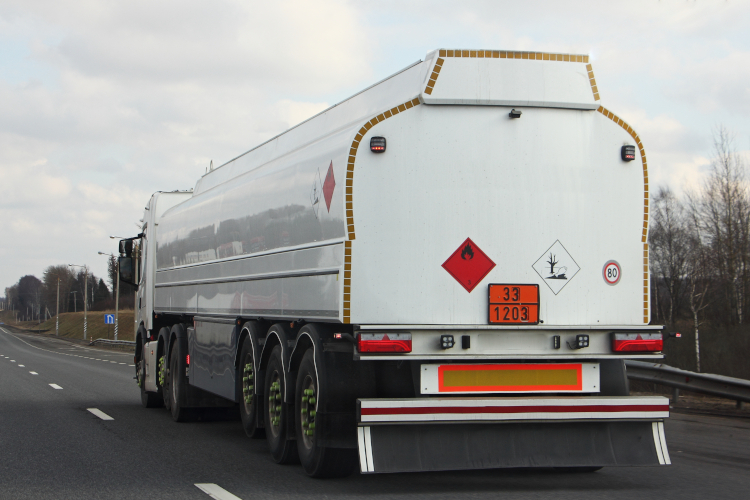
Both ADR transport and oversized transport are classified as special cargo. In the era of continuous economic development, oversized transport is being used more and more frequently. An example of this is the “Karpatka”, the transport of a tunnel boring machine, which was awarded the ESTA Award in 2023. The latest achievement in this field – the petrochemical Wash Tower column – is breaking records again. The armed conflict on our eastern border has, to some extent, forced carriers to transport dangerous goods they had not previously dealt with. How, then, can one properly prepare for such ventures and ensure safety? How do the regulations regarding ADR transport differ from those for oversized transport?
Safe ADR transport
The rules for the transport of goods considered potentially harmful to humans and the environment are regulated by the ADR agreement (L’ Accord européen relatif au transport international des marchandises Dangereuses par Route). Poland ratified this agreement in 1975, and the last amendment took place in January 2023. The current law will be in force for two years. The possibility of using regulations from the previous cycle expires on June 30, 2023. The ADR agreement distinguishes 9 dangerous cargo classes, which differ in their dominant hazard. The transported goods have different states of matter: liquid, gas, solids. Each ADR transport has its own individual standardized label. The vehicle is marked with an orange plate with a hazard identification number, and additionally, colored diamonds with warning symbols of the given class are affixed.
ADR – who can transport?
To be able to drive a vehicle with dangerous goods, one must be at least 21 years old, hold a valid ADR training certificate, and have the appropriate category of driving license. A list of companies authorized to conduct ADR courses can be found on the Transport Technical Supervision (TDT) website. After completing the course and passing the exam, one must submit an ADR driver application form to the appropriate marshal’s office. The fee for issuing the certificate is 50.50 PLN, and the certificate itself is valid for 5 years. To carry out the transport of goods in tankers and goods of classes 1 and 7, additional qualifications are required. Importantly, ADR in-house training is also required for employees who have physical contact with dangerous goods, e.g., warehouse workers, packers, loaders, etc., and it also applies to those commissioning the transport and those filling out transport documentation.
ADR Advisor – a new function in the transport process
Every company dealing with the transport of dangerous goods is required to appoint an ADR advisor, whose task is to oversee the safety of the entire process. According to point 6.2 of Annex No. 1 to the Act of October 19, 2011, on the transport of dangerous goods, failure to appoint an advisor by the consignor will constitute a violation of the conditions for the road transport of dangerous goods. This is therefore grounds for a financial penalty of 5,000 PLN.
Beyond the norms, i.e., oversized transport
Exceptional dimensions also mean exceptional procedures and requirements. For such transport to take place, the following conditions specified in the Road Traffic Act must be met:
Movement of a non-normative vehicle is permitted provided that:
- a permit for the passage of a non-normative vehicle of the appropriate category is obtained, issued by way of an administrative decision by the competent authority, and in the case of a non-normative vehicle belonging to the Armed Forces of the Republic of Poland, provided that a military permit for road passage is obtained, issued by the competent military authority;
- the conditions of passage specified in the permit are observed;
- the passage of the non-normative vehicle is piloted under the conditions and in the manner specified in the regulations issued pursuant to Art. 64i sec. 2 of the Road Traffic Act, including by the required number of vehicles equipped and marked in accordance with these regulations;
- special caution is exercised by the driver of the non-normative vehicle.
Road Traffic Act of June 20, 1997. Pursuant to Art. 64 sec. 1
Permits for non-normative transport
Obtaining the appropriate permit is a necessary step in organizing the huge undertaking that is the transport of non-normative loads. There are seven types of permits, which are conditioned by the type of exceeding the given norms, including dimensions, weight, or axle pressure. Category I and II permits are issued for divisible loads, and categories III to VII are intended for goods that cannot be divided into smaller loads. When applying for a permit, one must remember its duration.
Documents are issued in accordance with the regulations:
- category I permits – for 12 months,
- category II – IV permits – for a period of 1 month, 6 months, 12 months, 24 months,
- category V permit – is issued for a single or multiple passage of a non-normative vehicle on public roads at a designated time, on the route specified in the permit.
- a permit for a single passage of a non-normative vehicle is valid for 14 days,
- a permit for multiple passage of a non-normative vehicle is valid for 30 days.
Who drives this giant?
No additional qualifications are needed to drive non-normative transport. Due to the nature of the difficulties, however, drivers with more experience are preferred. Non-normative transport requires special focus, composure, and excellent ability to judge distance and space.
Pilot on board
According to the Ministry of Interior and Administration, there are situations in which a vehicle must be piloted. The pilot vehicle must be properly marked and must have a device that allows communication with the driver of the piloted vehicle. In most cases, when the width of the roadway is less than 2.5 m and the length of the vehicle is greater than 40 m, the police are involved in the piloting.
Both the transport of dangerous goods and non-normative transport are complex logistical undertakings that involve many people. Undoubtedly, it is important in each case to ensure all procedures are followed. The motivation for following them is primarily safety. In the case of failure to comply with legal provisions or attempts to break them, high financial penalties are imposed.
Source: Polish Institute of Road Transport