









Total cargo handling in the three ports of primary importance to the Polish economy (Gdańsk, Gdynia, Szczecin-Świnoujście) in the first half of 2020 (H1 2020) fell by 9.94% compared to H1 2019. The main reason is the decline in Poland’s international trade caused by the COVID-19 pandemic – emphasize experts from the consulting department of Actia Forum, a company specializing in, among other things, market research in the fields of transport, tourism, and the natural environment.
All analyzed ports recorded a decreased volume of cargo handling. The most significant changes occurred in the Port of Gdańsk (-4.2 million tons of cargo handled in the port compared to H1 2019). The Port of Szczecin-Świnoujście also lost volume (-1.3 million tons). The scale of declines in the Port of Gdynia was the smallest and did not exceed 1% (-0.1 million tons).
Performance of Polish seaports in the first half of 2020
Basic cargo groups
Analogous to the first quarter of 2020, the largest decline among the analyzed cargo groups was recorded in timber handling (-78.5%). Large declines are a consequence of increased timber exports from Poland in 2018 (timber handling in Polish ports was record-breaking at that time, which was caused by windthrows passing through Poland in 2017). All analyzed ports recorded a decreased volume of handled timber (-459.849 thousand tons compared to H1 2019). However, comparing the turnover in the first quarter with the second quarter of the current year, one can notice a more than 20 percent increase in turnover in this group. The Szczecin-Świnoujście port complex is characterized by the largest share in ore cargo turnover – over 90% of handling takes place in Świnoujście. In H1 2020, there was a weakening in handling (-550.58 thousand tons compared to H1 2019). In the Port of Szczecin-Świnoujście, declines oscillated at the level of 608.8 thousand tons. Reduced ore handling, according to the Szczecin and Świnoujście Seaports Authority, is a result of the worsened situation in the steel industry and the use of cheaper steel from China and Russia, as well as limited ore imports by sea. The Port of Gdańsk recorded a more than 12-fold increase in handling in the analyzed cargo group, however, with very small turnover volumes (+58.2 thousand tons).
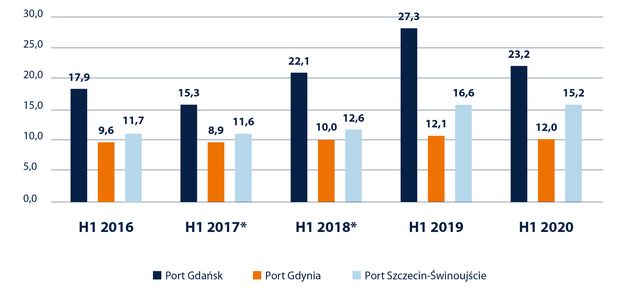
Figure 1. Cargo handling in the largest Polish ports in the first half of the years 2016-2020
*Source: data for H1 2017 and H1 2018 come from Eurostat, while H1 2016, H1 2019, H1 2020 are data from seaports
The only cargo group in which all analyzed ports recorded an increase in turnover is grain. In total, cargo handling in Polish ports increased by 112.5% (+2,390 thousand tons compared to H1 2019). The most growth was in the Port of Gdynia (+1,485.6 thousand tons), which remains the leader in grain handling. The Port of Szczecin-Świnoujście was also in the positive (+506.1 thousand tons). The largest increase was recorded by the Port of Gdańsk, however, with significantly smaller volumes (+398.3 thousand tons compared to H1 2019). Record handling is the result of increased demand for wheat caused by fires in Australia.
Compared to the first half of 2019, the share of the coal and coke group in total cargo handling fell by more than 3 percentage points. Most handling takes place in the Port of Gdańsk, which lost 825.5 thousand tons. Declines were also recorded in the Port of Gdynia (-1,017.6 thousand tons) and in the Port of Szczecin-Świnoujście (-466.7 thousand tons). Reduced handling in this cargo group is a result of limitations in steel production in Polish, Czech, and Slovak steel mills, as well as a decline in industrial production, which leads to a reduced demand for coal and coke.
Deeper declines were also observed in the fuels group. Total handling decreased by more than 23%, with a decrease in handled volume of 2,979 thousand tons. Double-digit growth in the Port of Szczecin-Świnoujście (+376.3 thousand tons compared to H1 2019) and maintaining the level of handling in the Port of Gdynia (+20.5 thousand tons) did not compensate for the deep declines in the Port of Gdańsk, which accounts for almost 67% of fuel handling in Polish ports.
General cargo handling decreased in all analyzed ports (-6.11% compared to H1 2019). Also, comparing the data with handling for the first quarter of 2020, we can notice an increased scale of decline. All analyzed ports recorded a smaller volume of handled general cargo – Port of Szczecin-Świnoujście (-800.2 thousand tons compared to H1 2019), Port of Gdynia (-400.2 thousand tons), and Port of Gdańsk (-409 thousand tons). The largest share in general cargo handling is held by container turnover (the largest declines in 5 years) and ro-ro freight unit handling.
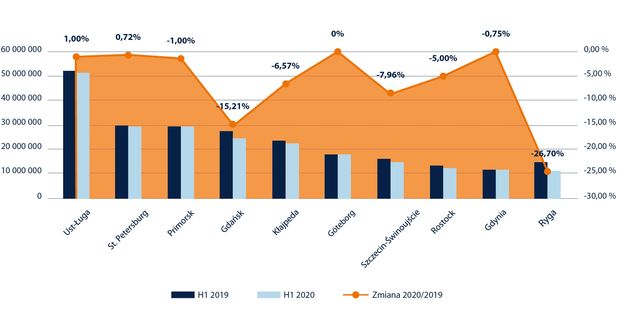
Figure 2. Cargo handling in the largest Baltic ports in H1 2019 and H1 2020
In total, the 10 largest ports on the Baltic Sea recorded a more than 5 percent decline in cargo handling compared to the first half of 2019. This is also a more severe change than at the end of the first quarter of 2020, when cargo handling increased slightly (+0.18% compared to 1Q 2019).
Against the background of the largest ports on the Baltic Sea, the Port of Gdańsk maintained its fourth position, and Szczecin-Świnoujście its seventh. Unlike H1 2019 and 1Q 2020, the ranking is not closed by the Port of Gdynia, whose cargo handling in the period January – June amounted to 12 million tons. The Port of Gdynia advanced to the 9th position in the ranking.
More information on Baltic port cargo handling is available in the report Port Monitor: Baltic ports with a decline in cargo handling in the first half of 2020. Actia Forum, 2020.