








Health and safety training is mandatory, and many companies organize additional safe driving courses. Despite this, accidents involving forklifts still occur at work. Some of them can be avoided by using appropriate technological solutions.
According to industry reports, the number of fatal incidents involving forklifts in our country remains relatively constant at about 20 cases per year. As shown by data published periodically by the Central Statistical Office (GUS), the most common cause of workplace accidents is invariably the improper behavior of employees. According to STILL experts, the frequency of proper conduct can be increased by using safety systems designed to support operators. Here are the solutions that, according to the company’s data, help prevent accidents in three areas where typical events threatening the health and lives of operators occur.
Collision prevention systems for forklifts
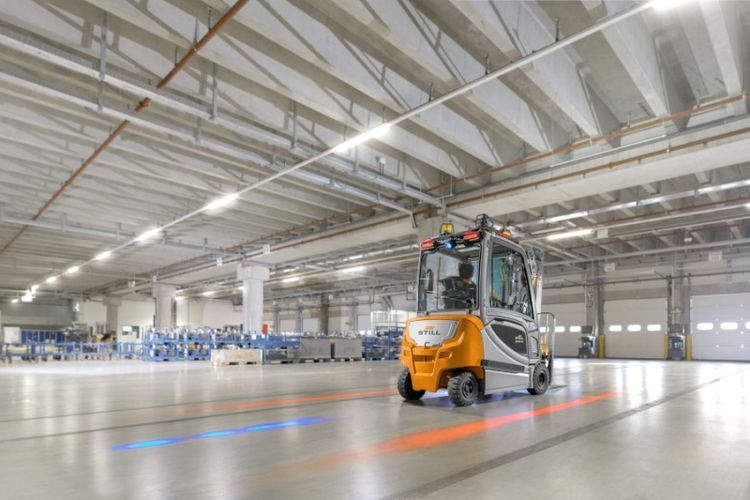
Collisions with objects – both moving and stationary – are, according to the Central Statistical Office, the two categories of events that are the most common cause of workplace accidents. In total, they account for more than half of them. Visual warning signs are an effective way to prevent collisions. They increase the visibility of forklifts by displaying light strips on the side of the vehicle and a spot indicating the direction of travel. They thus define a zone where being present can be dangerous for other traffic participants. This type of additional lighting acts as a visual warning for both pedestrians and operators in the immediate vicinity of the forklift.
A step further are systems based on two-way radio communication between objects – transport vehicles, infrastructure elements, and even pedestrians. RFID transponders can trigger a desired reaction from a forklift in a specific location (e.g., reducing speed at the end of an aisle or near an intersection). Although this is still relatively rare, there is nothing to prevent using communicating transmitters to trigger a speed reduction in forklifts when they get too close to each other or to pedestrian traffic participants.
Anti-tip control systems
Due to experience from road traffic, where vehicles move two or even six times faster than forklifts, it might seem that excessive speed does not occur in warehouses. However, due to the mass of vehicles and transported loads, as well as the stresses occurring as a result of physical forces – especially in corners – loss of vehicle stability can occur here. Combined with unfastened seat belts, the result can be the operator being crushed by a multi-ton weight.
– The Curve Speed Control system was created to avoid the loss of lateral stability by forklifts. It automatically reduces the forklift’s driving speed when the steering wheel or control device is significantly turned. This prevents excessive speed in corners – explains Grzegorz Kurkowski, product specialist at STILL Poland. – Accidents involving tipping over also happen when an operator overestimates the load capacity of their equipment. If a load that is too heavy is placed on the front part of the forks, the vehicle may tip over onto a rack. To prevent this, STILL engineers have developed the Dynamic Load Control system. It limits the lifting height depending on the weight of the load, thereby preventing the vehicle from being overloaded – adds Kurkowski.
Something for a good start
Accidents can also be prevented even before the shift begins. Thanks to access control systems, it is possible to eliminate the phenomenon of forklifts being driven by unauthorized persons or those without adequate qualifications. Tools of this type also allow for programming the requirement to confirm the operational capability of the vehicle (before each shift or at designated intervals). This prevents work from starting if the forklift is not fully functional.
– The FleetManager 4.x access control system from STILL offers an extensive package of reports and telematics applications, which can be used to monitor the operation of forklifts and drivers on the premises – says Kurkowski. – The driving style of operators can be monitored using acceleration sensors. If necessary, they also allow for preventing the exceeding of a specific speed. If you want to eliminate cases of concealing collisions, it is worth investing in sensors that detect mechanical shocks. After a collision, such a system reduces the forklift’s speed to a minimum. A return to full functionality is possible only after the intervention of a person with a higher level of authorization – explains the product specialist at STILL Poland.
In non-automated warehouses, nothing can replace qualified, trained, and responsible personnel. However, thanks to the use of modern technologies, it is possible to significantly reduce the number of accidents and shape desired attitudes among operators. Safety systems can support employee improvement, the development of proper habits, and encourage driving in accordance with health and safety regulations. With their use, accident-free logistics is within reach.
Source: Newseria