










The policy of setting prices for services related to the use of railway transport infrastructure is an important instrument of state policy influencing the functioning of the railway transport market. In the area of regulating access charges for infrastructure, the aim should be to correctly reflect in the access charge rates the justified infrastructure costs incurred in connection with specific types of services and the passage of specific types of trains on specific categories of railway lines.
In principle, the costs incurred by carriers must be based on the direct costs incurred by the manager as a result of operating train services. The proposal for a new directive consolidating the first railway package maintains the principle that the costs incurred by the manager are covered by access charges and subsidies received from the state budget. The barrier set in the proposal for covering costs from charges (see Annex 8 of the proposed directive) from carriers at a level of up to 35% of the total costs incurred by the manager means a significant increase in the involvement of the state budget. The structure of charges for the minimum access package is based on direct costs and is reflected in the provision “at a cost that is directly incurred as a result of operating train services,” provided that if direct costs exceed 35% of the average costs of maintaining, managing, and repairing the network on average for the entire network, calculated on the basis of train-kilometers (train/km) performed, the infrastructure manager shall submit a justification for such a situation to the regulatory body. This should be done within the framework of long-term plans finalized by an infrastructure financing agreement for a period of at least 3 to 5 years. This is to provide a guarantee of stabilization for the infrastructure manager’s financing and so that price lists are not valid for only one year, but longer, for example, also for the duration of the agreement between the state and the national infrastructure manager. Any potential changes would concern adjustments in the inflation level. The railway business needs long-term stability for its development and responsible planning.
Currently, the system for calculating access charges is based on statutory provisions (Act on Railway Transport, Chapter 6) and the 2009 regulation on the conditions of access and use of infrastructure. In short, it assumes the need to balance the revenues and costs of the infrastructure manager while taking into account the state budget subsidy for maintenance and repairs. This is the so-called total cost model reduced by state budget subsidies. The regulator’s authority concerns approving or refusing to approve the submitted draft of charges if it is developed inconsistently with the principles defined in the law. De facto, this concerns the authority to examine the principles and compliance of the submitted draft with these principles, and not the price level for access, although the regulator may seek the opinion of auditors or experts in case of doubts regarding the justification of the unit rate increases adopted by the manager (§ 17 para. 2 of the regulation). Perhaps this should be utilized by conducting audits of projects in the context of the correctness of cost calculation and classification – in terms of their potential impact on the level of unit rates. Annex X of the directive consolidating the first package points to monitoring access charges for infrastructure through the analysis of a whole range of economic and financial documents submitted to the regulator. However, it does not mention the regulation method or the analysis period at all, as it is surely not about the annual regulation of the cost growth rate.
On the model and level of charges
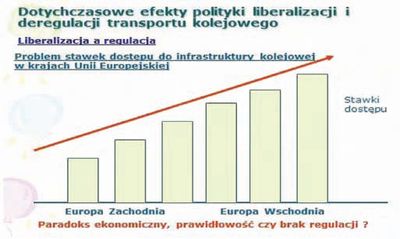
The problem of charges actually concerns two issues, namely charges for access to service infrastructure facilities maintained and managed by operators of such infrastructure, and charges for access to linear infrastructure, i.e., the route made available for a train’s passage, which is the rate per 1 train/km. As for charges for the use of service facilities, there is a lack of transparency in their setting in Europe. In the opinion of the European Commission, the courts of some Member States have interpreted that operators of service facilities must create price lists, but do not necessarily have to link the offered services to specific prices. More readable in terms of methodology, although diverse in practice, are the models used for charges for access to linear infrastructure. As Jana Pieriegud states, among the models for covering the costs of making railway lines available, we encounter marginal cost models, total cost models with modifications, and total cost models in Europe. Generally, the current European trends in rate policy are illustrated in Figure 1.
The article comes from the magazine “Logistyka” 5/2011.