









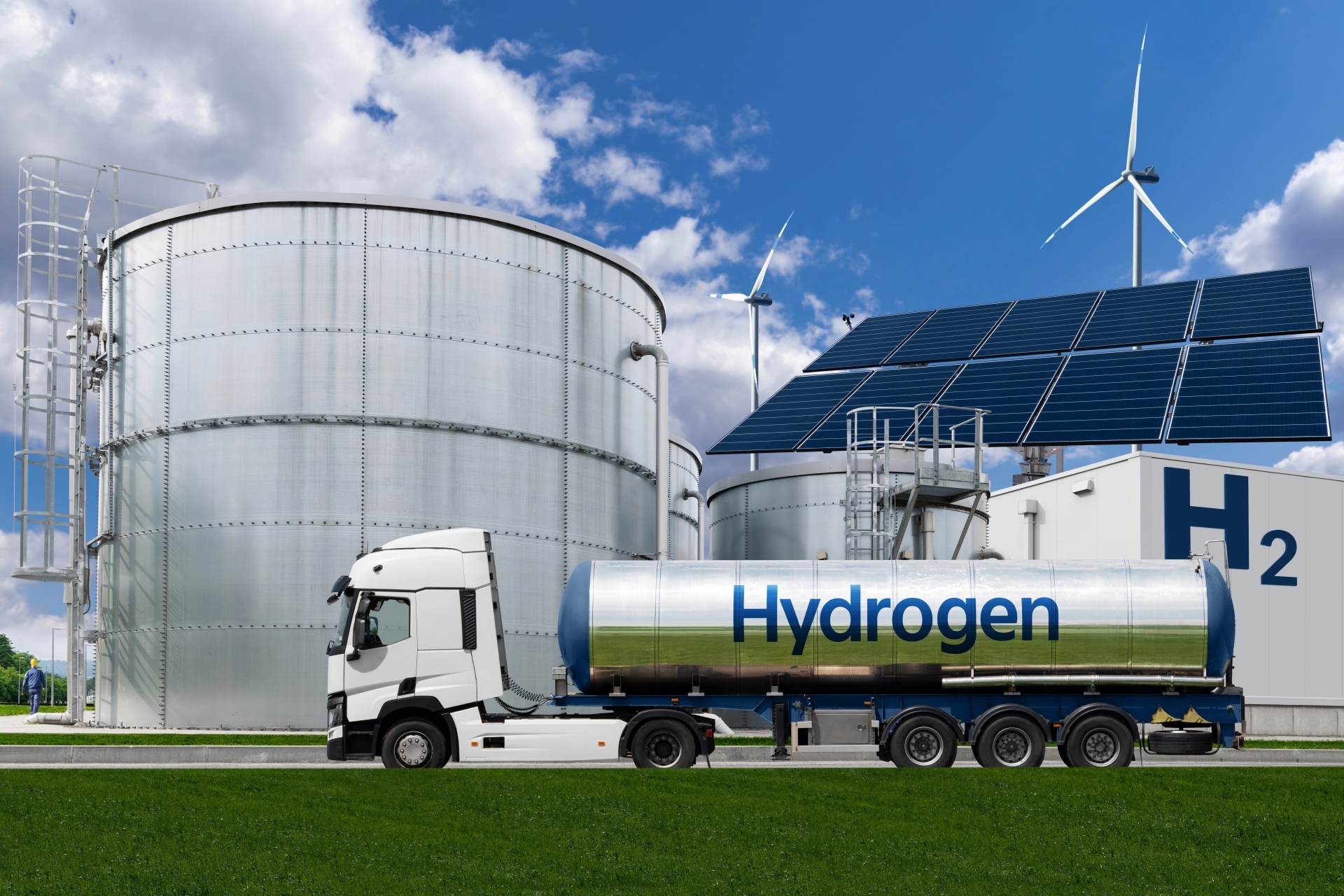
Changes in European transport are accelerating. Electromobility is a key trend, especially in “last mile” logistics. However, at the same time, the share of fully electric vehicles in Polish companies has fallen from 18 to 12 percent, which is in line with a broader European trend of slowing electromobility. The main barriers are the limited number of public charging stations, high vehicle prices, and a lack of access to adequate infrastructure. “We need sufficiently large, low-cost energy storage facilities. Hydrogen is, above all, the future,” assesses Andrzej Gemra of the Renault Group.
Transport is changing very significantly. This is due to the impact it has on our climate and the environment in which we live. Transport is changing very significantly, especially in the so-called last-mile area, which is the area where, on the one hand, there are the most people affected by the pollution generated by transport, and on the other hand, regarding the needs of people living in these regions. Therefore, this is where the greatest electrification of transport is taking place.
– emphasizes Andrzej Gemra, Public Affairs & Electromobility Expert at Renault Group, in an interview with the Newseria agency.
Road transport remains one of the largest sources of greenhouse gas emissions. According to Eurostat data, between 1990 and 2019 alone, greenhouse gas emissions in the EU resulting from fuel combustion in transport increased by 23.9 percent, or 161 million tonnes of CO2 equivalent. The “State of European Transport 2025” report indicates that road transport accounted for 73 percent of greenhouse gas emissions in 2024. On the other hand, however, European transport is undergoing significant changes. The trend is particularly visible at the last-mile stage. More and more carriers are electrifying their fleets.
The courier industry is functioning very strongly due to the dynamic development of e-commerce. The products we have ordered should be delivered as quickly as possible, so there are a lot of these vehicles, and in order not to pollute, the courier industry has already changed its vehicles to low-emission ones. It is more difficult in the case of trucks that operate between cities, because they cover very long distances, and the electrical energy storage, which is the battery, is not able to provide the truck driver with long distances.
– explains Andrzej Gemra.
According to the “Fleet Barometer 2025,” developed by the Arval Mobility Observatory, although more and more companies are increasing the level of sophistication of their pro-ecological activities, only 8 percent of Polish enterprises have specific decarbonization goals. The share of fully electric vehicles in Polish companies has fallen from 18 to 12 percent. The main barriers are the limited number of public charging stations (indicated by 46 percent of respondents), high vehicle prices (41 percent), and a lack of access to appropriate infrastructure at the company’s headquarters (36 percent).
In Poland, we have a lot of trucks that carry out transport over long distances. On the other hand, the number of charging points where trucks can recharge is still small, as is the connection capacity, which hinders this development. Another barrier is the price of electricity, which is very high and unstable; we do not know how much it will cost in the near future. Despite the existence of various types of protective shields, balancing this is quite difficult and does not allow for an immediate transition to this low-emission fuel.
– assesses the expert.
According to data from the European Automobile Manufacturers’ Association (ACEA), in terms of the number of electric vehicle charging points, with a result of less than one charger per 100 km of roads, Poland ranks among the last in the EU. Most charging points are located closest to large agglomerations, but they are missing along routes.
The PSNM “White Paper on New Mobility” assesses that the development of the electric vehicle market is being blocked precisely by insufficient infrastructure and the too slow pace of its construction. Of the 120 changes postulated by the industry to stimulate electromobility, 30 concern public and private charging infrastructure.
Something that would shorten the downtime required for recharging, the capacity of the energy storage, could help in reaching low-emission transport faster. That is, on the one hand, these are technologies that are developing very quickly, which will allow for the construction of sufficiently large and quickly replenished energy storage facilities that will be able to release energy quickly, be safe, but also cheap, i.e., built from generally available raw materials.
– points out Andrzej Gemra.
The report by the Institute of Power Engineering-PIB “Electromobility and alternative fuels in Poland until 2030 from a market and regulatory perspective” indicates that the goal of a 29 percent share of RES in energy consumption for transport needs in 2030 will be achieved through various methods, solutions, and fuels, including biogas, biomethane, or renewable hydrogen. The future is hydrogen, which can be used both as a fuel and as an energy carrier for storage.
We have very large resources of hydrogen throughout Europe, including in Poland; mainly it is grey hydrogen, and large amounts of energy are needed to purify it. On the one hand, it gives us the issue related to long-distance travel; the filling speed of a few minutes is comparable to refueling liquid fuel, while the cost of hydrogen fuel is very high. However, as a future, hydrogen fuel is associated with storing electrical energy, stabilizing power grids, but it is also possible to use it in transport.
– explains the expert.
The Institute of Power Engineering indicates that hydrogen currently offers greater potential in the transport of goods over longer distances. Despite the hypothetical technological evolution of batteries (with a solid electrolyte), it is unlikely that within 10 years it will be possible to recharge batteries in such a way that increased capacity can be used for journeys over 1,000 km without major problems. Furthermore, current batteries are very heavy, and even if the energy density were doubled from the current 260 Wh per 1 kg of battery to 500 Wh per 1 kg, a battery with a minimum capacity of 1.5 MW and a weight of 3 tons would still be needed for long-distance transport.
The question is whether we are able to technologically construct electric batteries faster that will charge quickly and have a large capacity, or build additional equipment, because today hydrogen equipment for electricity production, fuel cells, takes up a lot of space in the car.
– assesses Andrzej Gemra.
Renault is investing in sustainable mobility solutions. WeRide and Renault conducted an experiment in Spain with two autonomous electric minibuses. The test demonstrated the ability of both autonomous vehicles to move in an urban environment. From July 10, 2025, a commercial L4 automated shuttle transport service is to operate, i.e., vehicles capable of independently controlling the situation while driving in a specific area of operation and under remote supervision, but without staff in the vehicles.
By 2030, the Renault Group plans to create a robotic platform of electric minibuses that will be able to cooperate with autonomous driving solutions developed by specialized partners.
This is a completely new range of commercial delivery vehicles that are intended to operate in urban regions. The point is for them to have a design that allows them to move in congested cities, along narrow streets, to deliver goods to shops, to restaurants. The vehicles should be electric and make the driver’s work easier.
– explains the Public Affairs & Electromobility Expert at Renault Group.
Source: Newseria