









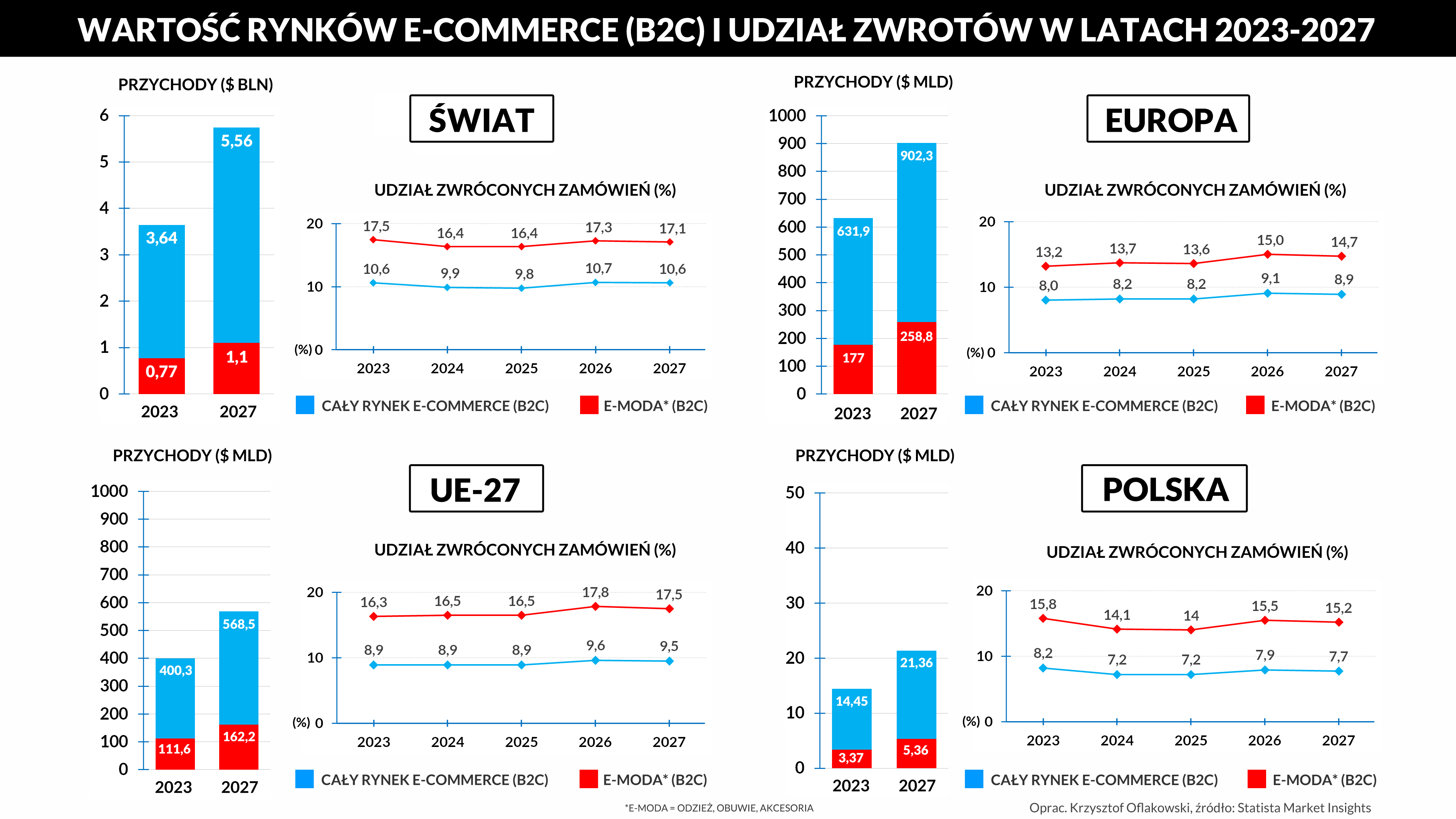
Fashion sold online in the European Union this year is expected to generate $111.6 billion in revenue, and up to $162.2 billion in four years. However, this will not be without its problems, as products in this group generate the highest share of returns among all product categories, both in the EU and global e-commerce. In the EU, this will amount to 16.3% this year and 17.5% in 2027. On the horizon, there are also two worrying phenomena that will further complicate the logistics operations of this sector.
Fashion, meaning clothing along with footwear and accessories, has for years been one of the most popular categories among all available product groups sold online. This is true in Europe, the USA, and the Asia-Pacific region, which are the largest global e-commerce markets. In a summary of the EU e-commerce industry published at the beginning of 2023, Eurostat calculated that as many as 42% of all people aged 16-74 using the internet in the EU in 2022 made a purchase in this very category. The transaction took place in the three-month period preceding the survey, and most of the data was collected at the beginning of 2022. In this short period, fashion outperformed the next items on the list: restaurant deliveries (19%), cosmetics and wellness products (17%), furniture, home and garden accessories (16%), and books, newspapers, and magazines (14%), as well as all other categories.
The fashion sector in e-commerce has also been generating the highest revenues in the Union for years. The latest update from Statista Market Insights, which takes into account the effects of the war in Ukraine, shows that this year fashion could generate $111.6 billion in revenue out of the $400.3 billion projected for total online retail sales. This is nearly 27.9% of the value of the community’s B2C e-commerce industry (sales to individual customers by companies).
Stable growth forecasts for e-fashion
Despite persistent economic problems, clothing, footwear, and accessories also have good growth prospects. While the average annual growth for EU B2C e-commerce in 2023-2027 is estimated at 9.17%, which will translate into $568.5 billion at the end of the forecast period, the fashion sector will grow at an average rate of 9.8% per year, reaching a value of $162.2 billion in 2027. In four years, the share of fashion in EU revenues generated by online retail purchases will increase from just under 27.9% to over 28.5%, and the fashion industry will remain the most popular group among EU e-consumers.
The data looks slightly different globally. Here, fashion yields to electronics, which this year is expected to account for almost 23.08% of global e-commerce. This will translate into $0.84 trillion out of the $3.64 trillion in revenue for the entire global market. The share of clothing, footwear, and accessories will be slightly less, at over 21.15%, which will yield almost $0.77 trillion in 2023. The revenue disparity will persist until 2027, when the share of electronics will be almost 24.3% ($1.35 trillion), while the global fashion industry will be about 19.8% ($1.1 trillion). Total online retail will reach a value of $5.56 trillion and will grow at an average rate of 11.17% per year between 2023 and 2027. Unlike the EU market, the global growth dynamics of fashion sales until 2027 will develop below the global trend and will average 9.45% per year.
Gigantic sales potential means more challenges for logistics
Fashion will remain safe on both the global and EU product podiums and is expected to attract as many as 2.4 billion online customers worldwide this year. In 2027, this will be 3.4 billion people. In the EU, 227.1 million e-customers will use online shopping in the clothing, footwear, and accessories category, and in 2027 there will be 272.9 million of them. Even greater potential is hidden in the broader European market, where there are expected to be 395.8 million buyers this year and 480.9 million in four years, each of whom will spend an average of $538.2. In Poland, meanwhile, this sector will attract 17.6 million e-consumers in 2023 and 21.6 million four years later.
This is potentially good news, both for sellers and the logistics operators serving them, many of whom have specialized in serving this very market. Organizing at least 227.1 million deliveries in 2023 to e-customers in the EU alone, or more broadly 395.8 million in Europe, and additionally handling a category that attracts the most buyers and grows faster than the average for the entire sector both in the EU and in Europe, is a guarantee of steadily growing revenues.
However, there is a catch in the fashion puzzle – serving this market is difficult, requires large investments, know-how, and resources, including human resources. Everything is to blame on large commodity volumes and a very high share of returns, the handling of which is expensive and significantly exceeds other product groups.
– Returns in the fashion market in Europe have for years accounted for the largest percentage among all the most popular product categories in e-commerce. The share of returned clothing, footwear, and accessories remains at the level of a dozen or so percent, and in 2022 in Western and Central Europe, it amounted to almost 22%. At the same time, there are no indications to assume that this trend will radically change direction, although sellers are trying to limit the return of orders, whether through additional fees or higher purchase values. However, it is difficult to expect customers to give up their right to free returns, which is also an important component of the purchasing decision. The scale of the phenomenon has really surprised, and it turned out that the logistics handling of returns is a process so resource-intensive for the largest fashion retailers that it has become increasingly common to outsource all such operations and launch separate facilities providing services of this type only. Many of them operate in Poland, where returns are comprehensively managed not only domestically but also from other markets in the region and sales channels – says Michał Wochna, Chief Operating Officer at ID Logistics, which provides comprehensive warehousing and fulfillment solutions for e-commerce as well as transport handling and supply chain management in 18 countries.
What is the exact scale of returns in fashion e-commerce?
The percentage of returned products in global e-commerce, covering all product categories, is expected to be 10.6% this year according to Statista analyses, and this share will remain with minor deviations until 2027. For comparison, returns in the fashion market will reach 17.5% this year and 17.1% in four years. This is by far the highest among all assortment groups, in which in no case will the scale of returns exceed 10% either this year or in 2027. It is clear that the fashion sector significantly boosts the share of returned orders in the entire global e-commerce.
It is similar on the Old Continent, where returns of clothing, footwear, and accessories will reach 13.2% this year and 14.7% in 2027. Similarly, returned products from all e-commerce categories will not exceed 10% and are expected to be 8% in 2023 and 8.9% in 2027, respectively.
In turn, in the European Union, fashion returns will reach 16.3% this year and 17.5% in 2027. The values for the entire EU e-commerce sector will stop at 8.9% and 9.5%, respectively. Available data for returns in the Polish market of fashion bought online indicate 15.8% this year and 15.2% in 2027, while for the entire domestic B2C e-commerce, the scale of returned goods will stop at 8.2% and 7.7% in four years.
Such large disparities have their sources both in the scale of clothing, footwear, and accessories bought online, purchasing preferences, the liberal and often free return policy practiced by e-sellers for years, but also in the EU law available to e-consumers. Promoters of returning a significant percentage of orders are also two increasingly clear and at the same time very logistics-absorbing phenomena, namely bracketing and wardrobing.
Bracketing and wardrobing vs sellers and logisticians
The first of these – bracketing, is a practice already known to Polish e-sellers and logisticians, consisting of ordering multiple sizes or color versions of the same product with the intention of returning some of the items. In such a scheme, the return shipment, often at the seller’s expense, is pre-calculated into the purchasing process. However, this is a fully legal practice, although due to the duplication of the delivery process, it is very burdensome for logistics. The described shopping standard is also a problem for e-sellers because some products, especially in the case of a long return period of 100 or even 180 days, no longer enter the re-sales cycle because a completely different collection, e.g., summer or winter, is available in the offer. The scale of the phenomenon is clearly gaining strength, and analyses by the Narvar platform, which deals with post-purchase experiences in e-commerce, show that in the USA, as many as 63% of e-consumers used such a shopping mechanism in 2022. In 2021, this percentage was 58%.
The second, less known in Poland, shopping model – wardrobing – is slightly different. It is a practice consisting of ordering goods from an online store, using them, and then returning them to the seller within the statutory period with a request for a refund of the paid funds. In this view, the online store acts as a free rental shop for clothing, footwear, accessories, or other goods. The mechanism is not yet well researched in Poland, but Narvar has analyzed this phenomenon in, among others, the UK and the USA, i.e., in much larger and more developed e-commerce markets.
Among the most frequently “bought” in this way assortment were, among others, clothing for special occasions (42.5% in the USA and 53.1% in the UK), household appliances (39.3% in the USA, 27.4% in the UK), products from the beauty category (18.65% in the USA and 22.5% in the UK), and jewelry and luxury items (17.9% in the USA and 17.1% in the UK). Moreover, there is a clear difference in “shopping” preferences by gender. Men most willingly choose, use, and return household appliances, including tools, equipment, and other items needed at home (42.5%). They are also more inclined to abuse their rights and the trust of sellers (44% use wardrobing as a regular practice). In turn, women prefer ordering clothing for special occasions (57.6%), and 32% of e-consumers admit to regular abuse. In both cases, however, the explanations of people caught cheating are bizarre. As many as 30.6% claim that they could not afford the purchase, although in reality, they belong to groups that are better financially secured than average. Using items only once or twice was an excuse for 20.6%, and 19.3% did so in retaliation for what they considered poor order handling. Interestingly, 19.1% of e-consumers believed that they had spent enough at a given seller, so they were entitled to something extra.
Wardrobing is expensive, but standard returns are too
Regardless of the reason for the return or the type of abuse, the goods must eventually return to the seller and undergo a verification procedure, and this can prove to be very expensive. According to Narvar, the complete processing cycle of a returned item with an average value of $100 reaches as much as 26.5% of this amount, i.e., $26.5. For comparison, in 2019 it was 19.8%.
The platform advises at the same time to fight wardrobing, and above all not to accept it as part of business risk, because it is a highly socially harmful action, as well as one that violates the rights of entrepreneurs. Methods of fighting abuse are to include, among others, return fees, introducing a “try before you buy” policy modeled on Amazon, which allows testing a product for seven days without making a payment. This gives at least a chance to quickly return the goods, which can then be put back on sale. Other solutions are logistics improvements in the form of, for example, consolidating returns from many channels in one location, ultimately leading to savings on handling and transport costs.
Returns in the fashion market are not only expensive but also difficult to implement because time counts
Although wardrobing has not yet settled in Poland, both logisticians and e-sellers will certainly get to taste the trend flowing to us from more developed markets. For now, according to industry experts, the percentage of added returns in the e-fashion sector in Poland is about 3%, but it is highly dependent on the potential of the entity handling the returned orders, as some of them can be quickly made available for resale. However, the ability to process large product volumes in a short time, the possibility of carrying out product regeneration, sanitization, and repairs, but also the machine park, consolidation capabilities, and staff experience count.
– The difficulty of implementing a return in the fashion sector results primarily from the number of operations that must be covered by each delivered product and the specifics of the market itself, focused on seasonality and frequent and comprehensive assortment replacement. This is especially a challenge for fast fashion segment clients, for whom the interval between return registration and the re-availability of goods is of key importance. Processing a return itself, alongside electronics and household appliances, belongs to the more complicated ones. Each item entering the warehouse goes through at least 3 to even 7 stages of so-called regeneration before it returns to the physical or virtual shelf. Each of them is individually verified for compliance with the original order, undergoes a quality assessment, taking into account defects, signs of use, and compliance of labels with the goods. Repairs are also carried out, and all clothing items, if only permitted by the manufacturer, are re-ironed and mandatorily repacked. The meticulousness and efficiency of the operator’s work often determine the percentage of goods that are suitable for resale. In our locations, only 3% of returns are rejected. These are products that could not be regenerated or were identified as foreign goods, permanently soiled, damaged, or used. In such a case, photographic documentation is prepared each time along with a written justification, and the case is taken over by the partner, who clarifies the matter with their client. However, all these activities take time, and it is of great importance in this sector of the market. The key is therefore to achieve maximum efficiency, and this is the biggest challenge – concludes Michał Wochna from ID Logistics.
Returns burden not only logistics but also significantly lower the margin
In The State of Fashion 2023 report recently published by McKinsey & Company, a global strategic consulting firm, analysts cite data saying that e-commerce retailers pay an average of $21 to as much as $46 to handle a single return when return transport costs, processing of goods at the seller’s, and other necessary expenditures are added to the total burden. Last year’s BOXpoll study conducted by Pitney Bowes also points to 21% of the total value of goods in the case of a return. In turn, SimplicityDX, a provider of IT solutions for e-commerce, places a large share of returns alongside the main factors affecting the rising costs of customer acquisition and the overall profitability of e-commerce. The company calculates that back in 2013, the average cost of acquiring a single customer was $9 on average, currently it is $29.
Returns also attract the attention of Polish organizations researching e-commerce
In the report “A Decade of Polish E-commerce,” the Chamber of Electronic Economy (e-Izba) calculates that 61% of e-buyers admit that the return policy is always taken into account before finalizing an online purchase, and the very possibility of making it without giving a reason along with a longer permissible time to return the goods are some of the most important benefits of shopping online. E-Izba points out that 30% of those returning orders do so because a better offer simply appeared, and 26% of e-consumers intentionally buy multiple versions of a given product, practicing the previously discussed bracketing. At the same time, these are not reasons that should be the real reason for a return, i.e., goods deviating from the provided specification, poor quality, or damaged. The report also calculates that 56% of e-customers currently admit to making a return, every third buyer does it regularly, and a significant increase in the scale of returns is visible especially in the fashion market.