








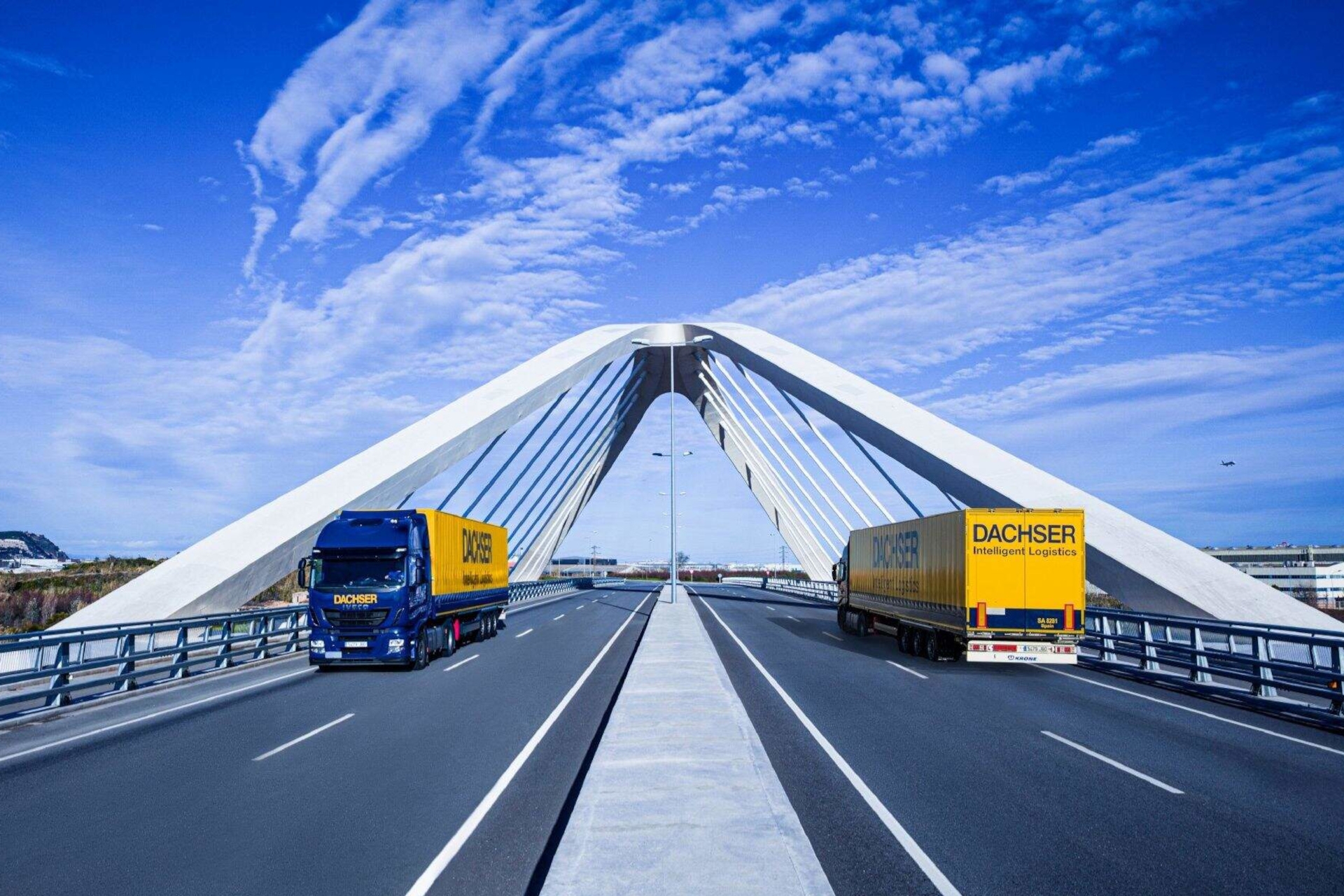
In the era of globalization, exporters face increasing logistical demands. Standardization of processes, consistent procedures, and supply chain transparency are key factors ensuring the effectiveness and efficiency of international transport. How can Polish companies not only compete but also outpace global players? Can a uniform distribution network be the key to success?
According to preliminary data from Statistics Poland (GUS), in 2024, the export of goods from Poland reached a value of 350.4 billion EUR, confirming Poland’s position as an export powerhouse in Europe. Exports remain a vital pillar of economic growth and a source of income for both companies and the state budget.
In this context, uniform logistics standards and operational transparency are becoming crucial for maintaining competitiveness in international markets. As a logistics company, DACHSER, thanks to its integrated distribution network, enables companies to optimize exports and eliminate logistical barriers.
Process consistency and logistics efficiency
A uniform transport network ensures that the carriage of goods in Europe takes place according to standardized rules, which simplifies the execution of deliveries.
Shipment management system – monitoring and control
Access to up-to-date information on shipments in real-time enables more effective supply chain management. A common IT platform allows for tracking shipments regardless of the destination country, which improves communication and reduces the risk of delays. System integration via EDI or API ensures full data synchronization between the logistics operator and the exporter.
A uniform distribution network in practice creates a Europe without borders – not only geographical but also operational. It is a space where goods move with the same freedom as data in a network, and companies benefit from uniform service standards, regardless of the destination country. In such an organized environment, logistics is no longer a barrier – it becomes a growth engine. Process transparency and full digital integration allow for planning with greater precision, acting flexibly and predictably. In the context of the development of Polish exports, it is precisely this operational efficiency that is of key importance today for maintaining competitiveness in international markets.
– emphasizes Rafał Owczarek, Sales Manager for European Logistics Poland at DACHSER.
A uniform network – the future of Polish exports?
Faced with growing logistical challenges and global competition, it becomes crucial not only to adapt to standards but also to stay ahead of them. A consistent and transparent transport network allows Polish exporters to operate more effectively, faster, and without unnecessary complications, providing them with:
- greater operational efficiency – simplification of logistics processes and shorter delivery times;
- better adaptation to foreign markets – uniform service rules in different countries;
- cost optimization – predictable logistics expenses and greater control over the supply chain;
- lower operational risk – elimination of errors resulting from procedural differences.
Standard operating procedures and a uniform level of service ensure process repeatability and delivery predictability. Thanks to this, exporters can use three main delivery models.
- Economy option – optimization of transport costs,
- Express option – minimization of delivery time,
- Fixed-day delivery – precise supply chain planning.
Strength in consistency
Is a uniform distribution network the key to success in international markets? More and more companies are realizing that this is not just a trend, but a necessity in an era of dynamic change. In a world where predictability and reliability of deliveries play a key role, effective logistics management can be what allows Polish enterprises not only to compete effectively but also to outpace global rivals.
Source: Dachser