









Bankruptcies among transport companies are on the rise, and further changes in the transport market only deepen the industry’s problems. For carriers, 2019 is also a time of intense struggle with staff shortages, according to the latest study “Finances, investments, trends in the transport industry in 2019” conducted by the Keralla Research Institute.
As the study conducted by the Keralla Research Institute shows, the difficulty in recruiting drivers will be the main factor strongly shaping the industry among carriers. Nearly half of transport companies express this opinion, whereas a year ago, 28 percent of transporters shared this view.
– The current year is a whole series of challenges for the TSL industry. The Mobility Package introduced by the EU is primarily changing the cost structure of this business, networking forces companies to become part of a massive information exchange system, legislative changes implemented by the government are regulating the market but also reducing transport margins. In addition, there is still uncertainty regarding the style and rules under which the British will leave the EU table – comments Katarzyna Pydych, General Director of the Keralla Research Institute, on the results. – Already last year, the transport market predicted that these twelve months would be really tough for the sector. The current reading of the FIT index for this industry confirms that it was expected to be weaker, and unfortunately, it is.
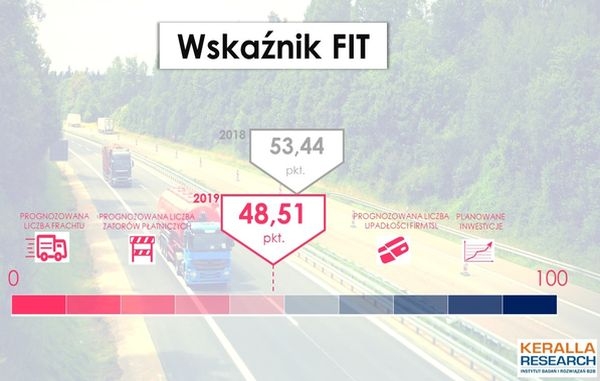
The state of the TSL industry is reflected by the FIT Index, which currently stands at 48.51, which is almost 5 points worse compared to last year. According to the forecasts of the Keralla Research Institute, both the carriers’ problems with rising operating costs and the rapidly implemented effects of the policy to eliminate the grey market have led to a deterioration of the transport industry’s situation. Importantly, today this information is compounded by a recorded decline in demand for transport services, which some carriers are increasingly feeling.
The low value of the index is also influenced by transport companies’ forecasts regarding difficulties in maintaining financial liquidity in the coming months. Over 38 percent of carriers estimate that compared to last year, the number of bankruptcies in the transport industry has already increased (a year ago, 18.3 percent answered the same), and 46.7 percent of respondents believe that there will be even more companies withdrawing from the transport market in 2019 as a whole.
The study was conducted on a random, representative, nationwide sample of n=300 transport companies. The FIT index is based on, among other things: information on the debt of transport companies, the scale of payment arrears in the industry, predicted bankruptcies, as well as projected freight and planned investments. It takes values from 0 to 100, while a result below 50 indicates a weakening condition of the TSL industry and an increase in risks for sectors cooperating with transport.
Source report: “Finances, investments, trends in the transport industry in 2019”, Keralla Research Institute for B2B Research and Solutions.