









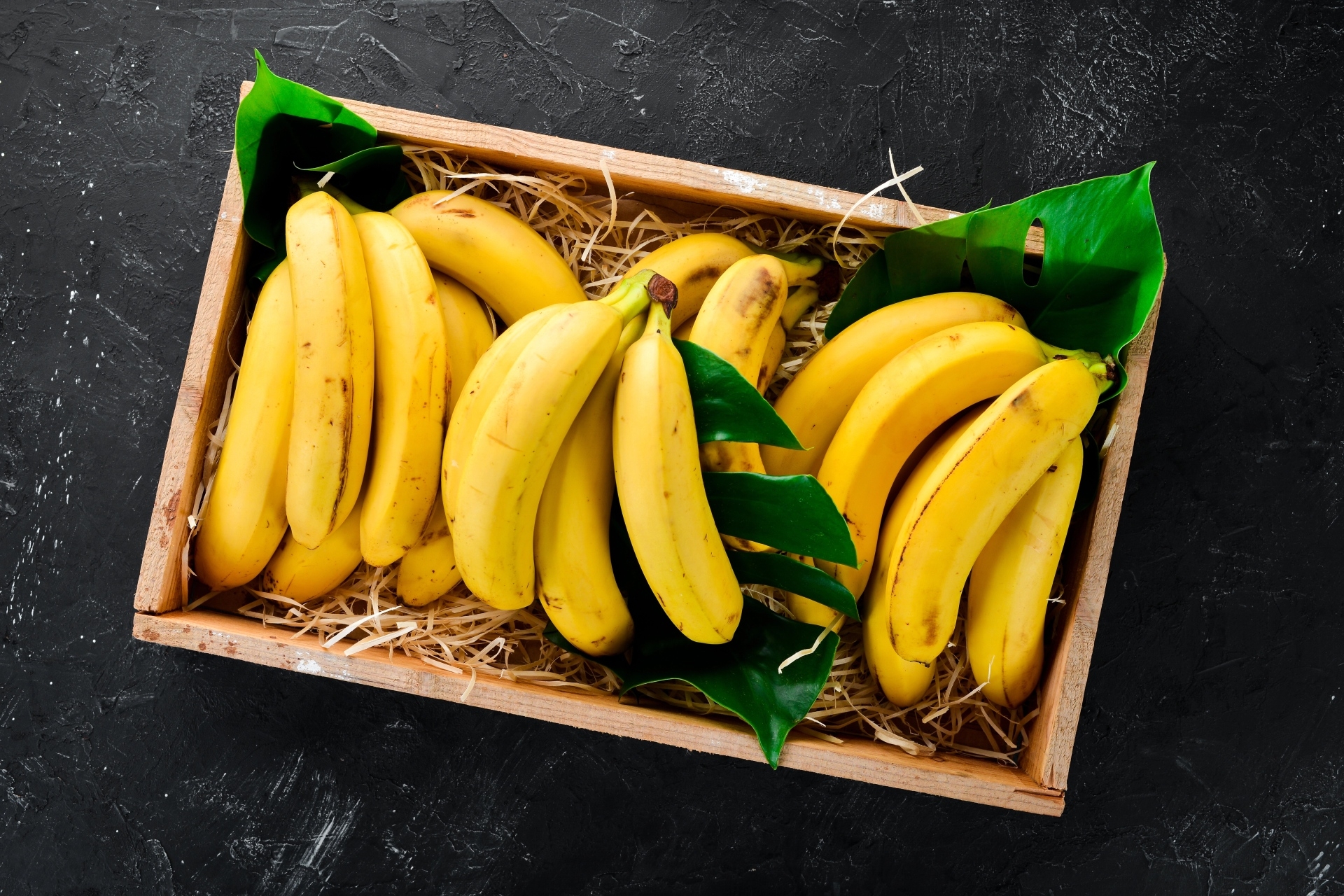
Bananas – the most popular fruit in European supermarkets – often travel over 9,000 kilometers and spend nearly a month in transit before reaching our shelves. Delivering fresh, ripe, and affordable products requires strictly controlled logistics from the plantation to the store. Experts from Girteka Logistics explain how to ensure that exotic fruits, such as bananas and avocados, reach tables across the entire continent, from ripening chambers in Rotterdam to refrigerated trucks traversing Europe.
How long does it take to deliver bananas to stores in Europe?
The time it takes for fruit to reach Europe largely depends on the country of origin. Oranges grown in Spain can reach neighboring markets in less than a week. However, for bananas and avocados from Central or South America, the journey can take up to 30 days. Deliveries from Asia take even longer – up to a month and a half.
According to Vytautas Oleškevičius, Girteka’s Regional Director for Central Europe, the journey of every fruit consists of many stages and entities involved in the process.
Avocados are a great example. Europe consumes over 1.1 million tons of avocados annually. They are usually grown on small farms, where growers sell them to exporters. Exporters wash and prepare them for sale, and then importers handle the logistics to bring the fruit to Europe. Only after all customs procedures are completed do European retailers step in, buy the required quantities, and ask us to transport them.
– says Vytautas Oleškevičius.
Exotic fruits are not the only goods that cross continental borders. Looking at product labels, one can notice that even vegetables like carrots, cucumbers, or potatoes can be imported from outside the European Union. The scale of fruit logistics may be even more surprising – in 2024 alone, Girteka transported over 7,000 tons of watermelons across Europe – which corresponds to over 300 fully loaded trucks.
Maintaining fruit freshness across different continents
The journey of bananas from South America to store shelves in Europe requires strict coordination between farmers, suppliers, and logistics companies. In 2025, Girteka has already delivered over 14,000 trucks of fruit to 30 European countries, totaling over 300,000 tons. The challenge is not only the distance but also maintaining the appropriate transport conditions. Even small temperature changes can affect fruit quality.
Our task is to assess and manage all potential risks. For example, there is always a risk of damage to pallets or boxes at a transshipment point. Customs checks must also be taken into account, and some delays are beyond our control. Containers sometimes have to wait three or four days due to heavy traffic. We call these ‘known unknowns.’ Identifying them helps us face challenges more effectively.
– says V. Oleškevičius.
The Rotterdam point
Most exotic fruits arrive in Rotterdam – the largest port in Europe, handling 400 million tons of cargo annually. It is there that companies like Girteka take control of the transport. The fruit is sent to logistics centers and loaded onto refrigerated trucks, which carry the goods across the entire continent. At this stage, the fruit is already being prepared for the end consumer. On ships, they are stored in containers at temperatures close to zero degrees Celsius.
Bananas are usually harvested while they are still completely green – at this stage, they are completely inedible. They must remain unripe throughout the journey across the Atlantic, otherwise, they will spoil before reaching Lithuania. In Rotterdam, importers place them in ripening chambers. The ripening process also continues in the truck, and by the time the truck reaches the stores, the bananas are almost fully ripe.
– says Mantas Briedis, Sales Manager at Girteka Logistics.
What is easy and what is difficult in transport?
According to experts, the complexity of the process depends on the type of fruit. Fruits differ significantly in terms of sensitivity. Bananas and avocados are relatively easy to transport, which explains their global popularity. Berries, on the other hand, are much more delicate and require very responsible logistics operations.
One of the products we transport from Peru is blueberries. They are very delicate, so maintaining the right temperature is an additional challenge that we take seriously. Because berries spoil faster, they are often transported to Europe by plane rather than by ship. Citrus fruits are also problematic – they are very sensitive to condensation. If moisture accumulates in them, the fruit begins to rot.
– explains M. Briedis.
In such cases, speed and precision are very important. Drivers play a key role in ensuring the fastest and safest delivery of temperature-sensitive cargo, preventing spoilage and waste.
The quiet success of fruit logistics
Despite the complexity and numerous risk factors, modern logistics chains operate with remarkable efficiency. Today, it is almost unthinkable for a store in any European country to run out of bananas.
The fact that consumers don’t even think about how exotic fruits reach them is the best proof of how smoothly the entire process works.
– says Mantas Briedis, a logistics expert at Girteka.
Behind every banana, avocado, or box of blueberries lies an advanced network – farmers, exporters, customs agents, logistics planners, and drivers who work closely together. Their coordination ensures that even fruit grown thousands of kilometers away arrives ripe, fresh, and ready to eat – exactly when we expect it.
Source: Girteka / Diana Kijauskaitė