








With the participation of over 70 participants from Poland, the Czech Republic, Russia, Ukraine, and the USA, the 8th Conference on Applied Logistics “Total Logistic Management” was held on December 9-11, 2004, in Zakopane. This year’s edition was held under the honorary patronage of the Chairman of the Transport Committee of the Polish Academy of Sciences (PAN), Prof. Janusz Dyduch, PhD, DSc, Eng., and the Rector of the AGH University of Science and Technology, Prof. Ryszard Tadeusiewicz, PhD, DSc, Eng.
Opening the proceedings, Prof. Janusz Dyduch stated, among other things, that there is nothing more practical than a good theory that inspires and is inspired by practice. “An example of this can be precisely this conference, which shows how to achieve a two-way benefit through the successful combination of science and practice, using the example of such a dynamically developing field as logistics. We must also remember that in applied sciences, it is the duty of each of us to seek contacts with practice,” emphasized J. Dyduch.
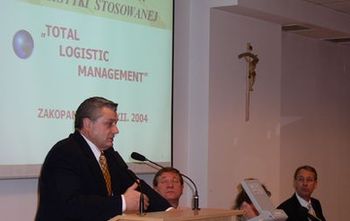
Opening the speeches of the plenary session, the Honorary Chairman of the Scientific and Programme Committee of the Conference, Prof. Stanisław Oziemski, PhD, DSc, Eng. (IMBiGS, Warsaw), pointed out in his speech that “it has long been observed that in Poland, logistics cannot exist as a field of knowledge. It lacks a uniform canon and theory on the basis of which educational programmes would be implemented”.
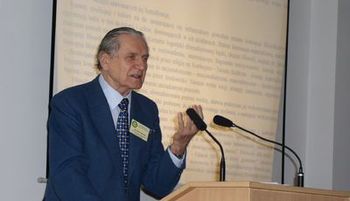
“In the logistics major, there is a lack of substantive foundations and logistics theory, which allows for a rather arbitrary interpretation of the required content and minimum study curricula. Logistics has been recognized by the Ministry of National Education and Sport as a major subject, and is offered with 120, 150, 165, 180, 420, 450, and even 525 hours of lectures and exercises. Something is not right here.” As Prof. Włodzimierz Rydzkowski points out, “the lack, regardless of the type and kind of studies, of a common canon and a specific core of the logistics specialty programme” gives the impression “that lecturers teach what they know, rather than what is currently needed,” said Prof. S. Oziemski. He also added that individual universities are not interested in establishing a binding “canon” relating to logistics. “Establishing semantics, common subjects, and the number of hours allocated to them requires a consensus among teaching institutions, which, however, especially for the weaker ones, will be inconvenient,” stated the Professor.
In the belief of the Chairman of the Scientific and Programme Committee of the Conference, Prof. Lech Bukowski, PhD, DSc, Eng. (AGH), “so far, both at home and abroad, there is no uniform view on whether logistics is ‘only’ an effective method of solving problems related to the processes of flow of goods in so-called supply chains, or whether it can already meet the requirements placed on fields of scientific knowledge. Due to the large number of interpretations of the concept of ‘logistics’ and the significant divergence of views on it, I think it can be assumed, in accordance with Kuhn’s concept, that it is currently at the pre-science stage,” assessed Prof. L. Bukowski.

For logistics to transition from the pre-science stage to the stage of science in the full sense of the word, the professor pointed out the need to meet several conditions. To this end, it would be necessary, among other things, to distinguish one specific concept from the set of concepts currently corresponding to the term “applied logistics” and name it applied logistics; assign applied logistics to complex sciences based on systems theory; classify applied logistics into generalized systems theories, and adopt the systems approach (holism) as the paradigm of applied logistics, which is characterized by the transitions: from the concept of the part to the whole, from structure to process, from objectivism to relativism, from the metaphor of a hierarchical building to the metaphor of a network, from the concept of absolute truth to approximate description. Next, divide the area of interest of logistics into three basic spheres of activity: analysis of logistic systems, synthesis (design) of logistic systems, and management of logistic systems. “I believe that the scientific community associated with the Applied Logistics Conferences is capable of leading to the transition of logistics from the pre-science stage, in which it currently finds itself, to the stage of normal science,” emphasized Prof. L. Bukowski, while proposing at the same time the adoption of the definition of applied logistics as “a field of scientific knowledge based on the systems paradigm, encompassing planning, coordination, and control in time and space of real processes realizing the goals adopted in the organization”.

Among nearly 50 papers and presentations (also during the poster session), issues presented included: rules for the coordination of logistic processes (Prof. Stanisław Krawczyk, PhD, DSc), support for logistic decisions in the development process of small and medium-sized enterprises (Prof. Danuta Kisperska-Moroń, PhD, DSc, Ewa Płaczek, PhD), the importance of modern identification systems in logistic processes (Prof. Barbara Kos, PhD, DSc, Anita Mutwil, PhD), material delivery strategies in make-to-order product assembly systems (Prof. Tadeusz Sawik, PhD, DSc, Eng.), a logistically integrated waste management system in maritime transport (Prof. Zofia Jóźwiak, PhD, DSc), organization of logistic processes (Prof. Ryszard Barcik, PhD, DSc), analysis of activity integration in industrial logistic systems (Grażyna Radziejowska, PhD, Eng.), possibilities of using GPS systems in logistics (Jerzy Feliks, PhD, Eng.), workflow broker – data and process flow management systems (Dariusz Sala, MSc, Eng.), as well as an analysis of the bullwhip effect using the example of demand for a short life-cycle product (Justyna Bobowska, MSc). The last day of the conference was filled with a Round Table discussion, which – as can be assumed – will become one of the more important elements laying the foundations for a nationwide debate on the place and development of logistics in Poland.