









FedEx Express, the world’s largest express transportation company and a subsidiary of FedEx Corp. (NYSE: FDX), presents the results of the second FedEx SME Export Report. The study was conducted by Harris Interactive. It involved 4,500 European SMEs. All data refers to currently exporting enterprises.
According to the FedEx SME Export Report, the vast majority of Polish SME exporters generate revenue through the digital economy. 81% of them also point to the important role of logistics companies in helping them expand into new markets.
– It is gratifying that European SMEs remain optimistic about their export prospects as well as development opportunities – says David Binks, President of FedEx Express Europe and CEO of TNT. – The FedEx report showed that small and medium-sized enterprises are aware of how exports contribute to their revenue growth. The e-commerce segment plays a key role in this. The combination of physical and digital channels has made the world even more open, and there are more export opportunities. This, in turn, contributes to both the revenue growth of SMEs and greater competitiveness on a global scale.
Polish small and medium-sized enterprises export mainly to European countries
The FedEx SME Export Report shows that 95% of them send their goods to European markets. Every fourth company surveyed recorded an increase in export-derived revenue over the last 12 months. A large proportion of entrepreneurs are optimistic about the near future – almost one in three (32%) expects an increase in export revenue over the next 12 months.
Germany remains the main regional trading partner for Polish SMEs, as indicated by 70% of respondents. The Czech Republic came in second (38%), and France closed the podium with 34% of indications. These same countries are also seen as the main competitors in regional trade. The main directions in foreign trade also include the UK, the Netherlands, Italy, and Hungary. Polish companies were considered the biggest competition by the Belgians.
If outside Europe, then mainly to Asia and the Middle East
35% of companies that took part in the study export their goods outside Europe. Among these export destinations for Polish SMEs, Asia (17% of indications), the Middle East (16%), and North America (14%) dominate. 8% of companies send their goods to African markets, 6% to South America, and only 5% trade with Asia-Pacific countries. Companies could also indicate the most important market for them on a given continent. The United States received the most indications (13%). India (9%) and Turkey (8%) were also in the top three.
25% of the surveyed entrepreneurs claim that revenue from non-European exports has recently increased. This was due to, among other things, the introduction of new products to the market, the use of multi-channel distribution, or favorable exchange rates. Every third company surveyed (33%) expects an increase in non-European export revenue in the near future. Only 15% fear a decline.
Polish SMEs participate in the digitization process and increase the demand for logistics services
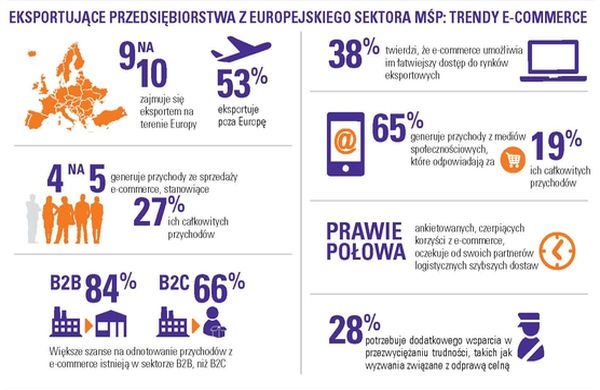
The FedEx SME Export Report shows that e-commerce accounts for 30% of the revenue of Polish SME exporters. More than 1/4 (28%) of the surveyed companies declared that their revenue in the e-commerce sector has recently increased, and almost one in four (24%) expects this growth within 12 months of the survey. This trend also causes an increased demand for logistics services. Entrepreneurs mainly point to the need for faster delivery, customized delivery options, or an automated shipping process.
75% of the surveyed companies generate revenue from m-commerce activities. On average, they account for 18% of total revenue. 23% of companies operating in this segment declared that their m-commerce revenue had increased over the last 12 months, while 11% said it had decreased. About 25% of companies expect growth in the near future. Entrepreneurs indicate that these increases result from the expectations of consumers who prefer shopping via mobile devices. Some of them also cite the optimization and improvement of their website or mobile application as a reason. About 65% of the surveyed companies use social media for sales.
– The study commissioned by FedEx clearly shows that exports and e- and m-commerce have become an inseparable part of the operations of many Polish SMEs – says Mariusz Mik, VP Operations Eastern Europe, FedEx Express. – We are not surprised that Polish entrepreneurs, as they develop in these segments, expect more tailored services in terms of transporting their goods. As a leading logistics company, we meet their needs and help them grow their business, regardless of the market in which they operate. Last year’s acquisition of TNT Express by FedEx allows for the combination of a strong road network with the excellent FedEx air network used in Europe and around the world. This, in turn, will create even greater opportunities for Polish SMEs that export within Europe and beyond – adds Mariusz Mik.
From a European perspective
The economic situation in Europe has been unpredictable over the last 12 months. The FedEx SME Export Report shows that – despite this – small and medium-sized enterprises on our continent are prospering and looking for new opportunities outside Europe – 53% of them send their goods there (compared to 29% in 2015). Moreover, exports account for 65% of the total revenue of European SMEs. This shows how important foreign expansion is for the development of companies.