








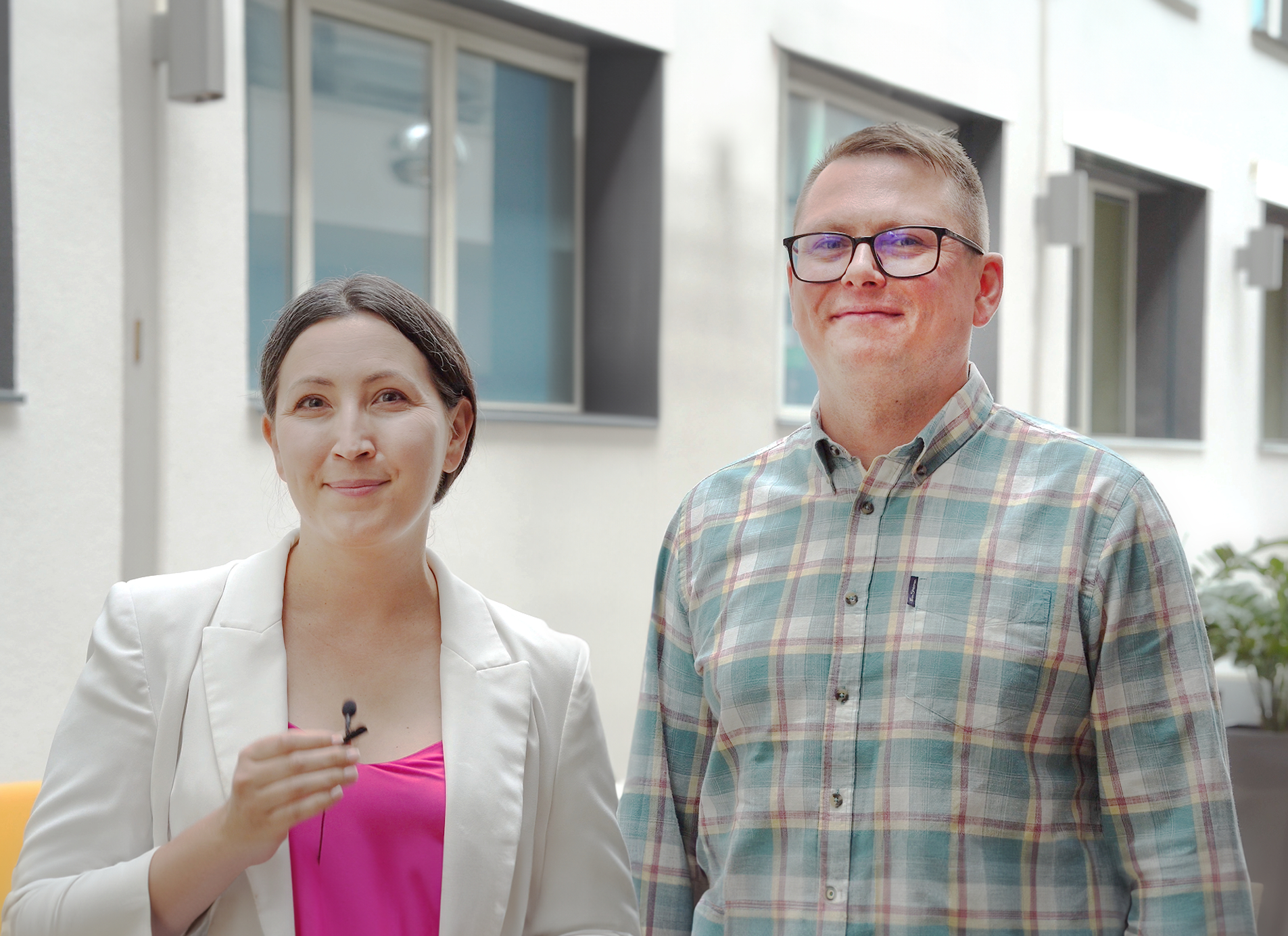
There are companies that implement circular economy ideas, use modern technologies, strive to minimize the use of secondary packaging, and repair products as part of returns or increase recycling scales. They operate on the assumption that what is good for the environment is also good for business. How does this look in practice? Joanna Tomczyk, Tender Manager for Central Europe at GXO, and Łukasz Wolski, Director of GXO Logistics Centers in Poznań, discuss this with Marcin Tomkowiak.
The “O technologii na głos” (Technology Aloud) podcast – the “Obok Logistyki” (Next to Logistics) series is available on YouTube, Spotify, Apple Podcasts, and Google Podcasts. We invite you to listen or read the transcript of the conversation.
MARCIN TOMKOWIAK: Good morning, I welcome everyone to another episode of the “O technologii na głos” podcast, in the “Obok Logistyki” series. My name is Marcin Tomkowiak, and we are recording the entire podcast from the Łukasiewicz – Poznań Institute of Technology. Today, my guests are:
Ms. Joanna Tomczyk, Tender Manager, GXO for Central Europe:
JOANNA TOMCZYK: Good morning, everyone.
MT: And Mr. Łukasz Wolski, Director of GXO Logistics Centers in Poznań.
ŁUKASZ WOLSKI: Good morning.
MT: Perhaps a few words of introduction. GXO is the world’s largest contract logistics operator, utilizing major market mechanisms, many technological innovations, and importantly, it is an innovative company, which I think fits very well with all contemporary trends. It is a company that directly manages 970 logistics centers; I think that speaks to its size. 130,000 employees – that is a huge investment. We also have a part that operates directly in Central Europe and also here, directly near Poznań, where we are now. Regarding who the company works with, these are truly large companies, the biggest and most well-known brands, with solutions tailored directly to them, to the client, to their needs. Logistics challenges realized. I think that shows well how the brand operates.
Today, we will focus on issues concerning a very enigmatic abbreviation, namely 3PL=3R. Deciphering it briefly, it refers to returns, revenue, and responsibility (sustainability), which directly concerns, among other things, the large logistics facility located near Poznań, operated by GXO. What is happening there, we will talk about that.
The very concept of sustainable development concerns greenhouse gas emissions, the carbon footprint calculated for every vehicle, every enterprise, and every power plant. But on the other hand, we have companies that try to go further with this, implementing circular economy ideas, using modern technologies, trying to minimize the use of secondary packaging, and on the other hand, repairing the aforementioned products as part of returns or increasing the scale of recycling. And that is exactly the area where GXO performs very well and has managed this segment of the market perfectly. So the question is: how do you support companies that want to operate in a sustainable way?
JT: That is a very good question, I assume, like most questions in this podcast. As GXO, we place great emphasis on the circular economy, and our overarching goal is to support our clients in achieving these environmental goals, because you could say that our motto is for logistics processes to be good for the environment and good for business. Actually, these two components of this slogan are equally important, because what is good for the environment also pays off for business, and that is what we try to prove in our daily logistics work.
We have an approach that is a bit from the general to the specific, because we are a logistics operator, we do not own most of the locations where we conduct our business, but already at the stage of preparing solutions, because I work in the business development department, I actually have a lot to do with our new or potential clients, so already at the stage of choosing a solution and choosing a location, we advise our clients to choose locations that meet high environmental requirements. Locations with certifications like BREEAM, and these are certifications at the VERY GOOD level and above, meaning those that are approaching the achievement of carbon neutrality goals. Here, perhaps Łukasz can tell us more.
ŁW: Yes, I will just add that our locations here in Poznań have this certificate, and it is the world’s leading building assessment system for sustainability, and what that actually means for us on a daily basis is, for example, that we recover greywater, we have a private water treatment plant. The entire lighting system is 100% LED. In the parking lots, we have chargers for electric cars, and on the roofs, photovoltaic panels for heating water.
JT: And something that I really like, because you probably don’t know yet, but I am generally passionate about insects, bees, and biodiversity. In Poznań, there are also small houses for bees, and in our other location, also in Poland, near Bolesławiec, we have a regular apiary from which there is truly fantastic, delicious honey, and this project was created in cooperation with our client. But besides such solutions related to the building and the surroundings of this building, which actually sell very well marketing-wise, because bees are fashionable now, and saving energy is very fashionable, if only due to the huge cost increases recently.
Of course, we also introduce optimization in the production process itself. And these optimizations of ours are exactly such optimizations from the general to the specific. Sometimes these are trifles, like for example in one of our Czech logistics centers, we introduced a system called “aqua stop,” and this is something that would be very useful in my house, that is, a system that turns off the water if we forget to turn it off. Simply, the water from the tap does not run indefinitely, but there, I don’t remember at the moment, after 10 or 15 seconds it turns off automatically. This water is not wasted, so even if it is greywater, it also saves our resources.
We also do such small optimizations with great significance. In one of our centers, we were doing research on the film we wrap pallets with. We managed to reduce the thickness of this film by a really tiny, tiny amount, just 2 microns, and reducing this film, narrowing it, making this film thinner by this tiny fraction, 2 microns, from 17 to 15 microns, meant that we managed to save as much as 30% of the film costs. And these film costs are also environmental costs.
ŁW: Yes, I will also add that we use film that is completely biodegradable, which means it does not end up in landfills at all.
As for lighting, it is also worth mentioning: every building, every part of the warehouse has lighting sensors. This means that the light is never on when there is no need to use it.
JT: Yes, that is exactly what we try to introduce in our buildings, also for our new clients. So, actually, entering into sensors, into these “smart house,” “smart warehouse” solutions, a bit in this way, which make energy saved in such a very natural way. But what we do as GXO is exactly that, going a bit further even in this care to ensure that our clients are satisfied, and the greenery is greener, and the environment lasts longer for us, because we all know that there is no “Planet B”.
These are, for example, such solutions as we had in the States for one of our clients. It was a client from the medical industry, and I don’t know if you know, I, for example, found out about this thanks to working at GXO, and this is also an additional bonus of working in logistics, that a person learns things they didn’t know before and didn’t realize at all. Medical gowns, the ones that nurses and doctors have, they have a specific expiration date. And it’s not like such a gown can just lie there and it’s always ready to be used, but in order for all sanitary regulations to be met, these gowns, from time to time, if they are not used, unfortunately, are suitable for disposal. One of our clients had as many as 500 tons of such gowns. These gowns were simply directed straight to a landfill, and that’s not cool, right?
And at that moment, we step in, maybe not all in white, but in green, and we find a third company for this client that not only saved these gowns from the landfill but even bought them and, as part of upcycling, turned them into bags. These are exactly such examples of solutions that we do, so this is a very, very wide range of what can be done.
And since we are talking about such a very wide range, in our local backyard, we are doing something fantastic near Poznań, because we are restoring full value to products, meaning products that would have ended up in a landfill do not end up in a landfill, thanks to what Łukasz and his team are doing.
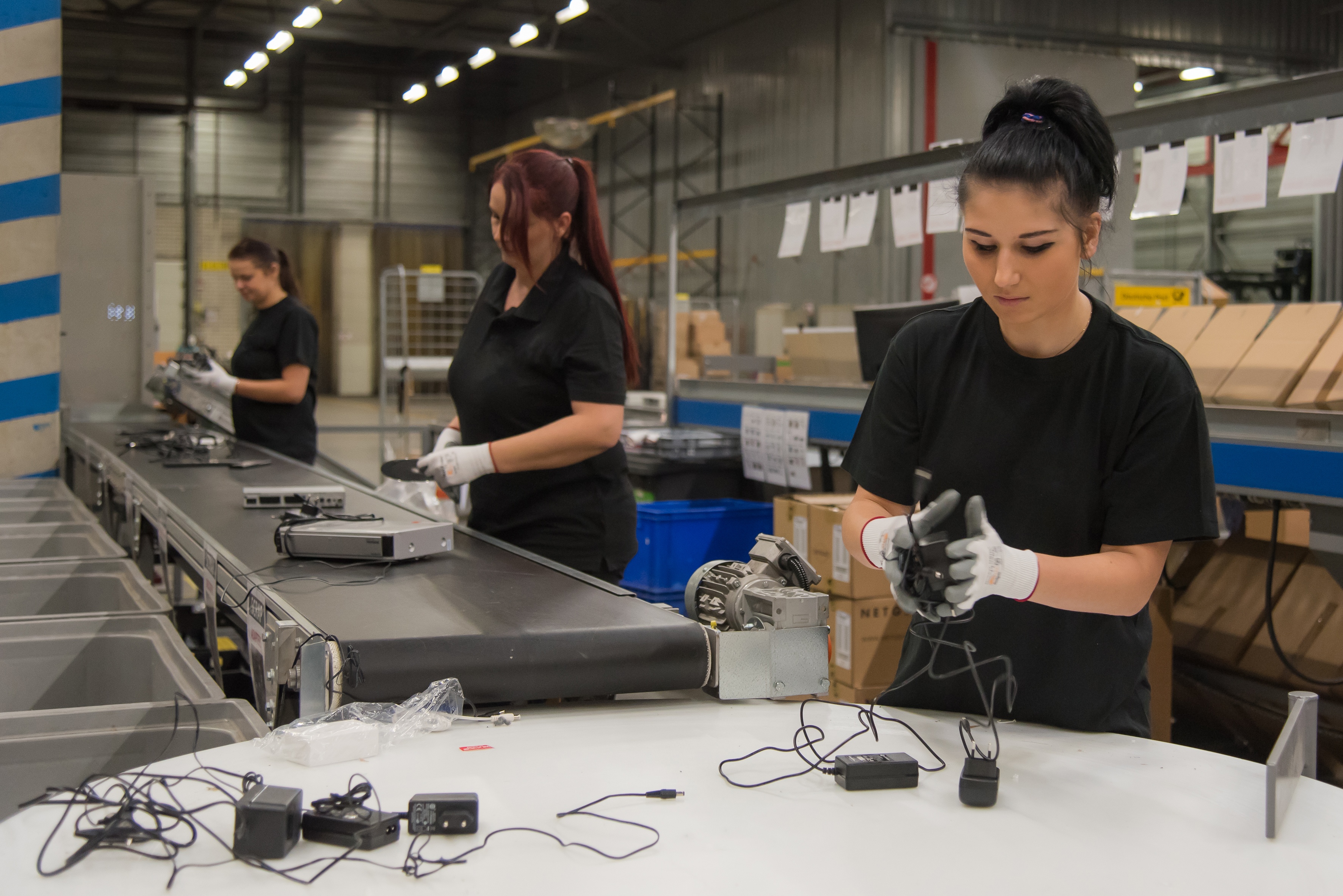
MT: Looking from this side, we have an image of a company that invests very heavily in modern technologies. It invests in ecology, which is currently not only fashionable but is very much needed and necessary. Looking from this side, how many all types of items are produced currently, how many things we throw into the trash, and on the other hand, how we return these things, because that is the practice, I think, also not unknown to us. We have a center in Poland, concerning return processes, for a company from the fashion industry.
As we mentioned earlier, it is located near Poznań. Also realized in this modern technology, so all these ecological novelties can be used there directly. And on the other hand, we have issues concerning such a warehouse to which 250,000 pieces of returned, not gowns, but clothing, arrive within 24 hours. And in such a case, ecology, again, how does this product recovery process take place?
ŁW: Yes, exactly, I confirm that we have a logistics center in Poznań with the latest technologies, that’s true. In total, our warehouses are 90,000 sqm, and due to the development of return logistics, we have allocated a dedicated space for return logistics, repairs, and renovation.
How exactly does it happen? The first stage of such work, when packages arrive at our warehouse, and I will add that as you mentioned, it is about 250,000 pieces a day. About 1,200 people process these packages daily, so a quite large group of employees who help us achieve these goals.
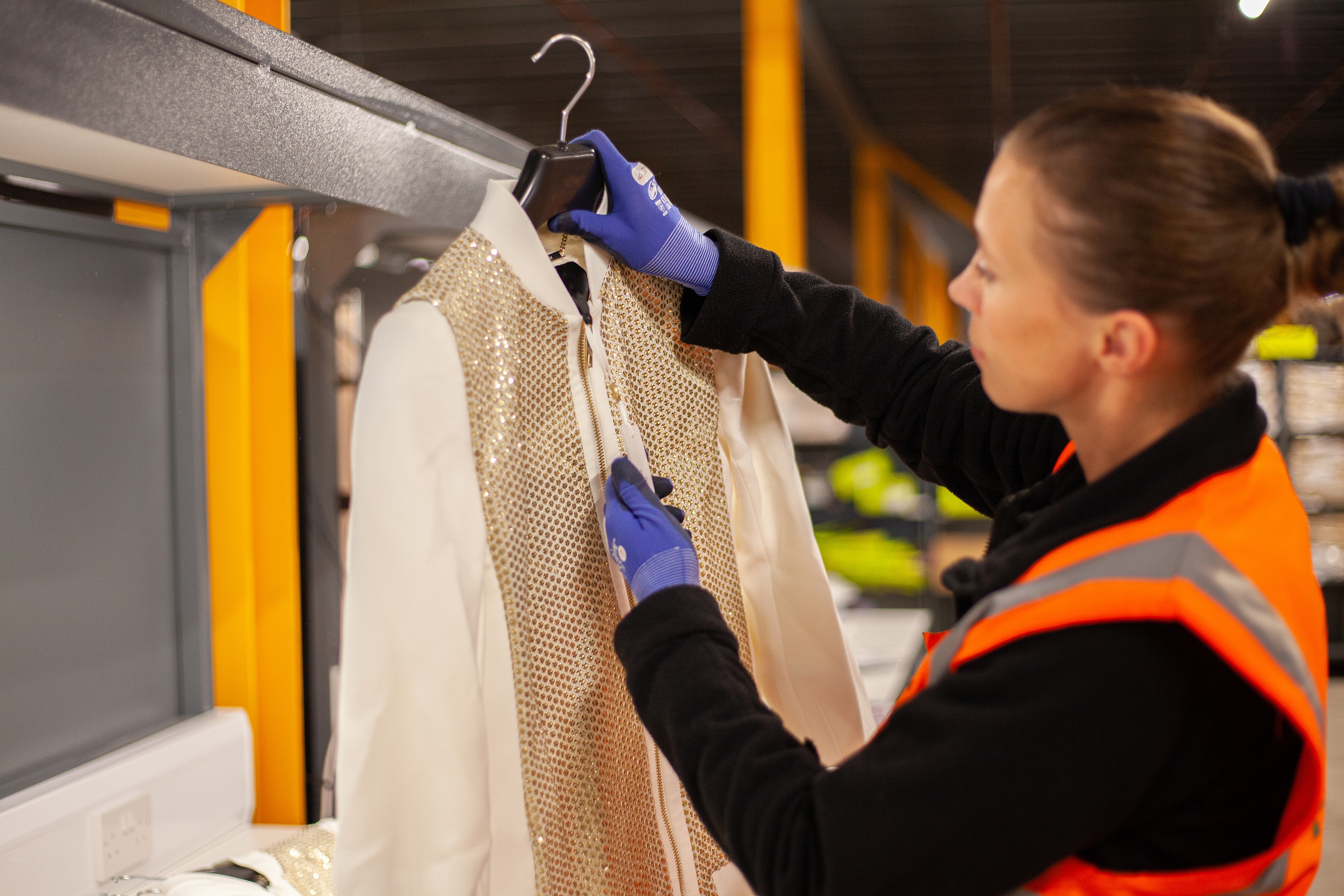
The first stage is, of course, opening this package, checking if the goods that reached us are the goods that the client ordered. We check it for quality and compliance with standards. Depending on the result of this inspection, if everything is fine, the product has no defects, we pack it and this product goes back to the warehouse, where it can be bought again. If, however, the product has defects, it goes to such a recovery process, and this process is divided into several parts. It can go, for example, to sewing, to odor removal. We also repair footwear and remove stains with steam. And thanks to these skills, we give these products full value.
What is actually the most difficult in this process, in return logistics and product classification, is properly determining the state of a given product. Whether it can be returned to the warehouse as new, whether it can be renewed in a profitable way, or whether it is no longer suitable for resale and performing the classification needed for recovery.
Therefore, such work should be directed to the appropriate logistics operator, and in this matter, I encourage you to contact GXO.
J.T: I might add here, because Łukasz didn’t mention that what he does besides this center in Robakowo is renewing wedding dresses. And it looks just like the Fairy Godmother from Cinderella. It is a truly fantastic process, I saw it with my own eyes when I was visiting Łukasz’s team here.
Let’s be honest, the dresses that arrive in Poznań are dresses that were simply tried on by clients and have, for example, traces of makeup, a button ripped off somewhere, they are wrinkled, and these dresses, fortunately, do not end up in a landfill. Thanks to a team of qualified seamstresses, they regain full value, shine beautifully, and will simply delight hundreds of brides around the world.
ŁW: Yes, that’s true. We also have a special place for wedding dresses, with special lighting, with special machines. And indeed, these dresses look beautiful, they look new, and they can be used again on that special day.
J.T: It is a truly fantastic sight.
MT: Yes, so we have issues concerning returns of very diverse things. We are talking about footwear, we are talking about clothing, but on the other hand, you also mentioned issues concerning electronics. And the question is, well, because things seem to be something easy to renew. Electronics are definitely more difficult. How then does the quantity of returns look and how much of them do you manage to recover for reuse?
ŁW: 96% of things are recovered for reuse. About 3% go to charity, and less than 1% go to landfills. And additionally, indeed in our GXO group, we have a separate GXO Service Tech department, which deals with the repair of electronics. All kinds of electronics, we can repair laptops, phones, washing machines, refrigerators, so nothing is scary or difficult for us. And this is also a very important element of sustainable development.
JT: I will just add that for one of our clients from the household appliance industry in the United States, we are preparing exactly such a process, and they add such additional hearts to this green process of repairing household appliances, because some of this equipment that is not suitable for resale at full value is donated to charity and is used by people who need it. So also in this way, we help our clients achieve their goals, from the broadly understood spectrum of ESG activities, because it is not only the environment but also the society in which we live. A human is also part of this ecosystem, so we also remember about people.
MT: Looking at the issues concerning electronics right now. We know that equipment works for a shorter time. On the other hand, it develops faster, which is why the rush to own new equipment, I think, also drives this segment of the industry. And on the other hand, you can still see in many stores, in many places, equipment that is “refurbished,” with that label. That is, of course, renewed, improved, cleaned, which has returned to the end user, often at a lower price, and what you mention also directly affects ecology, that we use fewer raw materials, fewer resources, and we can reuse what seems useless to someone, for someone else is perfectly working equipment. That is why the question. We have a large rotation of equipment, we also have issues concerning fashion, which also very strongly affects how often and how much stuff people throw away. That is why, how does the issue of returns look in recent years? Have they increased, decreased, what actually affects their quantity?
JT: Generally, when it comes to returns, this is a very complicated topic. From the angle that it very strongly depends on the industry. And in the case of industries such as the fashion industry, these returns constitute, also depending on the country, a very significant part of orders. This also results from the implementation of a certain sales policy by the fashion industry. In this area, we can observe certain differences between countries. For example, in a country like Germany, where since the 20s, such a practice of shopping, well, not online, but then mail-order, has been present in common consciousness. It is a habit of ordering too much to choose the right size, the right color, so the standard of an order placed remotely is that returns are associated with this order.
In Poland, we didn’t have such a tradition. Actually, these sales catalogs appeared in Poland in the 90s, they never had as much significance as in Germany, so at the moment when the e-commerce market was starting here, this habit of returns in clients was not yet there. So we had such, let’s say, a kind of “mishaps,” for example, one of the big players in the e-commerce/fashion market at one point, I don’t know if you remember, introduced such gigantic labels that counteracted such abuse of returns, which consisted of people buying products, hiding the labels, using cool dresses for one outing. These dresses then returned, these were returns that were not related to the intention of purchase at all. So this client also had to be educated. At this moment, from what I know, because I will also admit that despite the fact that I try to limit my own consumption and enter into this minimalism, I still order and I also order online. These labels don’t look like that anymore, even at this player. However, we are also getting used to it simply as clients, as consumers, how to order. Companies also meet this approach of clients halfway, to limit this number of returns, but also on the one hand to limit, but on the other hand to facilitate.
ŁW: Exactly, because actually looking also at the percentage of returns during the pandemic, it reached even 40% in e-commerce, and actually it was visible then that consumers even demanded such returns: free, easy, simple, and actually they made their purchases dependent also on whether these returns are and will be cost-free.
JT: Yes, cost-free returns have become such a necessity…
ŁW: That is correct.
JT: …I remember, I had such a situation recently. I ordered shoes that turned out to be too small and I had to, oh horror, pay for the return. And I was simply terrified, because it didn’t even cross my mind that I had to pay extra for it. Because not only were the shoes in undersized sizing, but I also had to pay to exchange them.
ŁW: And the question is, would you have ordered shoes from this client again?
JT: I never ordered any shoes from them again and I simply won’t.
That is exactly the point, that in this way, let’s say, the market spoiled us consumers a bit, because free returns have become the standard and we are outraged by the lack of free returns. So what our clients, players from the fashion industry, do is, for example, making it easier to choose sizes. I don’t know if you noticed, but at this moment, simply also, first of all, we see more and more such small videos on shopping sites, where we see how a given garment looks on a person. We have information on how tall the model is, what size they wear, and what size they have on. We have solutions like “e-size me,” where we provide our measurements and the algorithm tells us what size in the case of a given product we should order based on our previous orders as well as on the sizes we provided. Here, it doesn’t pay to cheat the system, because we won’t come out well on it. But it is visible that we are harnessing artificial intelligence also for this purpose, to limit these returns.
ŁW: It still happens, these reasons, whether they primarily limit them very strongly. However, it is still there and it happens that the reason for the return is the wrong color, wrong size, material that is not exactly as the client thinks, because they see it on the site. Goods, it happens that they arrive damaged, so I think that these parts you are talking about, of this technology, must also be linked to this warehouse part, where we must, together with the client, find solutions to avoid these errors. That is, it is certainly the inspection of goods that arrive to us from the manufacturer. Is it exactly what the client ordered, is the quality of this product good? Does the size match, because we also very often measure volume, cubic capacity. And all this together with the client, so these goals you are talking about, technological plus these control goals in the warehouse, certainly very strongly reduce the number of returns.
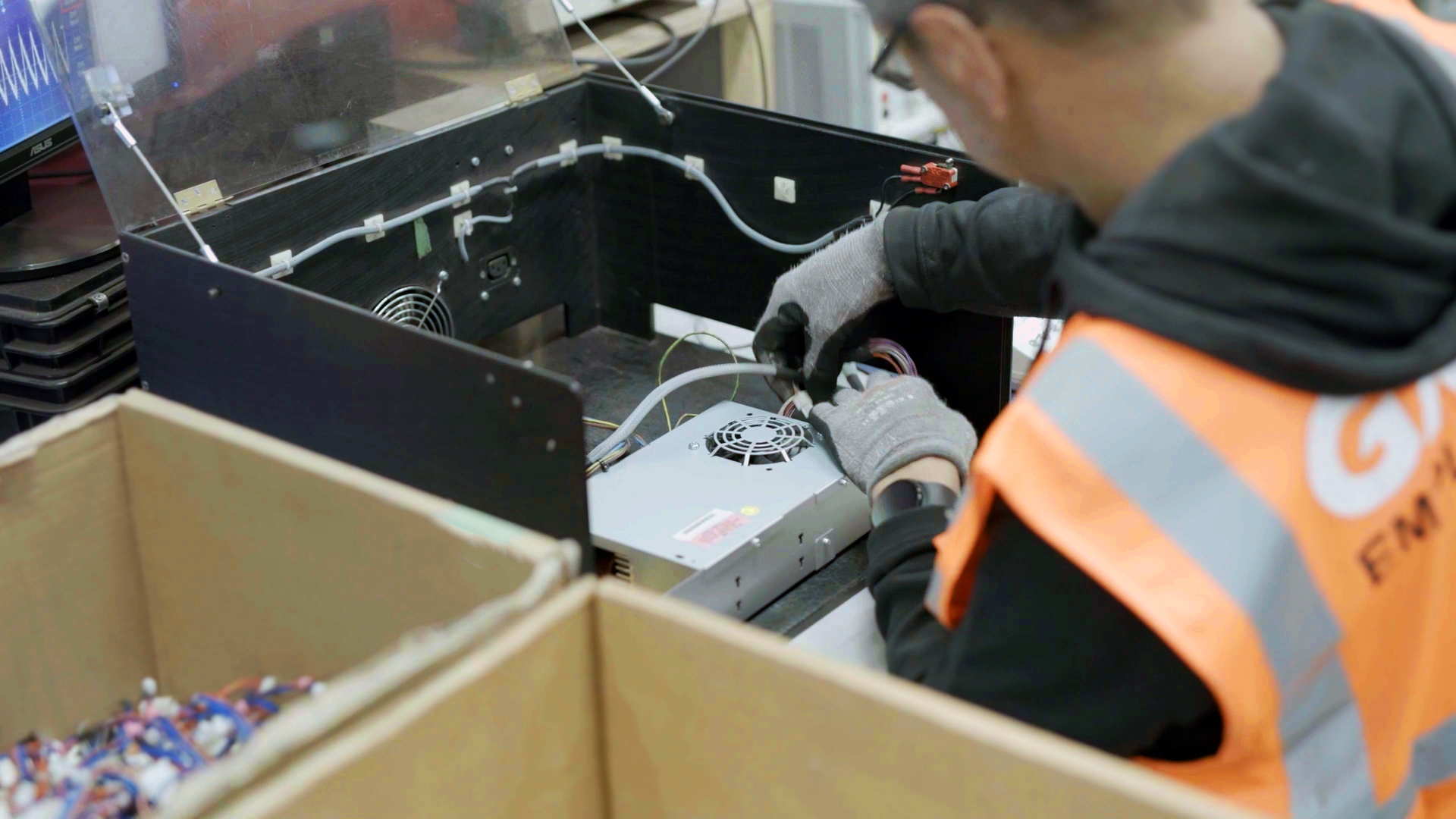
MT: I won’t hide that issues concerning paper catalogs, a long time ago, are not unknown to me. It was a matter that it was always lying at my grandmother’s, as a kid I watched it. It was very cool and was such a big world, not known from which side. And on the other hand, at this moment, I look at the fact that basically, there was also a friend of ours recently who says, she was ordering a dress, she was ordering shoes, “I ordered three pairs of this, three pairs of that.” But why? “Well, because I didn’t know, I took a size bigger, a size smaller, the one that will fit stays, and I’ll send the rest back.” And that indeed can be observed that this mechanism functions.
And from your side, directly, a company that handles such processes, it is something you encounter every day, that a product can return in perfect condition, but also in a condition, well, after experiences, just one party, or let’s define it as a “long try-on.” That is why issues concerning modern technologies, issues concerning measuring us, I also, I won’t hide, in places I also have a bit too much and I also lie, but that’s what I think each of us would like to look and feel better. But that is exactly such an issue that on the one hand, Western countries had mail-order sales for many years, earlier it was catalogs, now it is an issue of e-commerce and online. And how does Poland actually look in comparison to Europe? Do we return more products, less, differently?
JT: We return less than Western Europe. And this results exactly from this history of returns, from the fact that we, after all, do not order as much, we do not order five different sizes, but simply two and maybe one color, but it is also related simply to purchasing power. We don’t have that much money to freeze it in such a quantity of products to wait for a return. Generally, what companies that operate in the e-commerce industry do is, for example, accelerating, and thanks to what Łukasz’s team does, this is also achieved – accelerating this return time. When this return reaches the return center, the faster this return is processed, the faster the client gets their money back. The faster the client receives money, the more they can order and the faster this product can reach the market. So, the better Łukasz works, the better for the environment and for our wallets, that’s how it looks.
ŁW: Yes, if I can anecdotally ask us, in the sense of us Poles, to, the packages we return, we have a tendency to secure them very strongly. Even though the return description is, or the return packaging is ready to put them in. Put in the information note, close and send, we still try very hard to secure it with stretch film and other things. It is not necessary.
JT: It is not ecological, I will also add from my side, let’s be lazier.
ŁW: It is not necessary, it is not ecological, and also in the process of return logistics, it is very hindering to work. So the packaging that we all receive is tested, it is good. It is enough to use it, no additional protection is needed.
JT: Exactly, it is standardized, it is exactly standardized for the purpose that this return is easier, faster, so that money reaches our account faster, and the goods, after going through the renewal processes and restoring full value, return to store shelves and can delight the next client.
MT: I won’t hide that I know the term “armored package” very well because I send such ones myself, but it also depends on what product it is, of course.
JT: I mean, I hope you sent. Past tense.
MT: I mean, if I send a model or a comic book, I prefer to secure it well, but it is known that issues of things, shoes, soft, working elements, then of course. But there is also that moment when I have this box, I put shoes in and they will “fly” in it, well, then it needs to be filled with something, “so that it doesn’t fly,” after all, it will get bumped on the way. Well, actually it won’t get bumped, because it doesn’t have such force to hit, although issues of packages from couriers, I have also seen various ones, but let’s leave this issue perhaps.
What you are saying, limiting the amount of packaging, limiting materials that we use, directly to secure it. You also spoke earlier about what ecological solutions you have directly, how you change the client’s approach to ecology, but there is also an issue concerning exactly how the company talks about itself and what it shows to the outside. That is, we have an ESG report, which you also published, many companies currently publish this. It is also an increase in ecological awareness both among clients and also among end recipients. So the question is, what environmental goals do you have, what environmental goals have you included in it, and on the other hand, what examples of such global solutions can also be found at your place?
JT: So here, because as we have already established, these green topics are very close to me, so maybe I will tell a bit. At the beginning, I wanted to boast that despite the fact that we have been operating under the GXO company for a short time, before our first birthday, we already published our first ESG report. Because these environmental goals are extremely important to us and they constitute such a very strong core of how we think about business. And here, still as an introduction, when we talk about ESG, we decipher this abbreviation as environment, social, and governance. And all these three components are equally important, because there is no environment without a human who functions in society, and within the framework of operating in corporate reality, this governance and this proper management is also very important. So we try to make these three legs just as long and just as stable and just as strong.
However, also operating on the assumption that this environment is what surrounds us and that there is no “Planet B” and this context is very important. Among our long-term goals included in ESG, we have exclusively environmental goals. These goals are exactly goals aimed at all our locations, this is also very important, because as we have already mentioned, GXO is a global player. We have our branches not only in the countries of America and Europe but also in Asian countries, and that is why our goals are ambitious goals on a global scale, and here, for example, one of our goals is 80% LED lighting in all our facilities. And that was such a goal for which we set a deadline until 2025, and we actually already have it realized.
Another of our goals was waste segregation, that is, taking care that as much as 80%, I say as much as 80% and I remind you that we are talking about this global scale, together with Asian branches, that as much as 80% of our waste does not end up in a landfill, but is segregated. And here we have such a very cool story, which shows that we are developing simply at different speeds and as long as the direction is correct, everything is fine, because some things, unfortunately or fortunately, cannot be accelerated. Because at this moment in Europe, over 90% of our waste is waste that is segregated. And they simply, I believe this indicator is 93.4%, so almost what remains are such leftovers where someone threw it not where they should have. Of course, I’m joking, but generally, this waste segregation is at a very high level, so we have this goal actually exceeded in the European scale with a surplus, however, due to the fact that we function in this reality in which this global economy does not develop everywhere the same and these environmental goals are not realized the same, these countries, as if from outside our region, must catch up.
We hope that by 2040 we will manage to be a carbon-neutral company. This goal also, depending on the region, depending on the branch, we realize differently. We have such pilot warehouses that have been climate-neutral for several years. We all try to strive for this goal.
Generally here, from such a point of view, related exactly to managing environmental goals, it seems to me that this is such a cool approach, where we all recognize that this is an important direction and that this is a path that must be taken. However, we realize that there are various cultural conditions, of various regional organizations that are part of our organization. So we don’t do such “name shaming,” but simply we try to lead by good example. That is, we show, that is, we also very strongly communicate that exactly in this our global GXO space, which we have as employees – we promote examples of good solutions. We show that, actually, often fantastic results can be achieved with small means.
For example, we had such a very cool example in one of our French branches, where actually I also like to talk about it very much, because it shows that as a logistics operator, we must remember that it is very, very important that we never act alone. We always act with other logistics entities such as, for example, with transport companies, with the client, above all, with the environment, with the state and its bodies. In any case, simply what is extremely important is cooperation and that we jointly contribute to making the world and this our logistics “cookie” a better, tastier, green place. In any case, for this client from the footwear industry, we standardized their packaging process. Just that much and as much as that. We introduced three standard shoe boxes. Making it so that from many boxes only three appeared, whose dimensions were chosen based on extensive analyses, meant that the number of pallet configurations in transport was normalized. This transport became more predictable and by almost 200 trucks a year, we limited the amount of transport, which of course also lowers the carbon footprint. So just that much and as much as that. We are not responsible for transport, at least in the case of this client, because there, also as a company, it does not constitute this key part of our business. However, for some of our clients, we also offer transport services, but this was not the case for this client.
However, we function in a certain environment, we function with a client who is our main stakeholder, so we play on the same team.
ŁW: Exactly, and what I think we are also proud of, that these good practices – we share them with everyone, and if in one logistics center it is possible to achieve or find a solution that helps in the issue of sustainable development, information goes actually to the whole GXO world.
JT: And not only GXO, because we also talk on the market about what we do.
ŁW: A bit too, well yes, but on the other hand, we have one planet, so it is worth sharing such practices and we will certainly continue to do so.
JT: Yes, because we like to talk about ourselves.
MT: It is best to talk about yourself well, so that others also pick it up and talk about it further. We are looking at this moment at what was the main topic of this question, that is, ecological issues, ESG issues, that is, sustainable development and good practices that are present at your place in a very large quantity and what is important, these are clever solutions, which of course can be very willingly watched, can be let somewhere further, suggested by the fact that indeed sometimes it is enough to take a small step to improve a large process.
And this is of course noticed, not only by the competition, for sure, but also by the industry environment. And on the other hand, looking, thanks to this, you were also distinguished in the Responsible Business Forum report, exactly among others for one of your projects – that is, the Career Academy, which is also related to other activity, that is, the Food Bank. That is, we have not only ecology but also going into education, going from things that are very close to people, where you can already influence them directly. In that case, what are your good practices, how to share them?
JT: Well, that is exactly the “S” in ESG, that is, society and the fact that we realize that we function in a certain environment that influences us, but on which we also want to influence. Cooperation within the framework of the Career Academy, with leading universities, makes it so that on the one hand, we do something for ourselves, that is, once again we talk about ourselves and talk about how cool we are, taking care that students hear about it and also talking, they carry this good news into the world. But also in this way, we recruit new colleagues to our teams within the framework of internship programs and we take care that, knowing about us, they go with this knowledge also to business, simply. Because even those who stay with us only for a moment will, I hope, remember us well.
Another such good memory is what we did, I mean actually I am a bit piggybacking on the success of our colleague Piotrek, but the cooperation we established with the Food Bank. Because we try to ensure that our cooperation and our activity do not consist only of such impersonal transferring of corporate donations, which of course, like most companies in our sector, our activity, of course, we also do, but that this our activity also has a character that is more personal. And one of our colleagues, as a result, ended up for one month at the Food Bank, where he shared his knowledge as a forklift operator with colleagues who worked at the Food Bank. Sharing good practices that he learned at GXO, he supported the activity of the Food Bank.
So on the one hand, we provided his time, which also has, of course, a measurable monetary value, because we all know that time is money, especially here in Poznań, where we are, everyone should remember about it, and on the other hand, we shared knowledge. We also saw, thanks to Piotrek’s relationships, what this work looks like from the inside. And this, of course, also allows for a deeper entry into such charitable activity and also makes our colleagues much more easily engage in helping if they know from the inside simply how this process looks. And that is very cool.
MT: Looking at this, you are a global company that on the other hand also operates very strongly locally. Which cares about being perceived that way. Do you want to share any of your observations, with any interesting advice or anecdote from the company that would help convince everyone here that it is worth being, to put it most mildly, “eco“?
ŁW: Actually, as you mentioned, mildly “eco” also means so-called “fun,” that is, there must be a little bit of fun in it, it cannot be just dry data, worrying about this world, how it will be further, but there must be a little bit of fun from it.
Certainly also such a thing that we do together, we have fun with our employees, we organize various competitions, we organize various meetings. I can say that in Poznań we also have a football team, and besides the fact that we play this football, we train, we of course participate in various charity tournaments, we also in some way support this local community.
The results are various.
JT: But yes, respect, huge respect.
ŁW: It happens that I think our highest place is second, well, the lowest is last. However, quoting a classic, that is our coach, a GXO employee: “It is better to stand wisely than to run stupidly.” So we stick to this motto.
JT: And these are beautiful words.
MT: Okay, in that case, summarizing. You are a global company, you are a company well perceived locally, which operates both from the side of the direct end client as well as a large one, which commissions these works in various ways. We have a company that knows how to have fun with what it does, and on the other hand, it does it well. As we can see, there is also a direct result of this, that is, the EGS report, which everyone can reach and familiarize themselves with these practices that are applied at GXO as well as on the other hand are distinguished by various awards, as well as distinctions. That is, the GXO company.
More information can be found on the gxo.com website, where we have issues concerning exactly directly both offers as well as the scope of activity itself, served industries, and what is important, used technologies, which as we heard today, are modern and ecological.
On the other hand, I also invite you to the pit.lukasiewicz.gov.pl website, where we have information concerning the direct activity of our institute as well as the logistyka.net.pl portal, where we publish the freshest information daily from the scope of broadly understood logistics, transport, forwarding, and e-economy.
And today, my and your guest were:
Ms. Joanna Tomczyk, who at GXO holds the position of Tender Manager for Central Europe.
JT: Thank you very much for your attention.
MT: And Mr. Łukasz Wolski. Director of GXO Logistics Centers in Poznań.
ŁW: Thank you very much for the invitation.
MT: Thank you very much for the very interesting statements, as well as for the meeting itself. I sincerely thank you and invite you to the next episode of our podcast.
Recording/transcript: July 2023