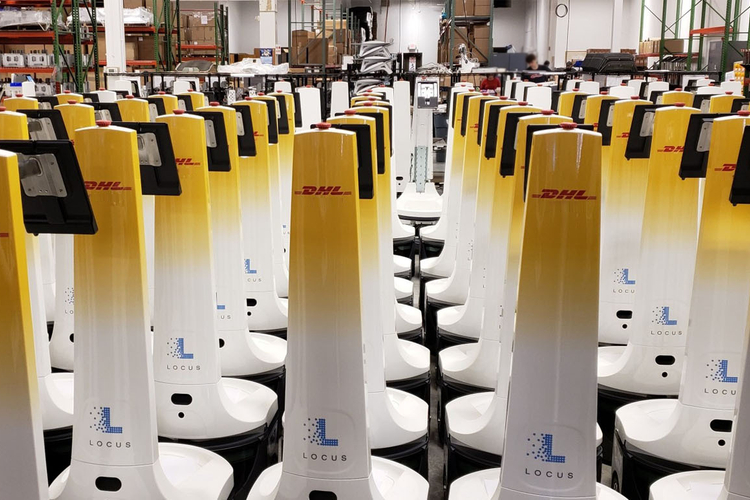
DHL Supply Chain, one of the leaders in contract logistics, has signed an agreement expanding its partnership with Locus Robotics. The initial investment in picking robots proved successful in commercial-scale operations, and the new multi-million dollar agreement will expand the scope of DHL’s accelerated digitalization strategy.
By 2022, DSC plans to acquire up to 2,000 robots, making it by far the most significant Locus Robotics customer globally. The picking robots are used primarily in e-commerce or in customer warehouses, where they support picking and replenishment operations, thereby increasing efficiency and accelerating the delivery process.
– The ability to continuously optimize supply chains is particularly important to us, and picking robots are extremely efficient in this regard – says Markus Voss, Global COO and CIO at DHL Supply Chain. – Currently, there are over 500 picking robots in industrial use in our warehouses in the USA, Europe, and the United Kingdom. By the end of this year, an additional 500 robots will appear in more than 20 other locations. The technology of picking by robots collaborating with humans has proven itself in modern warehouses, demonstrating efficiency and reliability. Further locations have already been identified with detailed implementation plans for the remaining robots, which will be delivered in 2022. However, the overall potential of picking robots for DHL warehouses is even greater. We are therefore confident that we will achieve the goals set with Locus Robotics. –
The further deployment of robots is the next stage in DHL Supply Chain’s accelerated digitalization strategy. Picking robots contribute to reducing the time needed to drive carts through the warehouse, decrease physical strain on employees, and increase picking efficiency. They display images of products to be picked, calculate optimal routes, and reduce the time required for training. Additionally, they can be easily integrated into the warehouse system architecture through the DHL Supply Chain Innovation Center and are well-received by employees. Moreover, during peak periods, the robots provide an optimal solution for increasing operational capacity, as additional units can be easily added with minimal interference in the work of the existing fleet.
– The expanded partnership with DHL reflects the increased demand for warehouse digitalization worldwide to meet rapidly growing order fulfillment challenges – says Rick Faulk, CEO of Locus Robotics. – Locus is proud of its status as a valued technological asset, helping DHL realize its strategic vision of digital transformation. –
The pandemic has intensified the already growing popularity, which makes the labor-intensive picking process in the e-commerce fulfillment environment play an even greater and more significant role in meeting the high demand of end customers. These trends have accelerated the introduction of new technologies and automation in many industries, especially in warehouse operations. It has also shown what the supply chains of the future might look like and that the world must quickly adapt to new challenges. DHL Supply Chain is constantly evaluating which of the implemented technologies will remain in warehouses permanently to further optimize processes. In addition to these tangible robotics solutions, DHL Supply Chain relies on software and Internet of Things solutions used in cockpits, which provide real-time information on activities performed in the global logistics service network. Access to big data and the implementation of algorithms and artificial intelligence have proven to be a turning point in planning global supply chains, and their use will certainly continue to grow in the future.
Source: DHL
Read more about automation:
– Amazon announces the opening of a European Innovation Lab
– FM Logistic invests in autonomous robots in warehouses
– Mobile Industrial Robots has published the results of research on intralogistics automation
– Robots at the Whirlpool plant in Łódź improve logistics
– Automation strategy
We wrote more about automation in Logistyka magazine 1/2020.
The e-edition of the magazine is available in our offer!