









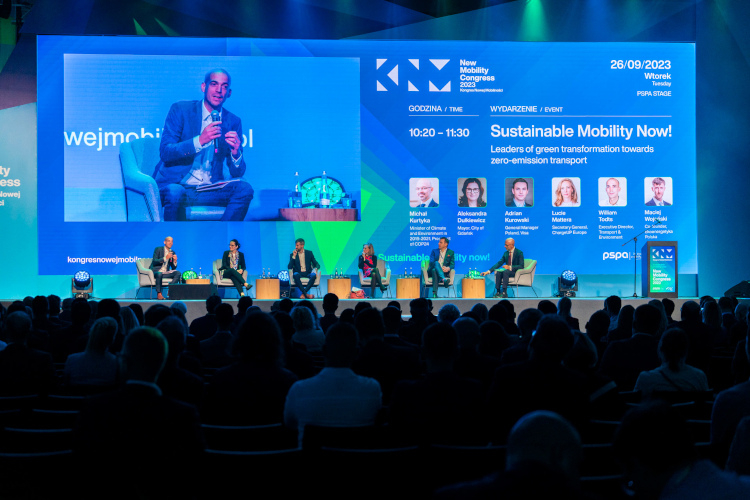
The New Mobility Congress 2023, which was record-breaking in many respects, has come to an end. Over 3,000 e-mobility industry representatives from around the world spent three days discussing key trends and challenges related to the transformation of transport. More than 150 partners and exhibitors presented the latest zero-emission technologies across 13,000 sqm of exhibition space at EXPO Łódź. The key conclusion from the largest mobility conference in the CEE region: Poland must seize the historic opportunity that the development of electromobility represents for the economy.
The fourth, record-breaking edition of the New Mobility Congress is now behind us. The scale of the event is reflected in the numbers: 6 stages, nearly 3,000 participants, over 300 speakers from all over the world, 100 debates, workshops and substantive presentations, over 150 partners and exhibitors, 15 industry premieres, and 19,000 sqm of expo space. The Congress was attended by representatives of EU institutions, central and local government administration, ambassadors, business representatives, universities, law firms, the third sector, and the media. What are the most important conclusions from NCM 2023?
- “The Seven for Electromobility” will strengthen the Polish economy
During NCM 2023, representatives of the e-mobility sector signed “The Seven for Electromobility” – an appeal addressed to public administration to take urgent action to enable the utilization of the historic opportunity facing Poland in connection with the transformation of the transport sector towards zero-emission. The automotive industry is a pillar of the Polish economy. It accounts for 8% of GDP, 13.5% of annual exports, and 490,000 jobs. In the coming years, the industry will face revolutionary changes that will determine its future. Mass electrification of fleets will create entirely new business perspectives. The sum of global investments in the area of zero-emission transport is estimated at USD 53 trillion by 2050. The signatories of “The Seven for Electromobility” indicated that decision-makers, led by public administration, should make every effort to ensure that as much of these funds as possible reach Poland. The postulates contained in “The Seven” concern, among other things, transforming Poland into a leading production hub for the electromobility sector, the development of RES and charging infrastructure, increased investment in R&D, strengthening the position of Polish transport companies, training qualified personnel, and supporting the domestic zero-emission transport market. The industry emphasized that the topic of transforming the Polish automotive sector should be taken outside the scope of current political discourse, build a consensus around it, and support it systemically.
- eHDV – the road heavy transport sector needs subsidies, legal changes, and the expansion of charging infrastructure on the road to electrification
During NCM 2023, industry experts and market practitioners discussed the tools necessary for Poland to maintain its position as a leader in road heavy transport in the European Union. The TSL sector is one of the largest branches of the Polish economy. It brings together 125,000 companies, employing approximately 750,000 people, which generate about 7% of Poland’s GDP. In connection with the EU CO2 emission standards for trucks in force since 2019, the upcoming introduction of the Euro 7 standard, and the AFIR regulation, the industry is facing the necessity of rapid electrification. NCM participants agreed that the development of a fleet of electric trucks in Poland and other CEE countries will not be possible without the expansion of charging and hydrogen refueling infrastructure (in particular along the TEN-T network). Support for the transformation of the transport industry should include not only financial incentives addressed to carriers, but also to charging station operators and DSOs. It is also necessary to optimize the law, e.g., by increasing the maximum weight of electric heavy vehicles, abolishing road tolls for eHDVs, or facilitating the connection of high-power charging stations to the power grid.
- City residents must learn about the benefits of implementing Clean Transport Zones
One of the widely discussed topics during the New Mobility Congress 2023 was Clean Transport Zones (CTZ). Such areas will soon appear in, among others, Krakow, Warsaw, Wroclaw, and the GZM. International experts and local government representatives present at NCM 2023 indicated that achieving the maximum socio-ecological benefits resulting from CTZs requires careful planning of the individual stages of establishing such areas. It is necessary, among other things, to define the problem that the city wants to solve, analyze the vehicle fleet in the city, conduct research and measurements of emission levels, and determine the main sources as well as the scale of pollution. It is also important to determine the number of residents who will be affected by the changes resulting from the establishment of the zone and to organize reliable information campaigns regarding the negative impact of transport on the environment, as well as human life and health. An element of these campaigns should be a description of the expected benefits resulting from the implementation of a low-emission area. Prior social consultations are necessary, as well as informing about the date of introducing the CTZ, its scope, restrictions, and their potential increase in subsequent stages of the zone’s operation.
- Poland will not meet AFIR targets without investment in power infrastructure
AFIR, the EU regulation on the development of alternative fuels infrastructure, will come into force on April 13, 2024, which means that Poland has less and less time to implement changes that will accelerate the development of the charging station network. During NCM 2023, industry representatives emphasized that one of the biggest barriers delaying the expansion of charging stations in Poland is the insufficiently developed power infrastructure. This also applies to locations that are key in terms of installing charging stations, including motorway service areas (MSAs). This is primarily a consequence of investment expenditures on the expansion of transmission and distribution networks being too low (at least several times over) in previous years. To limit the negative impact of these neglects on the development of electromobility, it is necessary, among other things, to expand subsidies addressed to both charging infrastructure operators and DSOs, deepen the integration of the charger network and the power sector (enabling, among other things, the popularization of smart charging technology), and finally, introduce regulatory changes. During NCM 2023, a number of legislative proposals in this area were presented, developed as part of the PSPA “White Paper on New Mobility” project. They include, among others, postulates to enable the preparation of investments in the scope of power connections and the construction of charging stations in a special mode appropriate for strategic investments, the introduction of an absolute deadline for the implementation of a connection agreement, the obligation for DSOs to provide binding information on the possibilities of connecting charging infrastructure to the network upon request, and furthermore, the obligation for the GDDKiA to create periodic construction plans, taking into account locations for charging infrastructure along with power reserves for its connection.
- Poland and Europe must become a production powerhouse in the battery sector
Under the banner of “Polish Battery Day,” a great deal of space at NCM 2023 was devoted to a key area for the development of both electromobility and the Polish economy, namely the battery industry. Congress participants emphasized that the priority should be to concentrate the battery sector value chain in Europe, both in terms of raw materials, design, technology, production, and recycling. Regulatory changes are important, including a decisive streamlining of permitting and environmental impact assessment processes. A comprehensive support program for the sector should be created, and within its framework, investment support for launching new production (in accordance with the second pillar of the Green Deal Industrial Plan, GDIP) and training in new competencies, development of staff, and retraining of the current workforce (in accordance with the third pillar of the Green Deal Industrial Plan, GDIP). It is important to educate a cadre of engineers possessing the qualifications and skills required to work at various stages of the battery life cycle. To this end, it is worth ensuring the strengthening of cooperation between the academic and business environments, and vocational and engineering curricula in Poland should focus on learning integrated and process-oriented thinking. The response to these needs includes, among others, PSPA activities, including the New Mobility postgraduate studies conducted in cooperation with the Warsaw University of Technology and training organized, among others, with EBA Academy Poland. In order to support the battery sector, it is also necessary to increase the share of RES in the energy mix and increase the intensity of communication with both local governments and their residents (a low level of social awareness regarding the safety of battery production in the context of environmental issues often delays the implementation of necessary investments).
- Development of smart charging technology is a priority in the charging infrastructure sector
During NCM 2023, leading stakeholders in the charging infrastructure sector discussed the regulatory, market, and technological opportunities and challenges related to the development of smart charging technology in Poland and the CEE region. The benefits resulting from the use of this solution include, among others, the possibility of remote supervision and management of the charging process, optimal power distribution between electric cars being charged in parallel, facilitated payment settlement for charging services, and an increased level of safety. Thanks to smart charging, which takes into account, among other things, dynamic tariffs, the power grid will be ready to handle the future demand of the e-mobility sector for electricity. Obligations related to smart charging are provided for by AFIR. At charging points launched 6 months after the regulation enters into force, operators will have to ensure the possibility of smart charging (this also applies to points whose renovation began 6 months after AFIR enters into force). Congress participants emphasized that currently, technology is significantly ahead of legislation. To fully utilize the advantages of smart charging, it is necessary to introduce appropriate regulatory changes (including in the area of tariffs), optimize software solutions, and strengthen cooperation between individual stakeholders.
- Hydrogen as the fuel of the future? Yes, but only green
During NCM 2023, a lot of space was devoted to the role of hydrogen as the fuel of the future in transport. Experts agreed that it is necessary to introduce instruments conducive to the popularization of “green,” zero-emission hydrogen, as well as to increase the supply and reduce the production costs of vehicles powered by fuel cells. A key area in which hydrogen can be an alternative to lithium-ion batteries on the road to climate neutrality is heavy transport. Stakeholders indicated that only green hydrogen can be considered a zero-emission fuel. In the coming years, Europe will strive not only to increase the scale of green hydrogen production but also to import this fuel. To achieve this goal, investments from both public administration and the business sector are necessary. Furthermore, technology for hydrogen derived from RES can be eagerly supported by financial institutions because renewable energy sources are an unlimited resource, burdened with low financial risk. In the NCM expo zone, there were also presentations of vehicles powered by fuel cells, including the hydrogen-powered BMW iX5 Hydrogen SUV, as well as the Iveco eDaily FCEV and Renault Master Van H2-Tech delivery vehicles, as well as the Pilea H2 bus.
- Cooperation between local governments and business is the key to accelerating the expansion of the urban charging infrastructure network
One of the leading topics of NCM 2023 was the expansion of urban charging infrastructure. This is a key challenge for the zero-emission transport sector: in 2022, the 37 largest cities accounted for about 70% of electric cars registered in Poland. Experts indicated that ensuring comfortable access to charging services for city residents who do not own private chargers requires strategic planning at the government and local government level. It is important to choose optimal locations and types of stations included in the urban network. When building it, it is worth considering both AC and DC devices (including ultra-fast chargers) and multi-station charging hubs. Local governments should ensure the optimization of tender conditions (e.g., by ensuring the most attractive and transparent rates for land lease). In order to ensure competitive prices, proceedings should be decided in favor of more than one operator (optimally 2-3). It is also worth installing the most modern stations possible (especially compatible with smart charging technology), tailored to the expectations of future and current EV drivers.
- Electromobility is not just cars, buses, and motorcycles
NCM 2023 participants also discussed the development prospects and challenges of the market for electric agricultural, construction, mining, handling machinery, and all other non-road mobile machinery (NRMM) used in various branches of the economy. Achieving climate neutrality by 2050, in accordance with the assumptions of the European Green Deal, requires reducing the amount of pollution and noise generated by such vehicles, especially since NRMM are very often used in cities. Experts indicated that emissions from work machinery are 2 to 6 times higher than emissions generated by cars. Therefore, not only bystanders but also employees operating non-road machinery can benefit from the electrification of the NRMM sector. In the first instance, zero-emission specialized machinery will be implemented in closed areas, such as mines or transshipment ports. Technologies based on hydrogen fuel cells can also have a significant share in the decarbonization process of this sector.
- Poland needs a National Cycling Strategy
Does Poland need a National Cycling Strategy? NCM 2023 speakers, including representatives of local governments and non-governmental organizations, answered this question in the affirmative. Every city has its own strategy and uses different technologies when building cycling infrastructure. NCM 2023 participants agreed that one universalizing document is needed, as it is difficult to reconcile many different standards. Therefore, a declaration for the introduction of a National Cycling Strategy was signed at the Congress. This document aims to create a comprehensive plan for promoting cycling as a means of transport and sustainable tourism. As part of the strategy, it is planned to assess existing infrastructure, research the needs of different user groups, modernize cycling infrastructure, integrate bicycles with public transport, introduce design standards improving cyclist safety, determine sources of funding, and educational programs. The assumptions of the Strategy also include improving the safety of vulnerable road users and promoting a healthy lifestyle.
Source: New Mobility Congress 2023