









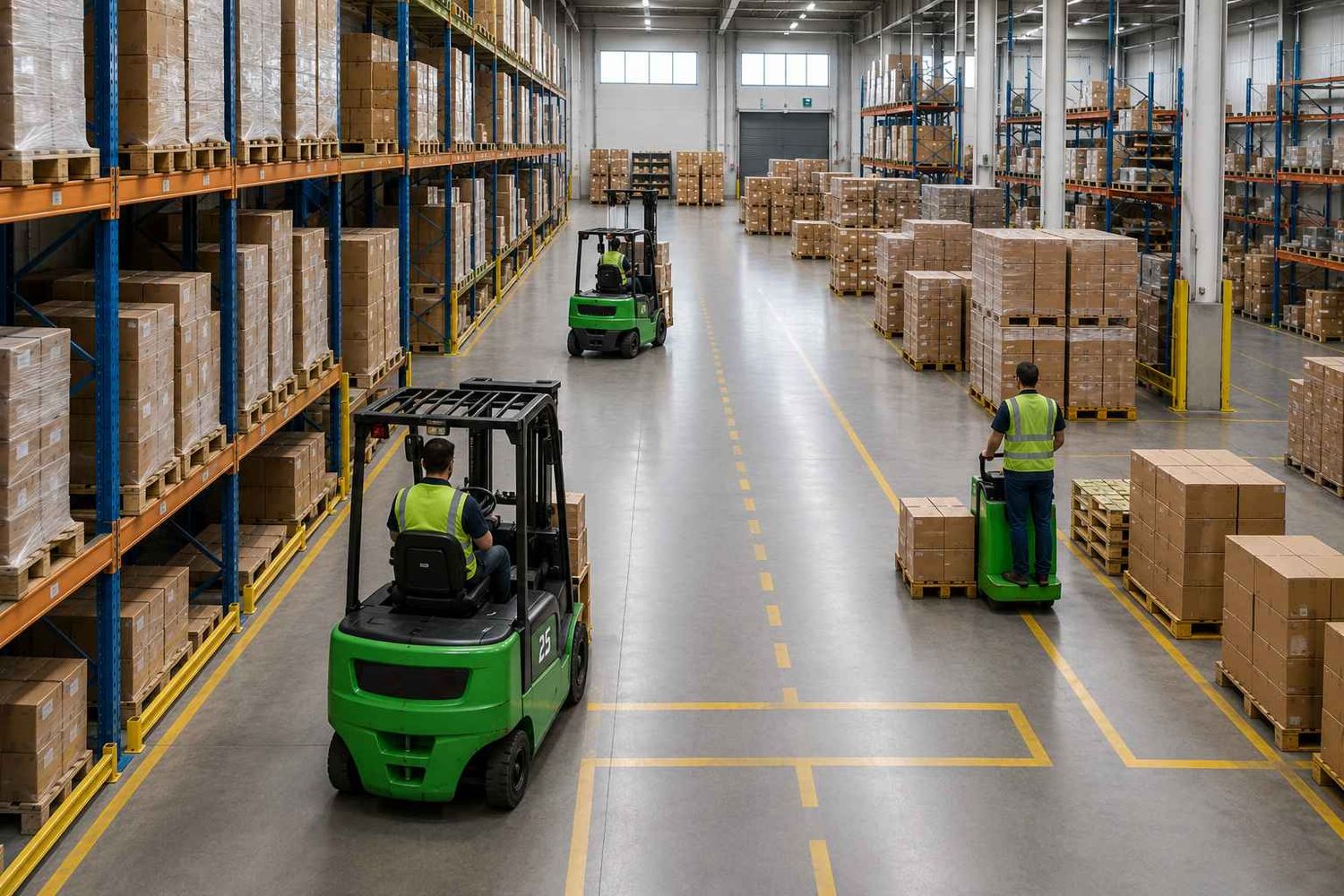
Internal transport in the warehouse is one of those areas of operation that can remain outside the main focus of managers for a long time. As long as goods reach the right place, picking proceeds without major disruptions, and shipments leave the warehouse on schedule, it is easy to assume that the system is working correctly. In practice, it is precisely the transport carried out between receiving, the storage area, picking, and shipping that has a direct impact on operating costs, the use of time and resources, and the operational efficiency of the facility.
Well-designed internal transport in a warehouse allows for reducing the number of empty runs, shortening the distances covered by operators, making better use of warehouse equipment, and reducing the risk of downtime. Every warehouse should analyze its own operational data instead of relying solely on solutions used in other facilities. Optimization does not have to mean immediate automation of the entire facility. In many cases, the greatest savings come from organizing processes, matching equipment to the specifics of the work, and properly organizing the fleet.
Why does internal transport generate such high costs?
Every movement of cargo requires energy, operator labor, the use of equipment, and time. If goods have to be moved several times before they reach their final destination, the handling cost increases, even though no additional value is created for the customer. Therefore, internal transport processes should be analyzed not only in terms of speed but also the number of trips, route lengths, and the degree of equipment utilization.
The cost of operations is influenced by, among other things, the distances between zones, the way inventory is arranged, the organization of operator work, and the selection of transport means. Every downtime caused by the lack of available equipment, waiting for an aisle to clear, or the need to move a pallet also matters. In practice, internal transport involves moving goods within a single warehouse, plant, or distribution center. The larger the warehouse and the more complex the network of operations, the greater the importance of controlling internal transport processes. It can involve both individual packages and full pallet units. Its cost increases with every additional movement, which is why it is worth starting the improvement of internal transport with an accurate measurement of the current state.
Start with a material flow map
The first step should be an analysis of how the flow of goods actually takes place. It is worth treating the warehouse as a map of dependencies where each transport process connects specific points. It is not enough to look at the floor plan. You need to check where goods move from and to, how often individual trips are made, and which routes are the most heavily loaded.
It is worth marking receiving points, inspection areas, buffer zones, warehouse racks, picking areas, and shipping areas. Then, you can calculate the distance a forklift covers during a typical cycle and how many times the same load is put down and picked up again. Such an analysis often shows that transport is longer than the logistics process requires. Modern logistics assumes the elimination of movements that do not create value, so the very visualization of goods movement can reveal simple reserves. The goal should not be just to shorten one route. It is more important to optimize transport routes as a whole so as to reduce traffic crossing, empty runs, and unnecessary backtracking. A well-planned layout can simultaneously increase efficiency and improve safety.
Adjust the warehouse layout to the actual turnover of goods
Inventory placement plays a key role in handling costs. High-turnover goods should be located closer to picking and shipping zones, while less frequently picked products can be stored in more distant locations. If the most frequently shipped pallet is at the end of the hall, transport will generate unnecessary kilometers every day. It is also worth checking whether the working aisle has a width appropriate for the equipment used. Aisles that are too wide reduce the area available for storage, while those that are too narrow can limit traffic flow and require equipment with different parameters.
In facilities with high racks, matching the rack height, aisle width, and equipment parameters becomes particularly important. Proper placement of pallets in the warehouse can reduce the time needed for travel and lifting, thereby shortening the entire transport cycle.
Select internal transport means for specific tasks
There is no single device suitable for every process. The type of transport should depend on the load weight, route length, storage height, work intensity, and type of surface. In many warehouses, the fleet is based on forklifts, but their selection should result from actual needs. Intensive pallet transport between the ramp and the storage zone requires different equipment than narrow-aisle handling or outdoor work. A forklift with too much power, capacity, or dimensions can generate unnecessary costs, while a forklift that is too weak will limit efficiency and wear out faster. For short distances, pallet trucks and simple transport trolleys work well. For repetitive routes, you can consider automatically operating internal transport devices. In selected applications, a roller conveyor, a rail-mounted system, or stacker cranes serving high-bay storage areas will be a better solution.
The most important thing is that internal transport devices in the warehouse are selected for specific operations, not just based on the purchase price. Transport equipment, transport devices, and lifts should form a coherent system corresponding to actual tasks. A well-chosen working load and equipment parameters reduce overloads and unnecessary energy consumption.
Reduce empty runs
One of the most common sources of loss is travel without a load. If an operator drops off goods in zone A and then returns with an empty vehicle to zone B, part of the working time produces no effect. Internal transport can be improved by combining tasks. After dropping off one pallet, the system can direct the operator to the nearest point from which another unit needs to be picked up. Such order management allows for reducing empty runs and making better use of the available vehicle. In larger facilities, integration with WMS systems or other task-controlling tools is helpful. Such an approach supports supply chain management and provides a better picture of the situation in the area of internal transport. The system can automatically assign orders based on location, priority, and equipment availability. As a result, transport becomes more efficient without the need to increase the number of operators.
Shorten waiting time between operations
The movement itself may take a short time, yet the entire cycle is long due to waiting. An operator may wait for documents to be prepared, a storage space to be cleared, a gate to open, or another operation to finish. Therefore, shortening transport time requires analyzing not only driving but also the activities performed before and after the trip. If picking is not synchronized with collection, finished goods may block the zone, and the equipment and operator will wait for the opportunity to perform the next task.
A good internal transport system should ensure the smoothest possible flow between successive stages. A warehouse with well-defined zones maintains task sequence and a predictable work rhythm more easily. Standardization of storage locations, clear signage, and current information on order status help with this.
Use automation where it is economically justified
Automation can significantly reduce the costs of repetitive operations, especially where transport takes place for many hours along the same routes. However, this does not mean that every warehouse should immediately implement a fully autonomous system.
An automatic AGV or AMR vehicle can carry out pallet transport, deliver components to workstations, or collect finished units. Integrating several transport systems can allow tasks to be passed between different technologies without manually planning every trip. In other places, a conveyor, gravity rollers, or a rack handling system may be effective. Before making a decision, you should calculate the number of cycles, labor costs, personnel availability, and the expected payback period. Investing in modern solutions makes sense when it leads to a real reduction in transport costs, not just an increase in the technological advancement level of the facility.
Take care of fleet utilization, not just its number
A large number of devices does not automatically mean higher throughput. Often, part of the fleet remains unused, while at other times the warehouse experiences a shortage of equipment.
It is worth measuring the working time, number of tasks performed, mileage, charging time, and downtime of each device. This allows you to determine whether powered trucks are used evenly and whether the number of machines corresponds to the actual demand.
Fleet optimization can lead to a reduction in the number of devices without compromising service quality. Sometimes it is enough to change the schedule, the way tasks are assigned, or battery charging hours. In other cases, it will be necessary to replace several specialized machines with a more universal solution.
Plan maintenance before a breakdown occurs
An unplanned equipment breakdown usually costs more than regular maintenance. A failure during peak hours can stop transport, delay shipping, and force work reorganization. Therefore, the company should maintain a maintenance schedule and monitor the technical condition of the fleet. Consumables, battery condition, tires, and safety systems are of particular importance. Regular service helps maintain a high level of safety and reduce costs associated with breakdowns.
In the case of an electric fleet, it is also worth analyzing the charging process. Incorrectly planned charging can make equipment unavailable exactly when it is needed most.
Standardize load units
Transport is cheaper and easier to automate when units are predictable. Different packaging dimensions, unstable stacks, and damaged carriers prolong handling and increase the risk of errors.
If possible, it is worth standardizing pallets, containers, and other carriers. A standard pallet facilitates the selection of equipment, planning of storage locations, and integration with automatic systems. It also allows for easier storage of products and reduces the number of exceptions in the process. A production facility can additionally use packaging standardization to streamline the delivery of components to the line and the collection of finished products.
Reduce the number of re-handling and intermediate points
Every additional putting down of a unit means another operation. If goods go to a buffer after receiving, then to inspection, then to another buffer, and only later to the rack, internal transport involves several movements that may be partially unnecessary.
It is worth asking whether the unit can be moved directly to the destination. If the warehouse allows bypassing an unnecessary buffer point, cost reduction can occur without additional investment. Cross-docking, WMS-directed put-away, or preparing locations before a delivery arrives can significantly reduce the number of operations. Such an approach works particularly well for high-turnover goods and in production and warehouse processes where fast material transition to the next stage counts.
Measure transport efficiency using specific indicators
Without data, it is difficult to assess whether the implementation actually brought results. Therefore, internal transport should be monitored using simple KPIs. Useful indicators include, among others, the number of pallets moved per hour, average transport execution time, share of empty runs, number of tasks per operator, fleet utilization, and number of downtimes. It is also worth measuring the distance covered per order. Data allows you to compare changes over time and capture problems. Full cycle measurement should include both travel and waiting for the next operation to begin. If the average route decreased after a layout change, but efficiency did not increase, the causes must be sought elsewhere, for example, in waiting for tasks or in the organization of buffer zones.
Safety also affects costs
Too aggressive shortening of travel time can lead to an increase in the number of incidents and damage. Effective transport must therefore consider efficiency and safety simultaneously.
Clear communication routes, markings, mirrors, barriers, and separation of pedestrian traffic from machines reduce the risk of collisions. Proper visibility, surface condition, and operator training also matter. If one corridor is used simultaneously by pedestrians, equipment, and manual transport, it is worth considering changing the traffic organization. Reducing the number of incidents means less damage to goods, infrastructure, and equipment.
How to choose the right type of transport?
Types of internal transport can be divided, among other things, according to the method of moving the load and the level of automation. Manual transport works well for small weights and a small number of operations. Transport using industrial trucks is flexible and reacts well to layout changes. Conveyor systems are efficient for repetitive flow, while stacker cranes and automatic solutions work well for high work intensity.
The selection should result from process analysis. Short-distance transport performed when handling goods over short distances has different requirements than handling a large distribution center. In turn, intermodal transport concerns a different scale of operations, but its efficiency also depends on the efficient transfer of units to the warehouse zone.
The most important functions of internal transport are delivering materials to the right place, handling storage, powering picking, and ensuring the continuity of shipments. Properly selected equipment should support these functions at the lowest possible cost.
How to improve internal transport in the warehouse step by step?
It is best to start by measuring the current state: route lengths, number of trips, share of empty runs, and waiting times. The warehouse should then establish a benchmark to compare results under the same conditions after changes. Next, you need to identify operations that do not create value and places where bottlenecks arise.
The next stage is the optimization of internal transport by changing the layout, inventory location, task assignment method, and equipment selection. Only later is it worth analyzing automation and more advanced transport systems.
In practice, the greatest effects are often brought by a combination of several small changes: shortening routes, better inventory placement, reducing empty runs, and adjusting the fleet to the load. Such actions can increase efficiency without the need for costly reconstruction of the entire facility.
Does automation always mean savings?
No. Even the best automatic system can be unprofitable if the number of operations is too small or the process changes frequently. The decision should result from an economic calculation.
It is worth comparing the cost of the current solution with the target cost, including purchase, service, energy, software, and training. You also need to estimate the benefits for the company: reduction in labor costs, faster execution, reduction in the number of errors, and the possibility of working in more shifts. Automation is particularly beneficial where the transport of goods follows repetitive routes and parameters. Where the assortment and layout change frequently, more flexible devices can provide a better economic effect.
Where then to look for the greatest savings?
Internal transport should not be treated as a single operation, but as an element of the entire chain of logistics processes. Its costs result from the number of trips, route lengths, equipment utilization, work organization, and the quality of information flow. The greatest potential usually lies in reducing empty runs, better placement of goods in the warehouse, reducing waiting, proper selection of devices, and reducing unnecessary re-handling. Only when basic processes are organized is it worth investing in autonomous solutions or extensive automatic systems.
The ultimate goal is not to maximize the speed of every trip, but to have internal transport that uses as few resources as possible while maintaining timeliness and safety. Well-conducted optimization allows for optimizing the work of the entire warehouse, speeding up order fulfillment, and achieving lasting cost reduction.