









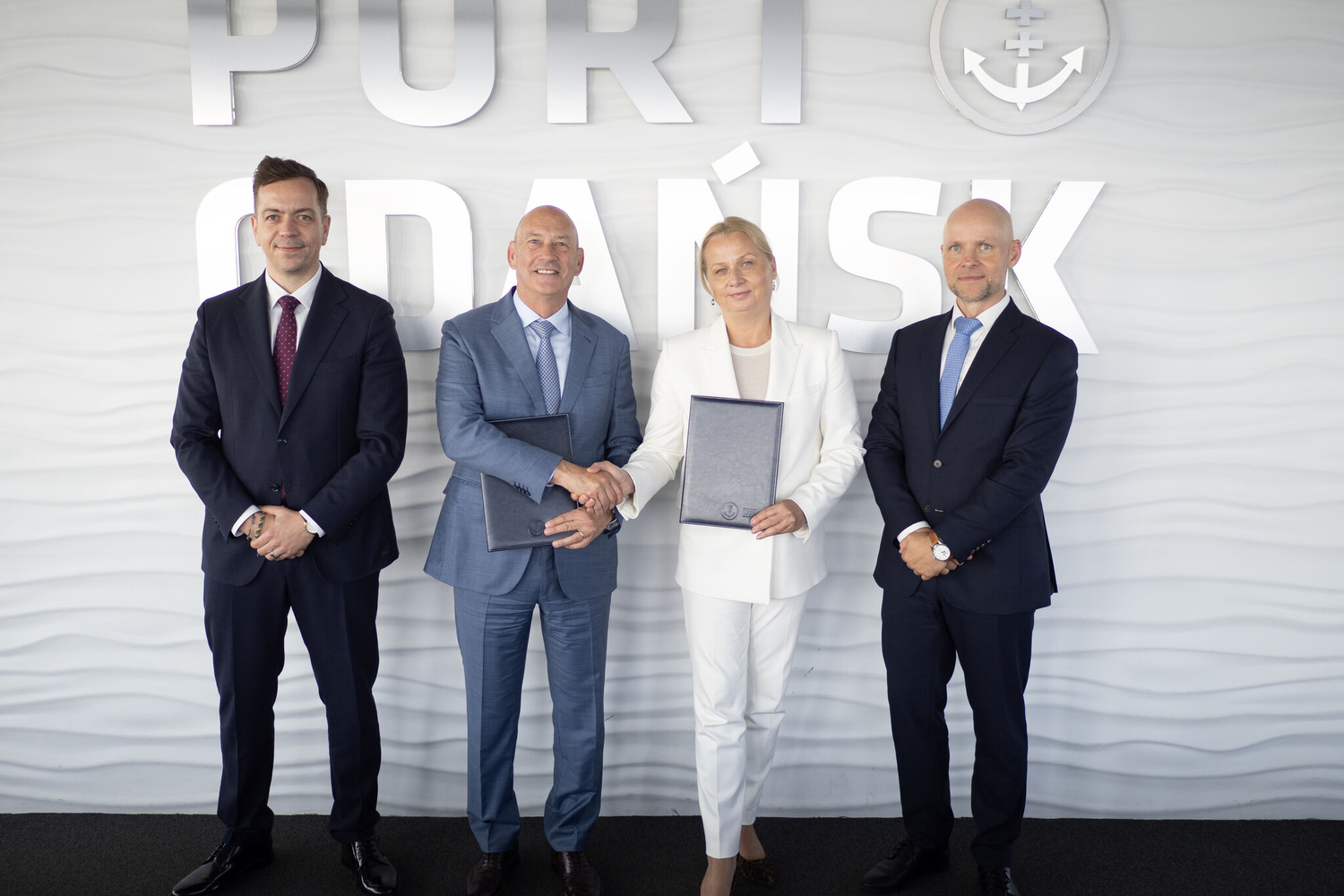
On August 4, 2026, the Port of Gdańsk Authority S.A. (ZMPG S.A.) signed an agreement with Baltic Hub Container Terminal Sp. z o.o. (Baltic Hub), granting the company the right to a 30-year lease of a strategically located 27-hectare plot adjacent to the T2 deep-water terminal. The agreement was concluded following a successfully completed tender process.
Under the lease agreement, Baltic Hub will develop the site, creating a new area dedicated to intermodal and rail transport operations as well as container handling. The investment will significantly increase the terminal’s capabilities on both the land and quay sides, strengthening Poland’s position as a major logistics gateway for Central and Eastern Europe.
Baltic Hub has committed to building a new rail siding capable of handling 750-meter-long trains, as well as new storage yards. Equipment for container handling, necessary for the full commissioning of the new infrastructure, will also be purchased. Construction work will be carried out in stages.
The signing of the lease agreement with Baltic Hub Container Terminal confirms the consistent implementation of the Port of Gdańsk’s development strategy. Thanks to direct services to and from Asia, the port can continue to strengthen its position among leading European ports – emphasizes Dorota Pyć, President of the Board of the Port of Gdańsk. – Our goal is not only to strengthen the competitiveness and position of the port but also to increase the stability of cargo flows in the face of the growing importance of global maritime transport and geopolitical challenges. This investment also aligns with the principles of sustainable development policy, creating conditions for shifting a larger portion of cargo from road to rail transport. This solution supports more efficient and environmentally friendly supply chains and builds a strong position for the Port of Gdańsk in competing with other European ports for serving Central and Eastern European markets, including the Czech Republic, Slovakia, and Ukraine.
In recent years, global logistics has been affected by major disruptions, including geopolitical events that have permanently altered cargo flows. At the same time, customers and shipping lines are placing increasing importance on low-emission transport solutions, which is accelerating the growth in demand for rail as a strategic alternative to road transport.
The lease agreement marks a breakthrough moment in the implementation of Baltic Hub’s long-term strategy – said Jan Van Mossevelde, CEO of Baltic Hub. – The expansion of our rail terminal and the increase in storage yard capacity, in line with the PSA Group’s ‘Node to Network’ strategy, will strengthen connections with the hinterland, enabling the transport of more containers by rail. This will allow for increased connection efficiency, reduced dependence on road transport, and support the modal shift necessary to reduce emissions in supply chains. At the same time, the investment will increase our ability to ensure the reliability, adequate capacity, and sustainable operational efficiency that our shipping sector partners and cargo owners expect.
The leased property is already designated for port activities, has access to existing rail infrastructure, and is located in the immediate vicinity of the T2 terminal. As a result, it represents the most practical location for the efficient implementation of the investment related to the construction of a second rail terminal.
The investment will support the further development and reorganization of the shipping network as carriers introduce increasingly larger vessels into service and modify their route networks, increasingly utilizing Baltic Hub as a gateway for Poland and the entire Central and Eastern European region.
Source: Baltic Hub