









The growing popularity of out-of-home deliveries, the development of the second-hand market, and artificial intelligence taking over some purchasing decisions will shape the future of e-commerce. As indicated by the latest DHL eCommerce Trends Report 2026, the common denominator of these changes is the increasing consumer expectation for convenience and quality of the shopping experience.
The DHL eCommerce Trends Report 2026 is a global study analyzing consumer behavior and the strategies of companies operating in online retail. This year’s edition covered 29,000 online shoppers and 5,800 e-commerce enterprises from 29 countries in Europe, North America, the Asia-Pacific region, Latin America, the Middle East, and Sub-Saharan Africa. By combining the perspectives of consumers and businesses, the report identifies the most important trends that will shape the development of e-commerce in the coming years and shows to what extent companies are prepared for changing customer expectations.
Consumer expectations for e-commerce are growing in virtually every area – from where and from whom they buy, through the method of delivery, to who is actually making the purchases. For companies, this means both challenges and new opportunities. Those organizations that can respond to changing customer needs and bridge the gap between expectations and the offered shopping experience will be in the best position for further growth.
– says Pablo Ciano, CEO of DHL eCommerce.
Convenience is the new currency of e-commerce
One of the most important conclusions from the report is the growing importance of convenience in the purchasing process. It is the need for time savings, flexibility, and simplicity that increasingly determines the choice of an online store and the method of order fulfillment. In Poland, this trend is particularly visible. As many as 92% of Polish consumers can be classified as so-called Convenience Shoppers, who are primarily guided by convenience when shopping online. Moreover, 78% of shoppers already prefer purchases made via mobile applications.
Growing expectations are also reflected in preferences regarding delivery and returns. 68% of Poles indicate parcel lockers as their preferred place for receiving shipments, and 79% prefer to use them for returns as well. The level of trust in logistics operators also shows how important a part of the shopping process delivery has become today. As many as 70% of Polish shoppers declare that they would not decide to buy from a brand whose delivery and return operator they do not trust. At the same time, 93% of companies operating in e-commerce consider the offer of delivery and returns to be a significant factor influencing sales.
OOH is the new standard, and online retail knows no borders
The report shows that deliveries to parcel lockers and collection points are becoming the standard for online shopping. This is also confirmed by company plans – 54% of e-commerce enterprises in Poland indicate the development of the OOH network as a key investment direction, 49% plan to develop more personalized delivery services, and 46% intend to invest in shortening order fulfillment times. The results show that competitive advantage is increasingly determined by convenient and flexible logistics services.
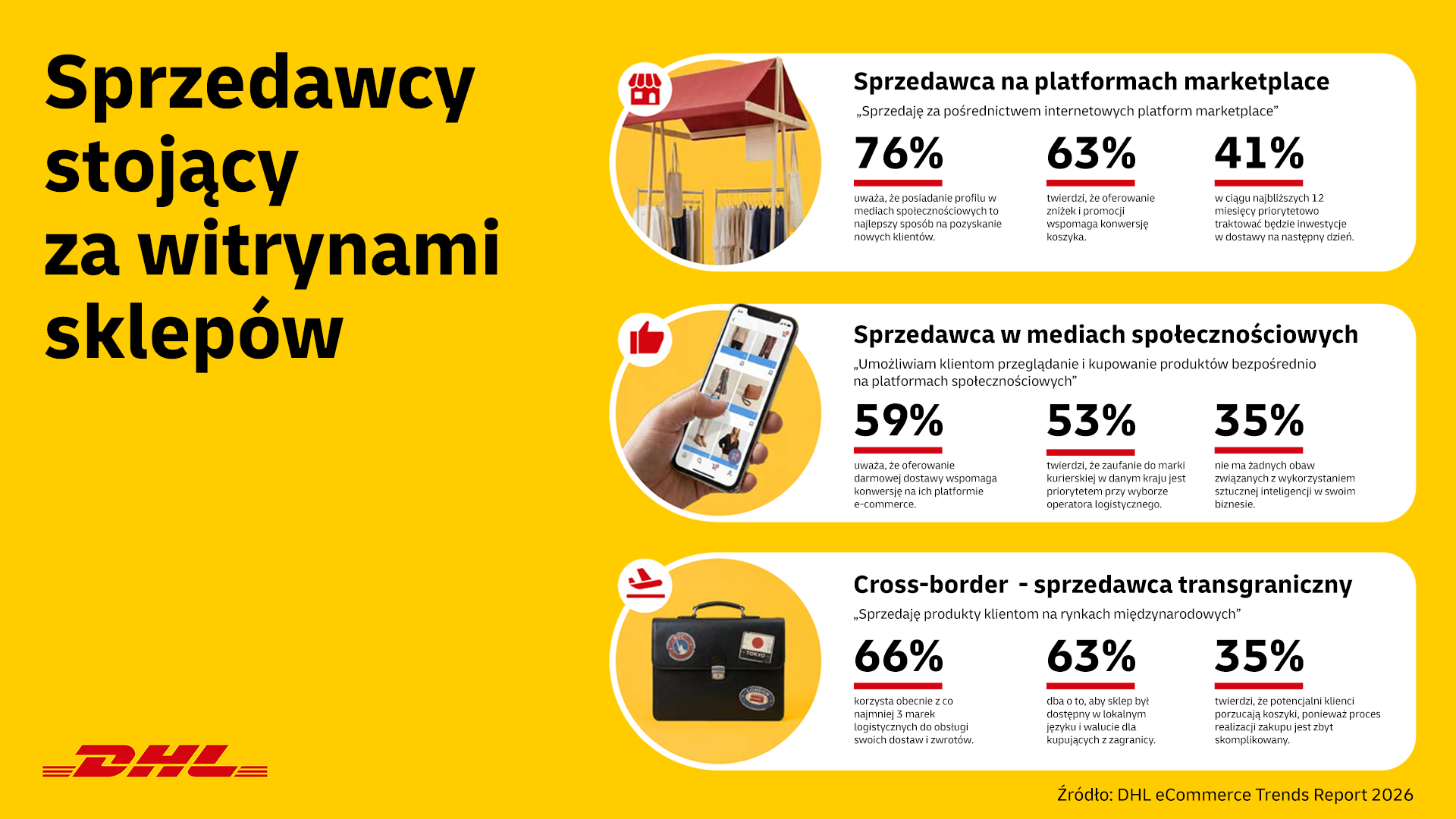
Online retail is increasingly based on international sales. Among Polish online consumers, 74% order products from China, 24% from Germany, and 15% from the UK. E-commerce companies are equally active in international expansion – 78% sell to Germany, 48% to the UK, and 46% to France. This trend shows the growing importance of cross-border trade and efficient international logistics for the further development of e-commerce.
AI, C2C trade, and sustainable logistics
The DHL eCommerce Trends Report 2026 shows that artificial intelligence will play an increasingly important role in e-commerce – 29% of consumers worldwide already declare their readiness to entrust AI with purchasing decisions or making purchases within the next five years, including 33% of Gen Z and 36% of millennials. Companies also recognize this trend: 59% believe that consumers will buy through virtual assistants, and 73% plan to increase their use of generative AI. At the same time, the importance of C2C trade is growing – 52% of respondents from around the world have already sold a product through an online sales platform, including 62% of millennials and 58% of Gen Z. The popularity of the secondary market is also driven by environmental considerations – responses from consumers in 29 markets show that 45% of them buy used or refurbished products for ecological reasons, and another 15% are considering such purchases. As a result, the importance of sustainable logistics is also growing, which 42% of respondents consider a fundamental element of the shopping experience over the next five years.
The full version of the DHL eCommerce Trends Report 2026 is available at: https://www.dhl.com/global-en/microsites/ec/ecommerce-insights/insights/reports/2026-ecommerce-trends-report.html
Source: DHL eCommerce Poland